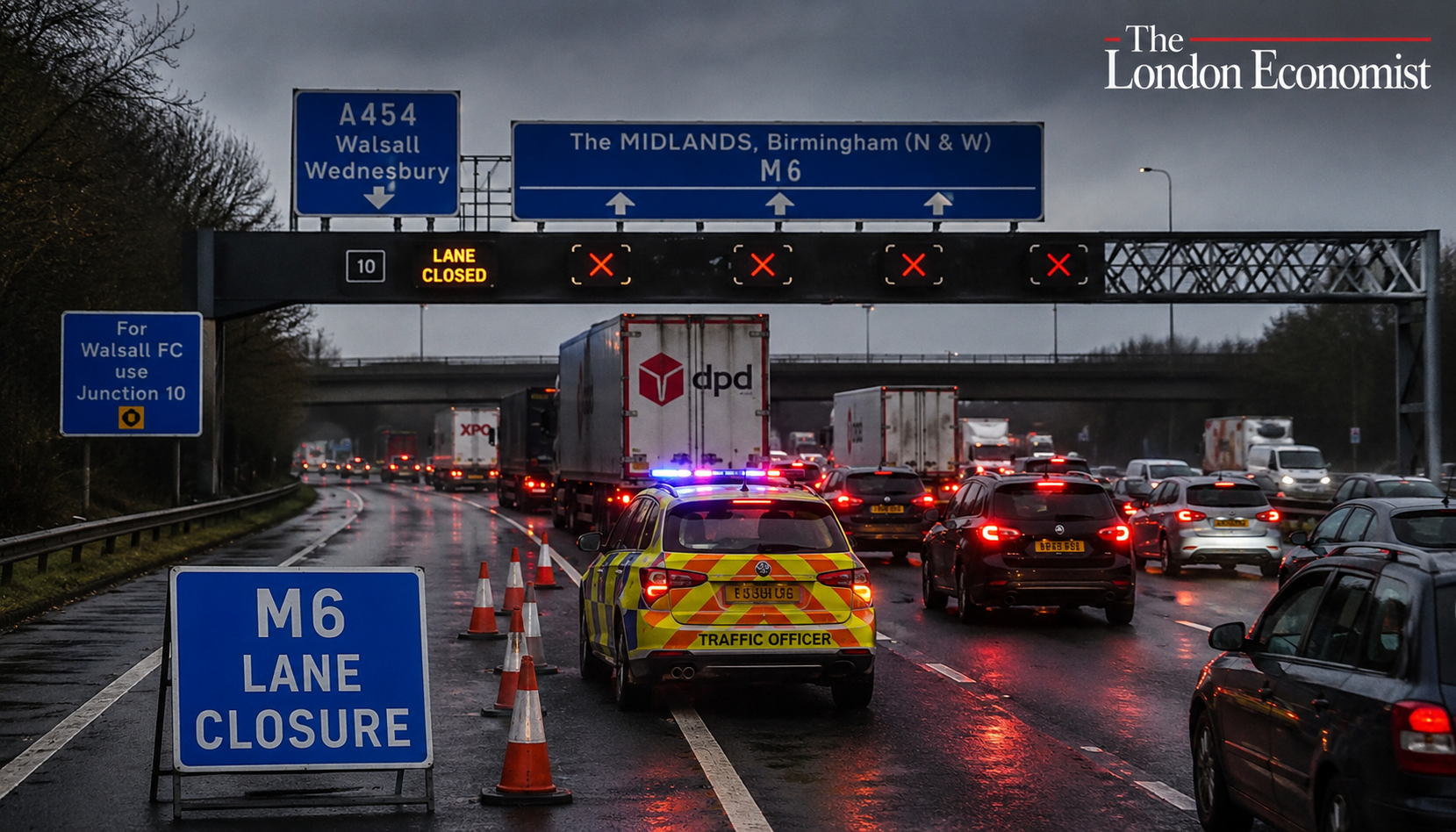
M6 Walsall Birmingham Lane Closure
The M6 between Walsall and Birmingham is one of the busiest and most disrupted stretches of motorway in the United Kingdom right now, and if you are searching for information about current lane closures, you are not alone. Thousands of commuters, freight drivers, and local residents rely on this corridor every day, and ongoing maintenance and infrastructure work has made reliable journey planning more important than ever in 2026.
The confirmed position, based on National Highways’ own published maintenance page for the West Midlands, is that full overnight closures of the M6 southbound between junctions 6 and 4, and between junctions 6 and 5, are in place on weeknights from 9pm to 6am, with work scheduled to remain until 16 October 2026. Separately, a significant bridge joint replacement scheme was confirmed on the stretch between Junctions 6 and 7 earlier in the year. This guide covers what is verified, what drivers need to know practically, and how to plan journeys through this corridor effectively.
Why Are There Lane Closures on the M6 Walsall Birmingham Section?
The M6 Walsall Birmingham lane closure is not a single event but an ongoing programme of essential infrastructure work running across multiple schemes and phases throughout 2025 and 2026.
The main reasons behind the closures are:
- Bridge and structural maintenance: The M6 carries extraordinarily heavy traffic volumes, and its bridges, viaducts, and overhead structures require regular inspection and repair to remain safe. The bridge joint replacement scheme between Junctions 6 and 7, confirmed by National Highways as running from 7 April to 13 May 2026, is one significant example. The Bescot Viaduct near Walsall is another structure that has required maintenance attention.
- Resurfacing and road repairs: The volume of traffic on this section creates continuous surface wear. Resurfacing work must be done periodically to maintain safe driving conditions and prevent more serious structural damage.
- Safety barrier and drainage upgrades: Modern safety standards require improved barrier systems, better drainage, and enhanced signage that older sections of the motorway do not currently meet.
- HS2 related works: The High Speed 2 rail project has required motorway works in certain areas of the West Midlands corridor, including temporary infrastructure to support construction access.
- Emergency repairs: Accidents and vehicle fires can damage road surfaces or safety barriers, requiring rapid temporary closures followed by repair works.
Much of the work is timed overnight to minimise impact on daytime traffic, but the scale and duration of the programme means drivers across this corridor continue to feel its effects at various times of day.
What Are the Confirmed Current Closures?
The most authoritative source for M6 closures is National Highways’ West Midlands maintenance page, which publishes verified scheduled closure information. Drivers should always check this source directly before travelling as arrangements can change at short notice.
The confirmed position from National Highways is as follows:
M6 southbound between Junction 6 and Junction 4 / Junction 5: Full overnight closures, weeknights only, operating between 9pm and 6am. These closures are in place until 16 October 2026. Work is suspended on certain bank holidays and there are no closures on Sundays and Saturdays under this scheme.
M6 Junctions 6 to 7 bridge joint replacement scheme: This scheme ran from 7 April 2026, with phases including full northbound and southbound closures at different points. One source with specific detail described a full northbound closure between Junctions 6 and 7 from 7 to 24 April, a full southbound closure between Junctions 7 and 6 from 27 April to 6 May, and a further full northbound closure from 7 to 13 May. National Highways itself confirmed that arrangements can change at short notice, and drivers should verify the current position through the official traffic sources listed at the end of this article.
M6 Junction 10 Walsall: Junction 10, which is the Walsall junction of the M6, was subject to significant upgrade works in 2024 and into 2025. Walsall Council directs residents to National Highways for more details on the M6 improvement scheme affecting Junction 10. Follow-up maintenance may continue.
Which Junctions Are Most Affected?
The junctions most commonly associated with delays and lane restrictions on the M6 Walsall Birmingham corridor are:
- Junction 7 (Great Barr / A34): The RAC identifies Junction 7 as a common hotspot because it connects with the A34, the main road between Birmingham and Walsall, where heavy traffic and slip-road merging frequently cause delays even outside planned roadworks. When closures are in place on the surrounding sections, Junction 7 amplifies the congestion effect significantly.
- Junction 9 (Wednesbury): Heavily used by local commuters and freight vehicles, this junction serves the industrial zones around Walsall and the Black Country.
- Junction 10 (Walsall): One of the busiest sections due to industrial traffic and local business activity, and the site of significant upgrade work.
- Junctions 6 and 5 (Spaghetti Junction area): The approaches to Birmingham’s famous Gravelly Hill interchange are consistently congested and are directly affected by the confirmed overnight closure programme running to October 2026.
- Junction 10A (M54 / Wolverhampton): A critical connection between the M6 and M54, often affected when lane restrictions are implemented in either direction.
The Wider Picture: How M5 Works Interact With M6 Disruption
One important and often overlooked aspect of this situation is the interaction between M6 closures and work on other motorways in the region.
National Highways confirmed safety barrier maintenance on the M5 between Junctions 7 and 9, running overnight from 8pm to 6am, Monday to Friday, from 7 April 2026. This is on the M5, not the M6, but the M5 and M6 interchange near Birmingham means disruption on one motorway regularly pushes traffic onto the other.
For drivers considering the M5 as a diversion from M6 closures, this interaction matters practically. Before diverting to the M5, checking whether overnight works are also in place on that route is essential.
Similarly, the M42 and M40 corridors carry significant additional traffic during M6 closures and can experience their own congestion and roadworks-related delays.
Alternative Routes for Drivers Avoiding M6 Closures
When M6 lane closures create significant delays between Walsall and Birmingham, drivers have several realistic diversion options, though none are without their own traffic pressures.
The A34 Corridor
The A34 is the direct road link between Birmingham city centre and Walsall, passing through Great Barr and connecting to Junction 7 of the M6. During M6 closures, this road typically sees increased congestion. It is practical for shorter journeys or those whose origin and destination sit along its route, but it is not a fast alternative for through traffic.
Transport for West Midlands is creating a bus priority corridor along the A34 to link Walsall with Birmingham, Solihull, and Birmingham Airport, known as the A34 Sprint project. Drivers should be aware that A34 construction updates are relevant to anyone planning to use this route regularly as a motorway alternative.
The M5
The M5 provides an alternative for journeys heading south or west of Birmingham. It is typically the most useful diversion for traffic that does not need to pass through the M6 Junctions 5 to 7 section specifically. However, as noted above, the M5 was subject to its own overnight barrier maintenance work from April 2026, so checking current M5 conditions before diverting is essential.
The M42
The M42 offers an eastern bypass of Birmingham and is useful for drivers whose journey can accommodate a longer but potentially faster route around the congested M6 corridor. It connects with the M6 at Junction 4A to the south and at the M6 Toll junction.
The A454 and Local Roads
The A454 is a useful route for shorter journeys around Walsall and Wolverhampton. Local roads in the area including the A41 can provide alternatives for drivers familiar with the road network, though these routes also see increased traffic during M6 closures and should not be assumed to be clear.
How Long Will the M6 Walsall Birmingham Closures Continue?
The confirmed National Highways overnight closure programme on M6 southbound between Junctions 6 and 4/5 runs until 16 October 2026. Beyond that date, further phases of work are likely given the age and complexity of the infrastructure on this section, though no formal confirmed schedule beyond October 2026 has been published at the time of writing.
Closures are primarily overnight, between 9pm and 6am on weeknights. Daytime travel on the sections under the confirmed overnight scheme is less directly affected, though general congestion from roadworks signage, lane narrowing, and traffic diverted from nearby closures can still affect daytime journey times on this corridor.
The key point National Highways emphasises is that closure arrangements can change at short notice. Any article, including this one, represents a record of a point in time rather than a live traffic source. The only reliable live source is National Highways’ own daily closures page and the Traffic England website.
The Economic and Community Impact
The M6 Walsall Birmingham corridor is not just a commuter route. It is a freight and logistics artery serving industrial zones across the West Midlands, including the manufacturing clusters around Walsall, the Black Country, and Birmingham itself.
Industrial zones around Birmingham and Walsall depend heavily on motorway transport. Even temporary disruptions can impact local commerce and delivery reliability. Commercial fleets operating through Birmingham and Walsall have experienced higher transportation costs as a result of stop-start traffic during closures. Bus operators using motorway connections have also faced scheduling challenges.
For residents near the M6, roadworks and lane closures create persistent noise, additional light from overnight working, and increased traffic on residential streets as drivers divert away from the motorway. Authorities acknowledge this and aim to work to the programme, minimising noise levels and additional lighting where possible during overnight operations.
Practical Travel Advice for Drivers on This Corridor
The following steps represent the most effective approach for anyone regularly using the M6 Walsall Birmingham section during 2026:
- Check National Highways’ daily closures page before any journey that depends on this corridor. The page is updated regularly and is the only authoritative source for current closure status.
- Sign up for National Highways travel alerts, which provide notifications about live incidents and scheduled closures on the network.
- Use the Waze, Google Maps, or TomTom apps for real-time traffic updates that reflect current conditions rather than scheduled closure information alone.
- If travelling overnight, be aware that confirmed closures operate from 9pm and that daytime journeys on this section are significantly less affected by the current confirmed scheme.
- For logistics operators, consider adjusting delivery schedules to avoid the 7am to 9am and 4pm to 6pm peak windows when roadworks-related congestion is most severe.
- If diverting, check conditions on the intended alternative route before committing to it. The M5, M42, and A34 all carry additional traffic during M6 closures.
- Factor in extra time. During peak hours near active closure sections, delays of 30 to 60 minutes above normal journey time have been commonly reported.
A Note on Information Quality
It is worth flagging something that drivers researching this topic will encounter: a significant volume of articles about M6 Walsall Birmingham lane closures have been published online that contain vague, unverifiable, or inconsistent information. Several do not cite National Highways directly, use imprecise dates and junction references, and reproduce the same generic travel tips without anchoring their claims to official sources.
The reliable sources for confirmed, current M6 closure information are National Highways’ West Midlands maintenance page, National Highways’ daily closures tool, the Traffic England website, and Walsall Council’s roadworks page for local road context. Any other source, including this article, should be cross-referenced with those official publications before making journey decisions.
Key Takeaways
- The confirmed National Highways overnight closure programme on M6 southbound between Junctions 6 and 4, and Junctions 6 and 5, operates weeknights only between 9pm and 6am and is scheduled to run until 16 October 2026.
- A bridge joint replacement scheme between Junctions 6 and 7 was confirmed as running from 7 April to 13 May 2026, involving full northbound and southbound closures in phased sequence.
- Junction 10 at Walsall was subject to significant upgrade works and may continue to see follow-up maintenance. Junctions 7, 9, 10, and 10A are the most commonly affected junctions for congestion and restrictions.
- Daytime travel is less directly affected by the confirmed overnight closure scheme, though roadworks signage, lane narrowing, and diverted traffic can still slow daytime journeys.
- The M5 between Junctions 7 and 9 was also subject to overnight barrier maintenance from April 2026, meaning the most obvious diversion route from the M6 may also carry delays.
- Alternative routes include the A34 between Birmingham and Walsall, the M5 southbound, the M42, and the A454 for shorter regional journeys.
- National Highways explicitly states that closure arrangements can change at short notice. Always check the official National Highways daily closures page and Traffic England before travelling.
- The closures form part of a long-term programme of essential infrastructure maintenance and upgrade on one of the UK’s most heavily used motorway sections.
Frequently Asked Questions
What is causing the M6 lane closures between Walsall and Birmingham?
The closures are caused by a combination of planned maintenance and infrastructure improvement works. The confirmed scheme involves bridge joint replacement between Junctions 6 and 7, and ongoing resurfacing and structural maintenance on the southbound carriageway between Junctions 6 and 4/5. Additional closures arise from emergency incident recovery, which can occur at any time on this busy corridor.
Which junctions on the M6 are most affected?
Junctions 7 (Great Barr), 9 (Wednesbury), 10 (Walsall), 10A (M54 connection), 6 (Spaghetti Junction approaches), and 5 are the most commonly affected. Junction 7 is identified by the RAC as a particularly consistent hotspot due to merging pressure from the A34.
When do M6 lane closures between Walsall and Birmingham happen?
The confirmed National Highways overnight scheme operates weeknights between 9pm and 6am. Daytime closures are less common under the current confirmed schedule but can occur due to emergency incidents. Bridge joint replacement phases involved full daytime and nighttime closures during the April to May 2026 period.
How long will the M6 Walsall Birmingham closures last?
The confirmed overnight closure programme on M6 southbound between Junctions 6 and 4/5 is scheduled to run until 16 October 2026. Further phases of work beyond that date are likely but have not been formally confirmed at the time of publication. Closure arrangements can change at short notice.
What alternative routes can I use to avoid the M6 closures?
The main alternatives are the A34 between Birmingham and Walsall, the M5 for southbound or westbound journeys, the M42 for an eastern bypass of Birmingham, and the A454 for shorter regional journeys. Before diverting, check that your intended alternative route is itself clear, particularly the M5 which had its own overnight maintenance works from April 2026.
Where can I find the most up-to-date information about M6 closures?
National Highways’ West Midlands maintenance page and their daily closures tool are the only authoritative sources for confirmed closure information. Traffic England provides live network status. The Walsall Council roadworks page covers local road context. Real-time navigation apps such as Waze and Google Maps reflect current traffic conditions on the ground.
Do the closures affect freight and commercial vehicles?
Yes. The M6 Walsall Birmingham section is a major freight corridor for the West Midlands. Commercial operators have reported increased transportation costs and scheduling challenges due to congestion during closure periods. Logistics operators are advised to adjust delivery windows to avoid the 7am to 9am and 4pm to 6pm peak congestion periods.
Are there any closures on nearby motorways that affect this corridor?
Yes. National Highways confirmed safety barrier maintenance on the M5 between Junctions 7 and 9 from April 2026, operating overnight Monday to Friday. As the M5 and M6 interchange near Birmingham means traffic pressure on one regularly transfers to the other, drivers should check both motorways before deciding on a route.
Conclusion
The M6 Walsall Birmingham lane closure situation in 2026 is the product of essential but disruptive maintenance and improvement work on one of Britain’s most heavily used motorway sections. The confirmed overnight closures between Junctions 6 and 4/5, running until October 2026, reflect the scale and complexity of maintaining infrastructure that carries enormous traffic volumes every day.
For drivers, the practical reality is straightforward. Overnight travel on this section is the period most directly affected by confirmed planned closures. Daytime journeys are less affected by the current scheduled programme but remain vulnerable to congestion from roadworks-related lane narrowing and any emergency incidents.
The most important habit any driver using this corridor can develop is checking National Highways’ official sources before travelling rather than relying on secondary sources, including those that appear high in search results but do not anchor their information to confirmed official schedules. Closure arrangements change at short notice. The only source that reliably reflects those changes is National Highways itself.
The disruption is real and its impact on commuters, businesses, and communities is genuine. So too are the long-term benefits of the infrastructure work being carried out: safer structures, better-maintained surfaces, improved drainage, and upgraded barriers that will serve drivers on this corridor for decades.
About the Author