Connected Kerb
Connected Kerb is one of the most important companies you may not have heard of in Britain’s transition to electric vehicles. Founded in 2017, it is a British electric vehicle charging company focused on a single problem that no amount of motorway rapid chargers can solve: how does someone who does not have a driveway charge their car at home?
Connected Kerb was launched in 2017 by five friends with the purpose to power the future of sustainable mobility for everyone. It describes its mission as becoming the most accessible, affordable and reliable EV charging network in the areas it works in. The founders’ track records include the delivery of Boris Bikes and the London 2012 Olympic Games Transportation programme as part of the Source London project.
In January 2025, the company raised £65 million from the government’s National Wealth Fund and Aviva Investors, a signal of how seriously both public and private capital now takes the on-street charging challenge. This guide covers everything a UK reader needs to know about Connected Kerb: what it is, how it works, what it costs, where to find it, and why it matters for the future of electric driving in Britain.
What Is Connected Kerb?
Connected Kerb is an electric vehicle charging company on a mission to change the world for good. It wants to make EV charging inclusive, convenient and reliable, as part of its journey to become the UK’s favourite charging network.
In practical terms, Connected Kerb installs and operates public EV charging points on residential streets, in car parks, at workplaces, and at commercial destinations across the United Kingdom. Its defining characteristic is its focus on on-street residential charging, the type of infrastructure that matters most for the millions of UK households who park on the road rather than in a private driveway.
Connected Kerb aims to deliver electric vehicle charging infrastructure across the country, providing on-street residential charging points to the 60 per cent of UK residents unable to charge their vehicles at home.
That statistic is the central fact around which the entire Connected Kerb proposition is built. Connected Kerb and Ubitricity provide on-street lamppost and bollard chargers for residents without driveways. Without this kind of infrastructure, owning an electric vehicle in a terrace street or a flat without parking is genuinely difficult for most people, whatever the theoretical range of the car.
Connected Kerb was recently recognised by ZapMap as the Best EV Charging Network 2026 for On-Street and Destination Charging.
The Scale of the Challenge Connected Kerb Is Addressing
Understanding why Connected Kerb matters requires understanding the scale of the problem it is trying to solve.
For years the charging industry has chased speed. Rapid and ultra-rapid chargers multiplied along trunk roads, reassuring drivers that long journeys were possible. Yet for most motorists the bigger problem has been more mundane. Millions of households lack driveways or private parking. Without a reliable place to charge overnight, owning an electric car is awkward, whatever its range.
Currently, 62 per cent of UK drivers lack home charging access and pay higher public network rates. This is the gap that on-street operators like Connected Kerb are specifically designed to fill, and it is a gap that matters enormously for mass EV adoption rather than simply for early adopters who happen to have driveways and garages.
Motorway chargers will still matter for long trips. But mass adoption depends on whether drivers can plug in near home without fuss. With public capital committed and private money following, the kerb is no longer the neglected edge of Britain’s charging network. It is becoming the centre of it.
Connected Kerb’s Funding and Growth Plans
The January 2025 funding round confirmed what industry observers had been anticipating: institutional capital has concluded that on-street residential charging is the critical next frontier in UK charging infrastructure.
EV smart charging infrastructure provider Connected Kerb secured £65 million backing from the National Wealth Fund and Aviva Investors to accelerate the UK’s EV public charging network expansion.
With this investment, Connected Kerb forecast to install at least 300,000 public EV chargers by 2030, just in time for the 2030 ban on new petrol and diesel cars.
Aviva is to invest up to £110 million in Connected Kerb. Connected Kerb says that the investment will be critical to delivering the Government’s plan of installing more than 300,000 chargers by 2030. Connected Kerb adds that the investment will support its plans of delivering 190,000 on-street EV chargers by 2030.
The involvement of the National Wealth Fund, a government-backed institution designed to crowd in private investment for strategic national infrastructure, is significant. It confirms that on-street EV charging is now considered part of Britain’s critical national infrastructure rather than simply a commercial service.
Local authority partnerships are central to Connected Kerb’s expansion strategy. Connected Kerb and Surrey County Council have announced that, together, they will take the lead role in delivering the 10,000 EV charge points needed across the UK county by 2030. Similar partnerships are being formed across the country. North Northamptonshire Council announced a major new partnership with Connected Kerb to deliver more than 1,500 new electric vehicle charging sockets across the region, co-funded by Connected Kerb and supported by £2.9 million from the Government’s Local Electric Vehicle Infrastructure (LEVI) fund.
Where to Find Connected Kerb Chargers
You can find Connected Kerb charging points across the UK, with councils serving Windsor, Maidenhead, Runcorn, Widnes, Kent, Dover, Ryedale District, Cambridge, Coventry, Swindon and more signing up to the scheme in a bid to improve the uptake of zero-emission vehicles.
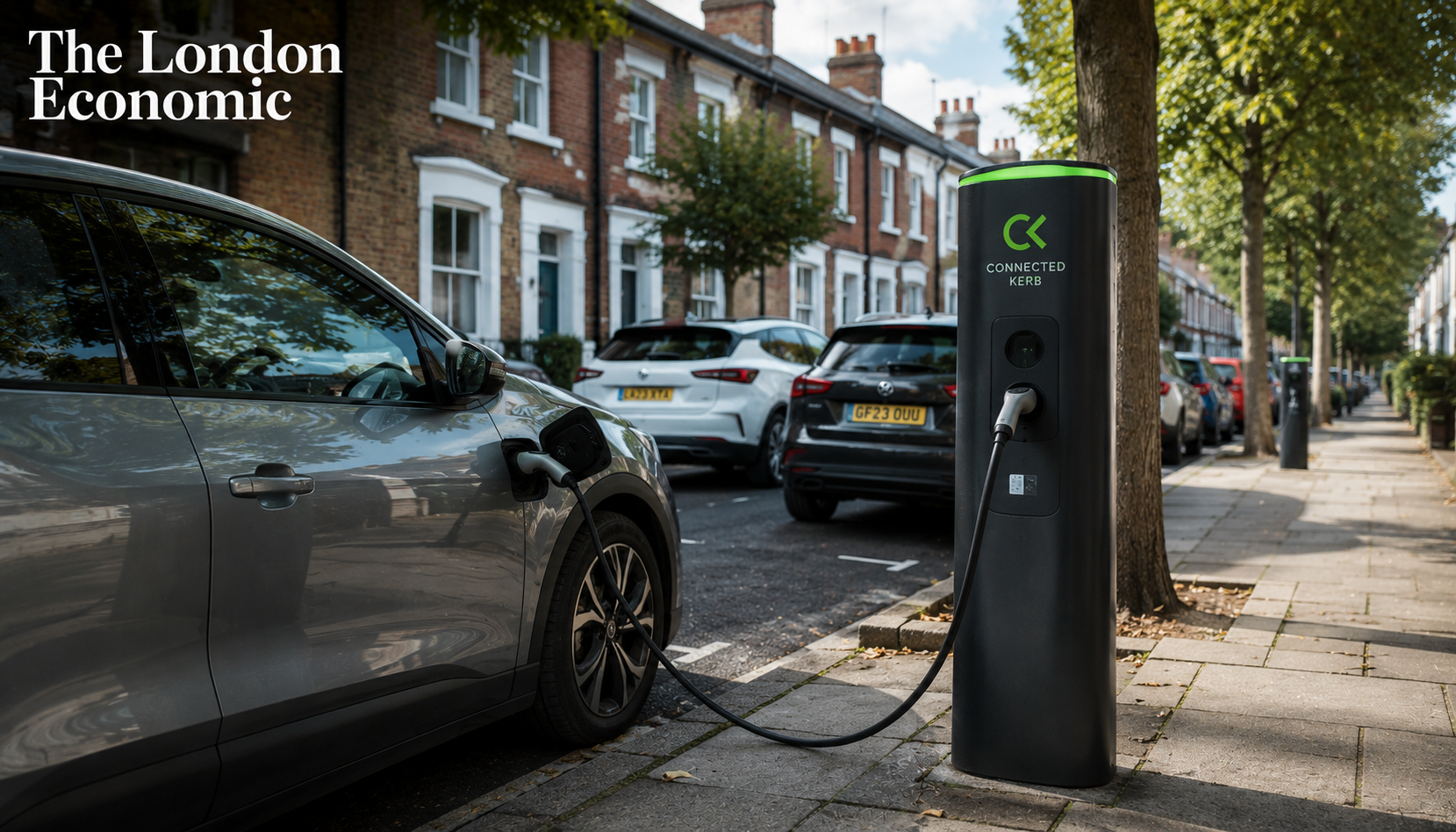
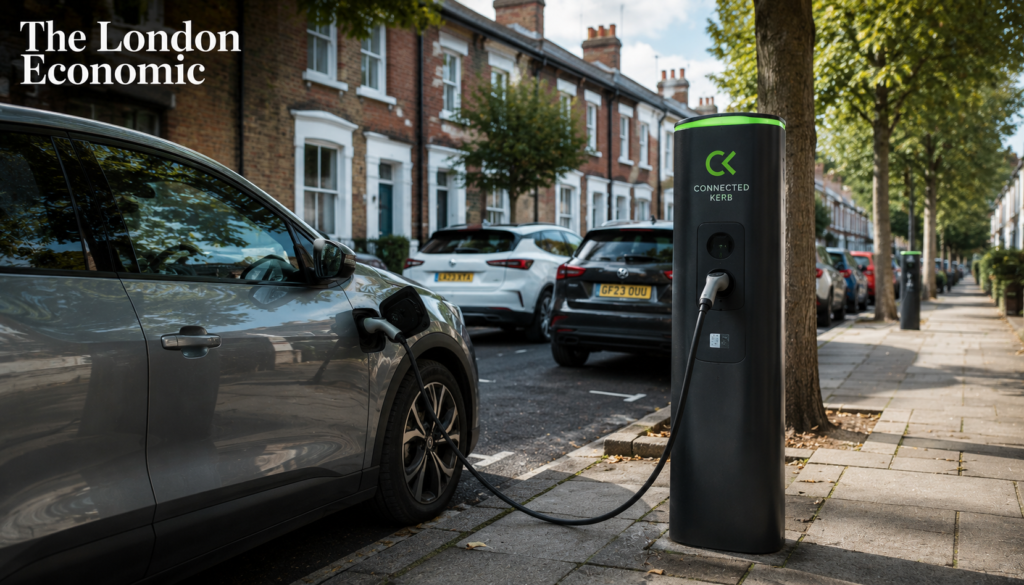
You can find your nearest Connected Kerb charging point using most major EV charge point mapping services including Electric Universe and Zap-Map. You can spot a Connected Kerb charging point via the small green rectangular logo on the machine.
While the chargers come in different shapes and sizes, the green and black brand colours are distinct and instinctively recognisable. As socketed or untethered charging points, the cable will not be attached. Instead, a circular hole will be present. This means drivers need to bring their own Type 2 charging cable when using Connected Kerb points.
The Connected Kerb Charger Range: Four Models Explained
Connected Kerb produces four distinct charger designs, each suited to a different installation context.
The Limpet
The Limpet charger is designed for commercial and destination car parks, offering a more reliable charging and eco-conscious solution. It is the most straightforward of the four designs, optimised for locations where multiple vehicles may need to charge during the day.
The Chameleon
The Chameleon features dual charging capability with two sockets, allowing two EVs to charge simultaneously, maximising space and materials. It has a discreet design that blends seamlessly into urban environments, minimising visual disruption. It is durable and future-proof with a modular design that enables easy upgrades for new technologies. It is made with recyclable materials where possible and exclusively manufactured in the UK to reduce the carbon footprint. It is also inclusive in design, accessible for drivers with physical impairments, with a user-friendly height for wheelchair access.
The Gecko
The Gecko charger is the most visually subtle option in the Connected Kerb range, designed to blend seamlessly into on-street and car park environments. For local authorities and residents concerned about street furniture aesthetics, the Gecko’s discreet profile makes it a natural choice for residential streets where visual impact matters.
The fourth charger type covers additional configurations for specific site requirements and is selected based on the particular installation context.
All Connected Kerb chargers are exclusively manufactured in the United Kingdom, an important detail for councils and central government bodies with commitments to UK supply chains.
Charging Speeds: What to Expect
Connected Kerb charge points operate at either 7kW or 22kW.
The average electric car will take between nine and ten hours to charge from zero to full on the 7kW charging unit, while a 22kW charging unit will take between four and five hours to charge an electric car.
These are classified as fast AC chargers rather than rapid DC chargers. They are designed for overnight residential charging and extended dwell-time charging at destinations, not for the quick top-ups drivers need on long journeys. EV drivers can charge their vehicles between four and eight hours with Connected Kerb charging stations.
For context, slow and fast chargers operating at 7 to 22kW typically cost 30 to 50 pence per kWh at most public networks, while rapid chargers operating at 50kW and above typically cost 55 to 79 pence per kWh. Connected Kerb’s positioning in the fast charging category means it is generally less expensive per kWh than rapid or ultra-rapid alternatives, though charging takes considerably longer.
How Much Does Connected Kerb Charging Cost?
Connected Kerb’s chargers cost 50 pence per kWh, and they do not charge a further connection fee or membership fee. This price is below average for the whole EV industry.
For comparison, at other public charging networks, you would pay 79 pence at Shell Recharge, 79 pence at Osprey Charging Network, and 56 pence at Mer Charging Network. Connected Kerb’s standard rate of 50 pence per kWh is competitive, particularly given the absence of membership fees or connection charges.
Smart Charging: A Lower-Cost Option
Connected Kerb has launched smart charging across its public network, and this is where the cost savings become genuinely significant for regular users.
Drivers will benefit from overnight tariffs as low as £0.45 per kWh, potentially saving £222 annually. This initiative aims to address the high-cost barrier for EV adoption, especially for those without home charging.
Drivers can schedule charging through the Connected Kerb app, with sessions starting at midnight and lasting until 7am or full battery. Smart charging does not just save money for individual drivers. By reducing peak energy demand, Connected Kerb estimates a 240MW reduction by 2030, equivalent to taking 1.4 million kettles off the grid at peak times. This grid benefit makes smart charging a genuinely public good rather than simply a commercial feature.
How to Pay for Connected Kerb Charging
Connected Kerb offers several payment methods, designed to remove barriers for drivers who do not want to download multiple apps or carry multiple cards.
You can use an RFID card or the Connected Kerb app to use one of their charge points. You can download the app via Google Play or the Apple App Store.
You can also use the OVO Charge app for an even smoother experience. OVO Charge removes the stress of searching for available charging points, offering access to tens of thousands of chargers across the UK and Europe. With OVO Charge, you no longer need separate cards or apps for different networks.
Octopus EV customers also have access through the Electroverse app. With the No Driveway No Problem scheme, Octopus EV customers can get 50 per cent off kerbside charging when using Ubitricity or Connected Kerb chargers.
To begin a session, scan the QR code on the body of the Connected Kerb charging point or manually enter the ID of the charging point. The process is designed to be accessible for drivers who are not technically confident, without requiring lengthy setup or registration.
Connected Kerb’s Inclusive Design Commitment
One of the more distinctive aspects of Connected Kerb’s mission is its explicit commitment to charging infrastructure for groups who are often underserved by mainstream commercial provision.
Connected Kerb also wants to reduce charging point blackspots in rural areas, thus bringing EV charging to remote areas. It also wants to make the use of an electric car easier for disabled drivers. Another ambition of the company is to provide electric vehicle charge points in lower-income areas. It has worked with local authorities such as Lambeth Borough Council to install electric car charging points to improve the take-up of electric cars in a bid to reduce poor air quality.
The Chameleon charger’s accessible design for wheelchair users reflects this commitment at the hardware level. Fully accessible bays will be provided in council car parks as part of the North Northamptonshire partnership, a model that is being replicated across other local authority partnerships.
How Connected Kerb Compares With Other On-Street Charging Networks
| Feature | Connected Kerb | Ubitricity | Char.gy |
|---|---|---|---|
| Founded | 2017 | 2008 | 2017 |
| Charging speed | 7kW to 22kW | 3kW to 22kW | 7kW to 22kW |
| Charger design | Standalone bollards and units | Lamppost-integrated | Lamppost-integrated |
| Geographic focus | National, residential and commercial | Primarily urban lamppost | Primarily London boroughs |
| Smart charging | Yes | Limited | Limited |
| Target by 2030 | 190,000 chargers | Significant expansion | Ongoing expansion |
| UK manufacturing | Yes | No | No |
| ZapMap award 2026 | Best on-street and destination | N/A | N/A |
Connected Kerb’s standalone bollard and dedicated unit approach gives it greater flexibility in installation locations compared with lamppost-integrated chargers, which are limited by the electrical capacity of existing streetlights. The 7kW to 22kW speed range also gives it more options for locations where faster AC charging is technically feasible.
The Government Context: ZEV Mandate and LEVI Funding
Connected Kerb’s growth is directly supported by the government’s charging infrastructure policy framework.
Chris Pateman-Jones, CEO of Connected Kerb, says that confirmation of the UK Government’s new Zero Emission Vehicle mandate is a much-welcomed step forward in the migration to electric vehicles.
The ZEV mandate requires a rising proportion of new vehicles sold by manufacturers to be zero emission each year through to 2035. This creates a predictable growth trajectory for EV numbers, which in turn supports the business case for charging infrastructure investment.
The Local Electric Vehicle Infrastructure fund, known as LEVI, provides government capital specifically for on-street and local authority charging projects. The North Northamptonshire project is supported by £2.9 million from the Government’s Local Electric Vehicle Infrastructure fund. This co-funding model, where government capital de-risks private investment, is being replicated across the country and is central to how Connected Kerb can commit to the scale of rollout its 2030 targets require.
The UK’s EV charging network has grown rapidly, from around 25,000 public charge points in 2022 to over 115,000 by early 2026. Connected Kerb’s expansion contributes directly to this trajectory and, if its 190,000 charger target is met, will represent one of the most significant single contributions to that network.
Key Takeaways
- Connected Kerb is a British EV charging company founded in 2017, focused on providing on-street residential and destination charging for the 60 per cent of UK residents who cannot charge at home.
- In January 2025, the company secured £65 million from the National Wealth Fund and Aviva Investors, with Aviva committing up to £110 million in total, to fund its expansion to 190,000 on-street EV chargers by 2030.
- Connected Kerb chargers operate at either 7kW or 22kW, providing fast AC charging suitable for overnight residential use and extended dwell-time destination charging.
- The standard charging rate is 50 pence per kWh with no connection fee or membership fee, below the industry average for public charging networks.
- Smart charging through the Connected Kerb app offers overnight rates as low as 45 pence per kWh, with potential annual savings of £222 for regular users.
- Payment is accepted via RFID card, the Connected Kerb app, OVO Charge, and the Octopus Electroverse app. No membership is required.
- The company produces four charger models: the Limpet, the Chameleon, the Gecko, and a fourth commercial configuration. All are exclusively manufactured in the United Kingdom.
- Connected Kerb was named Best EV Charging Network 2026 for On-Street and Destination Charging by ZapMap.
- The company has an explicit commitment to inclusive charging, covering rural blackspots, disabled drivers, and lower-income areas.
Frequently Asked Questions
What is Connected Kerb?
Connected Kerb is a British electric vehicle charging company founded in 2017, specialising in on-street and destination public charging infrastructure. It is focused on providing accessible, affordable EV charging for the 60 per cent of UK residents who do not have access to home charging due to a lack of driveways or private parking.
How much does it cost to charge with Connected Kerb?
The standard rate is 50 pence per kWh with no connection fee or membership fee. Smart charging, available through the Connected Kerb app for overnight sessions between midnight and 7am, offers rates as low as 45 pence per kWh, potentially saving regular users up to £222 per year compared with standard public network rates.
How fast do Connected Kerb chargers charge?
Connected Kerb chargers operate at either 7kW or 22kW. At 7kW, a full charge from empty typically takes nine to ten hours. At 22kW, the same charge takes four to five hours. These are fast AC chargers designed for overnight residential or extended dwell-time destination charging rather than rapid top-ups.
Where can I find Connected Kerb chargers?
Connected Kerb chargers are located across the UK in residential streets, car parks, workplaces, and commercial destinations. Areas served include Windsor, Maidenhead, Runcorn, Widnes, Kent, Dover, Ryedale, Cambridge, Coventry, Swindon, West Sussex, Lincoln, Scarborough, and Sunderland, among many others. Use Zap-Map or the Connected Kerb app to find your nearest charge point.
How do I pay for Connected Kerb charging?
You can pay using the Connected Kerb app, an RFID card, the OVO Charge app, or the Octopus Electroverse app. To start a session, scan the QR code on the charger or manually enter the charge point ID. No membership is required.
Do I need a cable to use Connected Kerb chargers?
Yes. Connected Kerb chargers are untethered, meaning the cable is not attached to the unit. You need to bring your own Type 2 charging cable. Check your vehicle’s manual or the manufacturer’s guidance to confirm the correct cable type for your car.
How many Connected Kerb chargers are there and how many are planned?
Connected Kerb currently operates approximately 6,000 chargers across the UK, with around 4,000 additional installations planned each year. The company’s target is to install 190,000 on-street EV chargers by 2030, supported by £65 million in funding from the National Wealth Fund and Aviva Investors in January 2025.
Is Connected Kerb reliable?
Connected Kerb was named Best EV Charging Network 2026 for On-Street and Destination Charging by ZapMap, the UK’s leading EV charging map and rating platform. Its reliability record is considered strong within the on-street charging category, though as with all public charging networks, individual charger availability can vary and users are advised to check the app before setting out.
Conclusion
Connected Kerb sits at the centre of one of the most consequential infrastructure challenges in Britain’s transition to electric vehicles. The proliferation of rapid chargers on motorways and trunk roads has addressed range anxiety for long-distance drivers. But for the majority of UK households who park on residential streets and rely on public infrastructure for their regular charging needs, the critical question has always been whether there would be enough accessible, affordable, and reliable charging close to home.
Connected Kerb’s answer to that question is practical, commercially serious, and increasingly well-funded. The combination of £65 million in government-backed investment, local authority partnerships across the country, a 190,000-charger target for 2030, smart charging technology that brings overnight rates below 50 pence per kWh, UK-manufactured charger hardware, and an inclusive design philosophy that explicitly includes rural areas, disabled drivers, and lower-income communities represents a genuinely comprehensive approach to the residential charging challenge.
For UK EV drivers without driveways in 2026, Connected Kerb is increasingly the answer to the most practical question in electric driving: where do I charge? The network is growing rapidly, the pricing is competitive, the smart charging technology is live, and the institutional backing behind it is as strong as it has ever been. The kerb is, as one industry observer put it, no longer the neglected edge of Britain’s charging network. It is becoming the centre of it.
About the Author