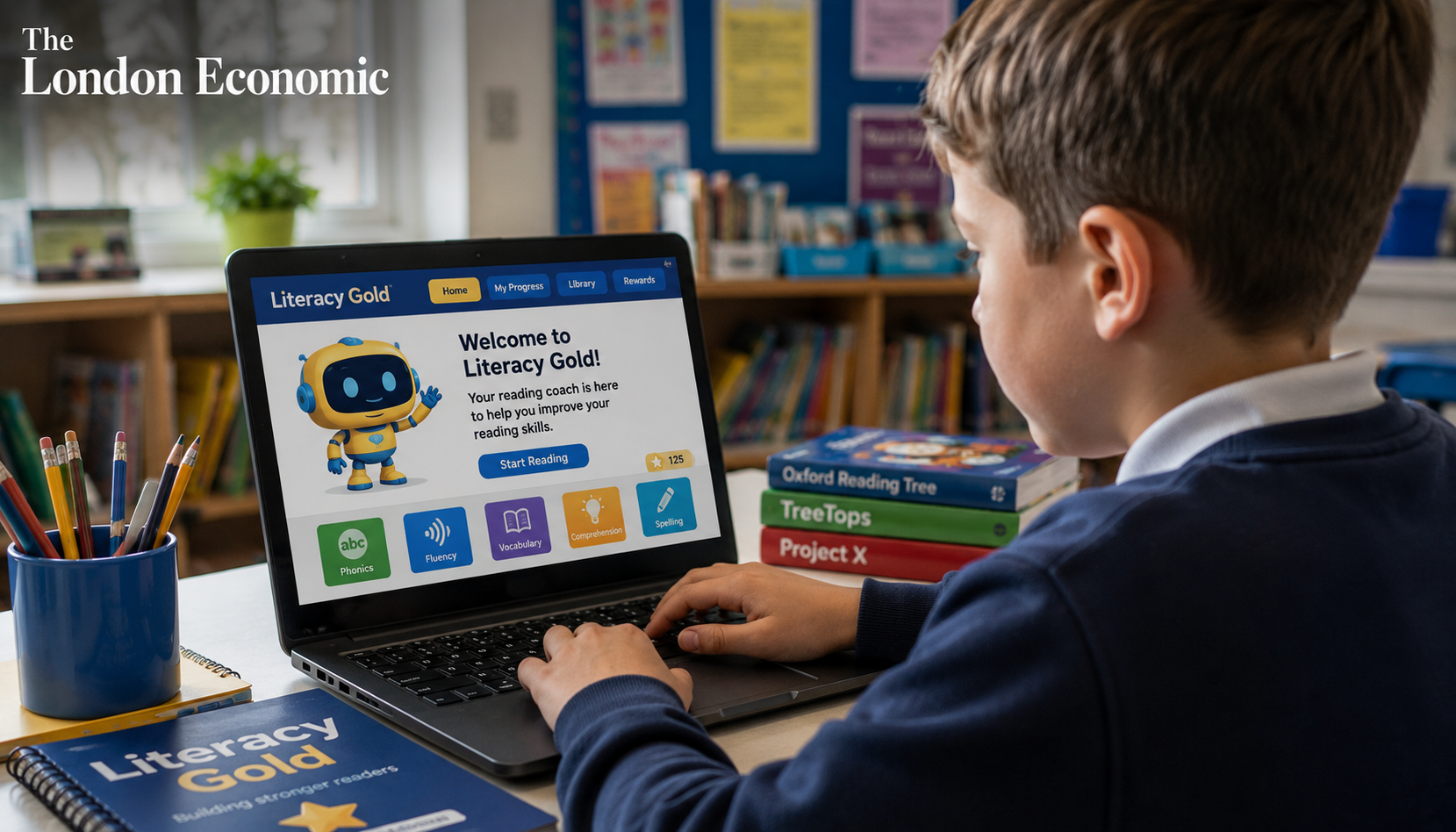
Literacy Gold
Literacy Gold is an online reading intervention used in over 1,000 UK schools that improves reading age, fluency, and comprehension for pupils from Key Stage 1 through to Key Stage 3. If you are a teacher looking to support struggling readers without extensive planning time, a SENCO evaluating targeted interventions for pupils with dyslexia, or a parent trying to understand what your child is using at school, this guide covers everything that matters: what Literacy Gold is, how it works, who it is designed for, what results schools have reported, and how it fits into the wider landscape of reading education in England in 2026.
Online reading intervention improves reading, fluency and comprehension. Suitable for all students in KS1, KS2, and KS3, including those with dyslexia. No planning, preparation or training is required.
That last point matters enormously for busy schools. The most effective intervention is the one that actually gets used, and Literacy Gold’s design around minimal staff burden is as important to its practical value as its pedagogical content.
What Is Literacy Gold?
Literacy Gold is an online reading intervention that improves reading age, fluency and comprehension. Currently used in over 1,000 UK schools, Literacy Gold is quick and easy to administer, and makes any adult as effective as a specialist teacher. Literacy Gold makes it easy for you to teach all your struggling pupils to read, and it can be run as a group intervention, which makes it a very effective use of staff time.
Literacy Gold sits within a family of products from the same development team, related to Dyslexia Gold, which was designed specifically for pupils with dyslexia. The two products share the same underlying approach and technological architecture, with Literacy Gold positioned as the broader reading intervention applicable across the full range of struggling readers regardless of a specific diagnosis.
The platform is delivered entirely online, meaning pupils access it through a browser on school computers, tablets, or home devices. There is no software to install and no specialist hardware required, which removes one of the most common practical barriers to digital intervention implementation in schools.
Who Is Literacy Gold Designed For?
Literacy Gold’s programmes are incredibly effective because they combine vision training, phonics and phonological awareness, which enables you to go beyond phonics and reach the pupils that phonics leaves behind.
This is a significant and carefully chosen statement. Systematic synthetic phonics has been the cornerstone of reading instruction in English primary schools since the Rose Review of 2006, and England’s results in international reading assessments have improved substantially since its widespread adoption. However, phonics teaching alone does not reach every struggling reader. Some children decode words correctly but struggle with fluency. Others have underlying processing differences, including dyslexia, that affect their ability to connect sounds to symbols reliably. Still others have visual processing difficulties that affect how print appears to them on the page.
Literacy Gold empowers pupils with essential reading and spelling skills through a meticulously structured, step-by-step approach that builds skills progressively. Each element, including eye control, phonemic and phonological awareness, phonics, vocabulary, and comprehension, is taught in a sequence that enables mastery, ensuring pupils progress systematically.
The inclusion of eye control training as a component is distinctive and reflects the programme’s attention to the physical and perceptual elements of reading that mainstream phonics programmes do not typically address. For some pupils, particularly those with visual stress or tracking difficulties, this element can make a meaningful difference to their experience of reading.
The Six Core Elements of Literacy Gold
Literacy Gold covers six distinct areas of reading development, each addressed in a structured sequence:
Eye control: Exercises that develop the tracking and fixation skills required for efficient reading. Many struggling readers have underdeveloped eye control that makes moving smoothly across a line of text difficult, even when they can decode the words themselves.
Phonemic awareness: The ability to hear, identify, and manipulate individual sounds in spoken words, which is the auditory foundation on which phonics learning is built. Pupils who have not fully developed phonemic awareness will struggle with phonics instruction regardless of how well it is delivered.
Phonological awareness: The broader ability to recognise and work with the sound structure of language, including rhyme, syllables, and word boundaries. This underpins fluent reading and is often underdeveloped in pupils who struggle.
Phonics: The systematic connection between written letters and spoken sounds. Literacy Gold’s phonics instruction follows a structured progression aligned with the Letters and Sounds sequence and the Department for Education’s Reading Framework.
Vocabulary: Active vocabulary instruction to support comprehension and word-level reading, addressing one of the most significant factors in reading development beyond the early stages.
Comprehension: Understanding of what has been read, the ultimate goal of reading instruction, developed through specific teaching rather than assumed to follow automatically from decoding ability.
How Literacy Gold Follows the Reading Framework
Literacy Gold follows the Reading Framework 2023. The 2023 update includes sections to support schools in assisting pupils who continue to struggle with decoding into Key Stages 2 and 3. The updated guidance stresses the need to continue phonics instruction for pupils with a reading age below 8, regardless of their actual age. Catch-up teaching is deemed essential, despite challenges in allocating time, space, and staff, with a particular focus on the need for secondary teachers and support staff to receive training in teaching reading.
The alignment with the Reading Framework 2023 is educationally significant. The Framework, published by the Department for Education, sets out the pedagogical principles for reading instruction in English schools and carries considerable weight in school inspections conducted by Ofsted. A reading intervention that explicitly follows the Framework gives school leaders confidence that it will complement rather than contradict their core teaching approach, and that it will hold up to scrutiny during inspection.
The Framework’s guidance on continuing phonics instruction for older pupils with reading ages below eight is particularly important for secondary schools, which have historically been less equipped to address fundamental reading difficulties. Literacy Gold’s suitability for KS3 makes it one of the few structured interventions that can be used meaningfully in secondary settings without requiring specialist teacher training.
How the Platform Works in Practice
Suitable for KS1, KS2, and KS3, pupils play Literacy Gold for 20 to 30 minutes, 3 to 5 times a week.
The frequency and duration model reflects established principles of effective intervention. Research on reading development consistently shows that regular, distributed practice is more effective than occasional longer sessions. Three to five sessions of twenty to thirty minutes per week is achievable within the typical school timetable without requiring dedicated specialist time for every session.
After an initial placement test, pupils begin their own personalised intervention.
The placement test is the entry point that determines each pupil’s starting level across the programme’s skill areas. This means pupils do not begin at an arbitrary fixed starting point but at the level appropriate to their current abilities, which is essential for maintaining both challenge and confidence.
Literacy Gold utilises inbuilt assessment tools to continually monitor each pupil’s progress and understanding. These assessments enable teachers to identify individual strengths and areas for improvement, ensuring that the programme proceeds at a suitable pace for each learner, allowing for tailored instruction that meets their specific needs. Literacy Gold is designed for daily use, featuring well-paced and meticulously planned lessons that captivate and motivate pupils.
The continuous assessment model removes the need for teachers to make manual judgements about when to move a pupil on or when to revisit earlier material. The platform responds to each pupil’s performance in real time, adjusting the pace and content accordingly.
Progress Tracking and Reporting
Graphs, reports and spreadsheets make it easy to track year group, class and individual pupil progress.
Effective intervention requires effective monitoring. Without clear data on whether pupils are making progress, schools cannot make informed decisions about continuing, adjusting, or discontinuing an intervention. Literacy Gold’s reporting tools provide progress data at individual, class, and year group level, giving teachers, SENCOs, and school leaders the information they need to evaluate impact without manual data collection.
The visual presentation of progress through graphs is particularly valuable for communication with parents and governing bodies, who may find raw assessment scores harder to interpret than a clear upward trajectory displayed visually.
What Schools Say: Reported Results
Literacy Gold is like nothing I have used before and has shown vast improvements with a variety of age groups. With some children the age gap had hugely reduced, one child by 62 months in only two terms. Quite amazing.
A reduction in reading age gap of 62 months, which is just over five years, in two school terms of approximately twelve to thirteen weeks each is a striking claim. It is important to note that this is a school-reported outcome rather than an independently peer-reviewed study. Extraordinary individual results exist in most reading intervention programmes and do not necessarily represent the typical outcome.
The Literacy Gold package is the single most important and effective programme we run at school.
I have never found another programme that replicates what we would do in a specialist one-to-one intervention. This does. It’s fun but very targeted.
The second testimonial addresses one of the most persistent challenges in reading intervention: the gap between what specialist teachers can achieve in one-to-one sessions and what is practically achievable when limited specialist staff need to serve a whole school population. If a digital platform genuinely replicates specialist one-to-one intervention at group or whole-class scale, the implications for schools with stretched staffing are significant.
One licence covers all your pupils at school and at home. Easy to run with a group. Enables all your staff to be as effective as a specialist reading teacher. Activities teach pupils how to break words into sounds, supporting blending and decoding. Systematic instruction reinforces sound-symbol correspondence. Pupils record and listen to their reading to improve fluency and confidence.
The home access element is significant. Many schools face the reality that pupils who most need reading intervention also have the least access to reading support at home. A single licence that covers home access as well as school use effectively extends the intervention time available to each pupil without requiring additional school resources.
Literacy Gold and Dyslexia
One of the most searched questions about Literacy Gold relates to its suitability for pupils with dyslexia, and the answer is clearly affirmative based on the programme’s own design and school-reported outcomes.
The platform was developed in parallel with Dyslexia Gold, a dedicated product for pupils with dyslexia, and the two share the same foundational approach. The inclusion of eye control training, phonemic awareness activities, and multi-sensory reading approaches reflects a design informed by the specific needs of pupils with phonological processing difficulties, which characterise dyslexia.
The fact that the programme reaches pupils that phonics leaves behind is particularly relevant here. Dyslexia often manifests precisely as a difficulty with the phonological processing that systematic phonics instruction targets. Pupils who have received phonics teaching and still struggle significantly may benefit from the additional visual, perceptual, and phonological awareness work that Literacy Gold provides beyond standard phonics delivery.
Literacy Gold in the Context of the National Year of Reading 2026
The platform’s growing use in UK schools coincides with a significant national moment for literacy education. The Department for Education and National Literacy Trust have joined forces to launch a National Year of Reading starting in January 2026, designed to reverse the trend as just one in three aged 8 to 18 said they enjoyed reading in their free time in 2025.
Reading for pleasure is linked to a range of benefits including stronger writing skills, improved wellbeing and confidence, and even higher future earnings, with new data showing those proficient in reading and writing in primary school earn £65,000 more over their lifetime. The government inherited a system which is holding too many children back from future success with over a quarter leaving primary school not meeting the expected standard in reading.
That final statistic, over a quarter of children leaving primary school below the expected standard in reading, underlines why targeted interventions like Literacy Gold matter. Universal classroom teaching, however well delivered, does not reach every child. Structured, evidence-informed interventions that can be run efficiently by non-specialist staff fill a critical gap.
How Literacy Gold Compares With Other UK Reading Interventions
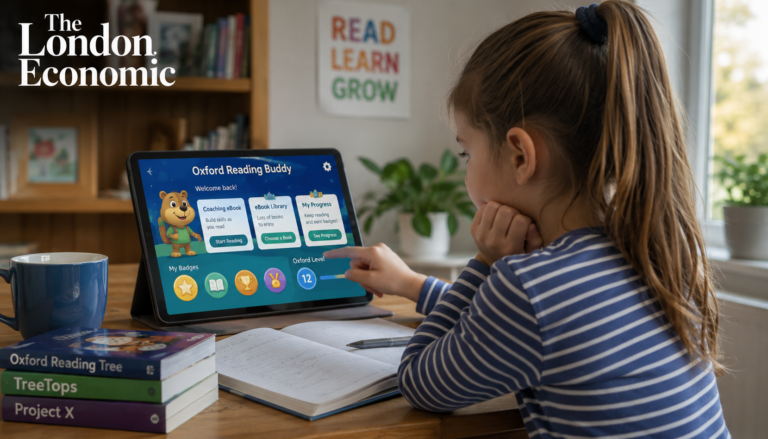
| Feature | Literacy Gold | Oxford Reading Buddy | Accelerated Reader |
|---|---|---|---|
| Primary focus | Reading intervention for struggling readers | Comprehension development | Reading practice and quizzing |
| Age range | KS1, KS2, KS3 | Nursery to Year 6 | Year 1 to secondary |
| Dyslexia support | Explicit, built-in | Limited | Limited |
| Phonics element | Yes, systematic | Yes | No |
| Eye control training | Yes | No | No |
| Vision support | Yes | No | No |
| Staff training required | No | Minimal | Minimal |
| Group use | Yes | Yes | Yes |
| Home access | Yes, same licence | Yes | Yes |
| Progress reporting | Yes, graphs and spreadsheets | Yes | Yes |
| Reading Framework aligned | Yes, 2023 | Partial | Partial |
The clearest differentiator between Literacy Gold and comparable platforms is its explicit attention to the non-phonological factors that can impede reading development, specifically visual processing and eye control, alongside its design for struggling readers rather than for the full ability range.
Practical Implementation: What Schools Need to Know
Implementing Literacy Gold in a UK school involves a straightforward sequence:
- Purchase a school licence, which covers all pupils at school and at home under a single subscription.
- Conduct initial placement tests for pupils identified for intervention, which can be done by a teaching assistant without specialist training.
- Begin sessions of twenty to thirty minutes, three to five times per week. Sessions can be run with groups rather than requiring individual one-to-one time.
- Monitor progress through the platform’s built-in reporting, reviewing graphs and individual pupil data regularly.
- Use the reporting data to inform conversations with parents, SEND review meetings, and whole-school literacy planning.
Schools can also participate in the Literacy Gold research project, where schools with struggling readers can trial the intervention in exchange for contributing progress data to the platform’s ongoing evidence base.
Key Takeaways
- Literacy Gold is an online reading intervention used in over 1,000 UK primary and secondary schools, designed for struggling readers in KS1, KS2, and KS3, including pupils with dyslexia.
- It addresses six components of reading development: eye control, phonemic awareness, phonological awareness, phonics, vocabulary, and comprehension, in a structured sequence that builds skills progressively.
- No planning, preparation, or specialist training is required from staff, making it practically accessible for schools with limited specialist resources.
- A single licence covers all pupils at school and at home, extending intervention time without additional cost.
- The platform follows the Department for Education’s Reading Framework 2023, aligning it with the pedagogical framework that underpins Ofsted’s expectations for reading in English schools.
- Built-in assessment tools continuously monitor progress and adjust the programme’s pace for each learner, with reporting available at individual, class, and year group level.
- School-reported outcomes include significant reductions in reading age gaps, with one school reporting a reduction of 62 months in two terms. These are school-reported results rather than independently peer-reviewed outcomes.
- The programme’s inclusion of vision training and eye control work distinguishes it from standard phonics-based interventions and makes it particularly relevant for pupils whose difficulties go beyond phonological processing alone.
Frequently Asked Questions
What is Literacy Gold?
Literacy Gold is an online reading intervention for pupils in KS1, KS2, and KS3 that improves reading age, fluency, and comprehension. It is used in over 1,000 UK schools and combines eye control training, phonemic and phonological awareness, phonics, vocabulary, and comprehension instruction in a structured, personalised programme that requires no specialist training to deliver.
Is Literacy Gold suitable for pupils with dyslexia?
Yes. Literacy Gold is explicitly designed to be suitable for pupils with dyslexia. It was developed alongside Dyslexia Gold, a dedicated dyslexia support programme, and shares the same foundational approach. Its inclusion of vision training and eye control activities, alongside systematic phonics and phonological awareness work, makes it relevant for pupils whose reading difficulties are not fully addressed by standard phonics instruction.
How long are Literacy Gold sessions?
Sessions are designed to run for twenty to thirty minutes, three to five times per week. This frequency and duration reflects research on effective distributed practice in reading development and is achievable within typical school timetabling without requiring dedicated specialist time for every session.
Does Literacy Gold follow the Reading Framework?
Yes. Literacy Gold explicitly follows the Department for Education’s Reading Framework 2023, which sets out the pedagogical principles for reading instruction in English schools. This alignment means the programme complements core teaching approaches recommended by the DfE and supports schools in meeting the expectations set out in Ofsted’s inspection framework for reading.
Can pupils use Literacy Gold at home?
Yes. A single school licence covers pupil access both at school and at home. This is particularly significant for schools whose pupils have limited reading support at home, as it effectively extends the intervention time available to each child without additional cost.
How does Literacy Gold track progress?
The platform uses built-in continuous assessment tools that monitor each pupil’s performance in real time and adjust the programme’s pace accordingly. Progress is reported through graphs, reports, and spreadsheets covering individual pupils, classes, and year groups, making data accessible to teachers, SENCOs, and school leaders without manual data collection.
What makes Literacy Gold different from other reading interventions?
The most distinctive feature of Literacy Gold is its inclusion of eye control and vision training alongside phonics and phonological awareness work. This enables it to reach pupils whose reading difficulties have a perceptual or visual processing component that standard phonics interventions do not address. Its design for group delivery without specialist training is also significant, as it makes the intervention practically achievable at scale for schools with stretched staffing.
How do schools access Literacy Gold?
Schools access Literacy Gold through a subscription licence purchased via the Literacy Gold website at literacygold.co.uk. Schools can also enquire about participating in the Literacy Gold research project, which offers a free licence during the trial period in exchange for contributing progress data.
Conclusion
Literacy Gold addresses one of the most persistent and consequential challenges in UK education: the gap between what struggling readers need and what schools can realistically deliver with the staff and time available. By combining the core elements of effective reading instruction, including phonics, phonological awareness, and comprehension, with the less commonly addressed areas of eye control and vision training, and by designing the whole programme to run without specialist teacher delivery, it occupies a genuinely useful position in the reading intervention landscape.
The context in 2026 makes this more rather than less important. Over a quarter of children leave English primary schools below the expected standard in reading. Just one in three young people aged eight to eighteen report enjoying reading in their free time. The government’s National Year of Reading 2026, fronted by the Department for Education and National Literacy Trust, reflects a recognition at the highest policy level that reading development requires a concerted, multi-agency national effort, not just good classroom teaching.
Within that effort, structured, evidence-informed digital interventions that can be implemented efficiently by non-specialist staff serve a specific and valuable function. Literacy Gold, used consistently and alongside strong whole-school reading provision, represents one of the more practically considered options available to UK schools in 2026. Its reported outcomes are compelling, its alignment with the Reading Framework is clear, and its design for the realities of school staffing and timetabling makes it one of the more deployable interventions available to SENCOs and teachers working to close the reading gap.
About the Author