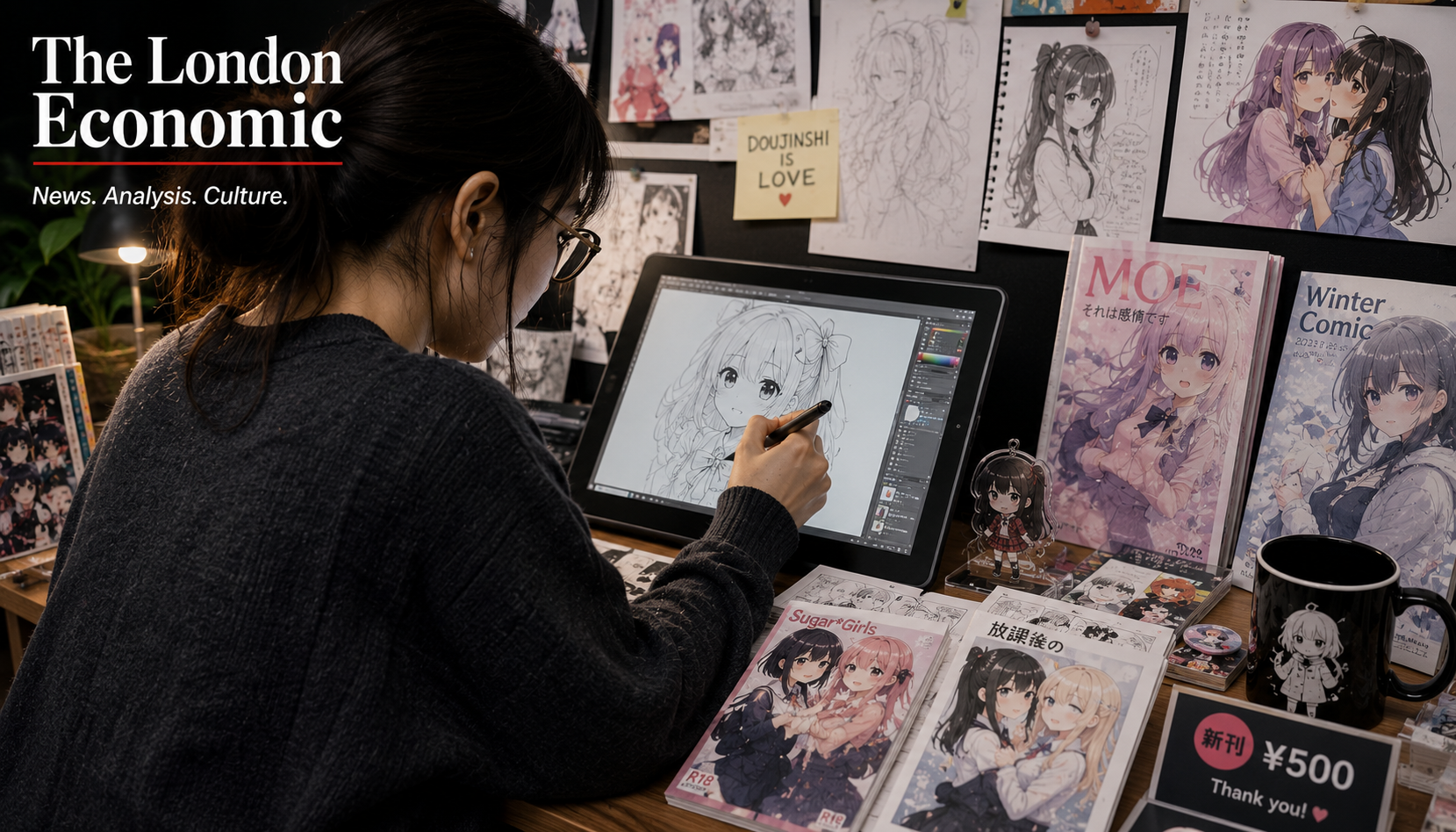
Doujinshi and Moe Culture
Somewhere between a professional studio and a bedroom desk, one of the most significant creative movements in modern popular culture has been quietly building for decades. Doujinshi, the tradition of self-published fan works originating in Japan, combined with the emotional aesthetic philosophy known as moe, has produced a global community of independent artists, writers, and illustrators whose output now rivals mainstream publishing in volume and, for many fans, in emotional resonance.
The terms doujinshi and moe are used widely across anime and manga communities online, yet they are rarely explained clearly for people encountering them for the first time. This guide provides exactly that: a thorough, accurate account of what these concepts are, where they came from, how they operate today, and what their growing global presence means for creative culture more broadly.
What Is Doujinshi?
Doujinshi is a Japanese word combining “doujin” (same person, or a group of like-minded individuals) and “shi” (publication or magazine). In practice, it refers to self-published creative works produced independently of commercial publishers, typically by fans of existing manga, anime, or video game franchises, though original works also fall under the term.
Doujinshi most commonly takes the form of manga-style illustrated stories, though the category also encompasses illustrated art books, poetry collections, music albums, and software. The defining characteristic is independent production and distribution outside the mainstream publishing industry.
Most doujinshi based on existing franchises exist in a legal grey area. The works are technically unauthorised derivatives of copyrighted material. However, Japanese publishers and studios have historically adopted a policy of tolerating, and in some cases quietly encouraging, the doujinshi ecosystem because it sustains deep fan engagement with their properties. This informal tolerance is not a legal right and does not extend automatically to commercial-scale sales or markets outside Japan where copyright enforcement differs.
Origins: From Literary Circles to Comiket
Doujinshi culture in Japan traces its origins to the early twentieth century, when literary circles produced small-run independent publications and circulated them among members. The modern form of the tradition, centred on illustrated manga-style content, developed during the 1960s and 1970s alongside the explosive growth of manga as a mainstream medium.
The pivotal moment in doujinshi history came in December 1975, when the first Comic Market, universally known as Comiket, was held in Tokyo. Founded by Yoshihiro Yonezawa and a small group of manga fans, the event began with approximately 32 participating circles and 700 attendees. The intention was to create a space where fans could sell their own creative works directly to other fans, bypassing commercial publishing entirely.
Comiket grew steadily through the 1980s and explosively through the 1990s as manga and anime became central to Japanese popular culture. Today Comiket draws over 500,000 attendees across its twice-yearly events, making it one of the largest fan conventions in the world by attendance. Tens of thousands of creator circles participate, selling printed doujinshi alongside digital works, illustrations, and merchandise.
The convention remains the cultural heart of the doujinshi tradition, even as digital platforms have transformed how the majority of works are now distributed.
What Is Moe?
Moe (pronounced moh-eh, written in Japanese as 萌え) is a concept that emerged from Japanese fan communities in the early 1990s. The word itself is a pun, derived from a Japanese verb meaning to bud or sprout, but repurposed by fan communities to describe a specific emotional response to fictional characters.
At its core, moe describes a feeling of protective warmth, affection, and emotional attachment toward a fictional character, typically one that possesses qualities associated with innocence, vulnerability, earnestness, or a kind of endearing awkwardness. The character design associated with moe typically features soft visual elements: large expressive eyes, gentle colour palettes, rounded features, and body language that communicates emotional openness.
Moe is not simply cuteness. Kawaii, the better-known Japanese aesthetic concept translated broadly as cute, is about surface appearance. Moe is about the emotional response the character provokes. A character can be moe without being conventionally cute, if their personality and situation create the specific feeling of wanting to protect or emotionally connect with them.
Moe in Academic and Cultural Context
The moe concept attracted serious academic attention as its cultural influence grew. The Japanese cultural critic and philosopher Hiroki Azuma examined moe extensively in his 2001 work “Otaku: Japan’s Database Animals,” which was translated into English and published by the University of Minnesota Press in 2009. Azuma argued that moe represented a shift in how audiences related to fictional characters, moving from engagement with narrative toward direct emotional attachment to character attributes themselves.
The book sparked significant debate in Japanese cultural studies and remains a key reference in academic discussions of fan culture, character design, and the psychology of media consumption. Whether one accepts Azuma’s full theoretical framework or not, his identification of moe as a distinct and culturally significant phenomenon has proven durable.
How Doujinshi and Moe Intersect
Doujinshi and moe are distinct concepts that have developed a deep, mutually reinforcing relationship within fan culture. Doujinshi provides the creative format and distribution infrastructure. Moe provides the aesthetic and emotional philosophy that guides a significant and particularly beloved subset of that creative output.
When independent artists create doujinshi that prioritises emotional warmth over action or plot complexity, focusing on quiet character moments, relationships conveyed through soft visual language, and stories designed to make readers feel genuine affection rather than excitement, the result is what fans describe using the combined concept of doujin moe or, in various romanisations, doujen moe.
This combination is not a formally defined genre in the way that romance or science fiction are. It is better understood as a creative sensibility: an approach to fan-made work that treats emotional connection as the primary goal and moe aesthetic principles as the primary tool.
The appeal is straightforward once understood. Much commercial anime and manga operates at narrative scale, driven by high-stakes conflict, power escalation, and plot momentum. The doujin moe space operates at an intimate scale, driven by character interiority, small emotional moments, and the particular pleasure of spending time with a character in ordinary rather than extraordinary circumstances. These are complementary rather than competing pleasures, which is why the same fan can enjoy both.
The Digital Transformation of Doujinshi Culture
The shift from physical to digital distribution has been the most significant structural change in doujinshi culture since the founding of Comiket. Several platforms now form the primary infrastructure of the global doujin creative ecosystem.
Pixiv
Founded in 2007, Pixiv is the dominant platform for Japanese independent illustration and manga. The platform hosts over 100 million illustrations and connects millions of artists with audiences worldwide. Its tag and search infrastructure makes it the most effective discovery tool for doujin and moe-aesthetic content globally.
Pixiv operates a companion marketplace called BOOTH, which allows creators to sell digital files, printed zines, and illustrated collections directly to buyers. The combination of Pixiv for visibility and BOOTH for commerce has created a self-contained creator economy for independent artists that functions without requiring involvement from any traditional publisher.
MangaDex
MangaDex is a community-driven manga reading platform with a substantial doujinshi section. It has become particularly important for international audiences because it hosts translated versions of fan works, making doujinshi content accessible to English-speaking and other non-Japanese readers who cannot engage with Japanese-language originals. The platform is reader-focused rather than creator-focused, and functions primarily as a discovery and reading environment.
DLsite
DLsite is one of the largest commercial download platforms for doujinshi globally. Unlike Pixiv’s social-platform model, DLsite operates as a straightforward digital marketplace where creators sell their works as downloadable files. It hosts a wide range of doujinshi across genres and content ratings, with clear labelling and filtering systems.
The Content Rating Question
Any honest account of doujinshi culture must acknowledge that the broader ecosystem includes adult content alongside the substantial volume of general-audience and all-ages work. Platforms including Pixiv and MangaDex operate content filters and clearly distinguish between general-audience and adult-rated works. The moe aesthetic itself, focused on emotional warmth and innocence, is fundamentally oriented toward general-audience content, and the majority of work in this specific sensibility is appropriate for teen and adult audiences.
However, because doujinshi as a broader category includes a wide content spectrum, parental awareness is appropriate for younger readers exploring these communities independently. Any reputable platform in this space provides filtering and rating systems that make navigation of the content landscape manageable.
The Global Reach of Independent Anime Fan Culture
What began as a distinctly Japanese phenomenon has become genuinely international. The global spread of anime and manga through streaming platforms, digital distribution, and social media has created large, engaged fan communities across North America, Europe, Southeast Asia, and South America, and many of those fans have moved from consuming existing works to creating their own.
Comiket itself has become a pilgrimage destination for international fans, with foreign attendees travelling to Tokyo specifically for the twice-yearly events. Beyond Japan, local equivalents have emerged: Doujima in Australia, various European doujinshi markets, and numerous convention events in the United States that include doujinshi dealer areas alongside mainstream anime merchandise.
Digital tools have democratised the creative side of participation. Drawing tablets, free and low-cost illustration software, online translation communities, and self-publishing platforms mean that a fan artist in the UK, Brazil, or South Korea can create, publish, and build an audience for doujinshi work without any of the infrastructure that physical production and Comiket participation required in earlier decades.
The result is a global creative community that shares aesthetic values and emotional sensibilities across national and language boundaries, united by a shared attachment to specific characters and the specific pleasure of exploring those characters through independent creative work.
Why Doujinshi Culture Matters Beyond Fan Communities
The significance of doujinshi culture extends beyond the communities that participate in it directly.
As a Creative Incubator
Numerous professional manga artists and illustrators began their careers creating doujinshi. The format provides a low-barrier entry point for developing technical skills, building an audience, and testing creative approaches without the commercial pressures of professional publishing. The ability to experiment freely and receive direct feedback from engaged readers has produced a pipeline of talent that has fed back into mainstream manga and anime publishing for decades.
Ken Akamatsu, creator of the commercially successful manga series Love Hina and Negima!, began in doujinshi circles before transitioning to professional publication. His trajectory is representative of a well-established pattern in the industry.
As a Model for the Creator Economy
The infrastructure of doujinshi distribution, direct creator-to-reader sales, platform-based discoverability, and community-driven quality filtering, anticipated many of the dynamics now discussed under the banner of the “creator economy.” Platforms like Patreon, Substack, and Gumroad operate on principles that the doujin community developed and tested at scale decades earlier.
The BOOTH marketplace in particular represents a mature, functional model for independent creative commerce that predates many of the Western creator economy platforms that now attract significant investment and media attention.
As a Subject for Media Psychology Research
Research into fan creativity and the psychology of character attachment has grown significantly alongside the cultural prominence of these communities. Work by scholars including Henry Jenkins, whose 1992 book “Textual Poachers” examined fan creative communities in the United States, and the aforementioned Hiroki Azuma on the Japanese side, has established fan creative culture as a legitimate subject of serious academic inquiry.
More recent research in media psychology has examined the mental health dimensions of character attachment, finding that strong emotional bonds with fictional characters can provide genuine comfort, reduce loneliness, and support creative self-expression. These findings are not unique to moe-aesthetic content, but they provide a substantive basis for taking seriously the emotional value that participants in these communities describe.
Key Takeaways
- Doujinshi refers to self-published independent creative works, typically manga-style illustrated stories, produced by fan communities outside mainstream commercial publishing.
- Comiket, founded in Tokyo in 1975 with 32 participating circles, now draws over 500,000 attendees per event and remains the cultural centre of global doujinshi culture.
- Moe is an aesthetic and emotional concept describing the specific feeling of warmth and protective affection toward a fictional character, distinct from the simpler concept of cuteness (kawaii).
- The combination of doujin creative practice with moe aesthetic philosophy produces a form of fan-made work focused on emotional intimacy and character connection rather than plot drama or action.
- Pixiv, with over 100 million hosted illustrations, is the dominant global platform for independent anime illustration; BOOTH, MangaDex, and DLsite complete the primary distribution ecosystem.
- Doujinshi culture has genuine significance beyond fan communities as a creative incubator, an early model for the creator economy, and a subject of serious academic research in media psychology and cultural studies.
Frequently Asked Questions
What does doujinshi mean? Doujinshi combines the Japanese words “doujin” (a group of like-minded people or individuals sharing a common interest) and “shi” (publication). It refers to self-published creative works, most commonly manga-style illustrated stories, produced independently of commercial publishers.
What does moe mean? Moe (萌え) describes a feeling of deep emotional warmth, affection, and protectiveness toward a fictional character. It emerged from Japanese fan communities in the early 1990s and has since become a recognised aesthetic philosophy in anime and manga character design. It is distinct from kawaii (cuteness), which describes appearance rather than the emotional response a character provokes.
Is doujinshi legal? Most fan-made doujinshi based on existing franchises exists in a legal grey area. The works are technically unauthorised derivatives of copyrighted material. In Japan, publishers have historically tolerated the doujinshi ecosystem because it builds fan engagement. Outside Japan, copyright enforcement varies and the legal situation is less predictable. Original doujinshi featuring no existing intellectual property presents no copyright issues.
What is Comiket? Comiket (Comic Market) is a twice-yearly fan convention held in Tokyo, Japan, founded in December 1975. It is the world’s largest gathering of doujinshi creators and buyers, now drawing over 500,000 attendees per event. Tens of thousands of independent creator circles participate, selling printed and digital works directly to fans.
Where can I find doujinshi online? The primary platforms are Pixiv (illustration sharing and discovery), BOOTH (digital and physical sales), MangaDex (reading and translations), and DLsite (digital downloads). All reputable platforms include content rating systems and filters.
Is moe content appropriate for children? The moe aesthetic itself is oriented toward emotional warmth and innocence and is generally appropriate for teen and adult audiences. However, because doujinshi as a broader category spans a wide content spectrum including adult-rated works, parental guidance is recommended for younger readers exploring these communities independently.
How has doujinshi culture influenced mainstream publishing? Numerous professional manga artists began as doujinshi creators before transitioning to commercial publication. The format functions as a creative incubator with low barriers to entry, producing a pipeline of talent that feeds regularly into mainstream manga and anime. The distribution model of doujinshi also anticipated many principles now central to the broader creator economy.
Who has written seriously about moe culture? Japanese cultural critic Hiroki Azuma examined moe extensively in “Otaku: Japan’s Database Animals” (2001, English translation published by the University of Minnesota Press in 2009). American media scholar Henry Jenkins examined fan creative communities more broadly in “Textual Poachers” (1992). Both works are considered foundational in academic fan culture studies.
Conclusion
Doujinshi and moe culture represent something genuinely unusual in contemporary creative life: a community-driven, largely non-commercial tradition that has sustained itself for decades, grown globally, and produced both significant cultural value and a workable economic model for independent creators, all without the backing of major publishers, streaming platforms, or venture capital.
The emotional logic at the heart of it is simple even if the cultural context is complex. People form deep attachments to fictional characters. When those characters are drawn with particular care for emotional warmth and human recognisability, that attachment becomes a powerful creative motivator. The doujinshi tradition provides the format and infrastructure to act on that motivation and share the results with others who feel the same way.
For the global anime and manga audience, understanding doujinshi and moe is not a niche interest: it is increasingly central to understanding how fan communities work, how creative careers begin, and how the relationship between audiences and the stories they love has fundamentally changed in the digital age.
About the Author