Codeword Solver
Introduction
A codeword puzzle sits somewhere between a crossword and a cipher. There are no clues, no definitions, and no hints beyond a handful of starter letters. Just a grid of numbers, each one representing a letter of the alphabet, waiting to be decoded through logic alone. For many solvers, the satisfaction of cracking one is unmatched. For others, hitting a wall mid-puzzle is genuinely frustrating.
That is where a codeword solver comes in. Whether you use one to check your progress, escape a dead end, or learn better solving strategies, understanding how these tools work, and how to use them effectively, can transform your relationship with this deceptively challenging puzzle format.
What Is a Codeword Puzzle?
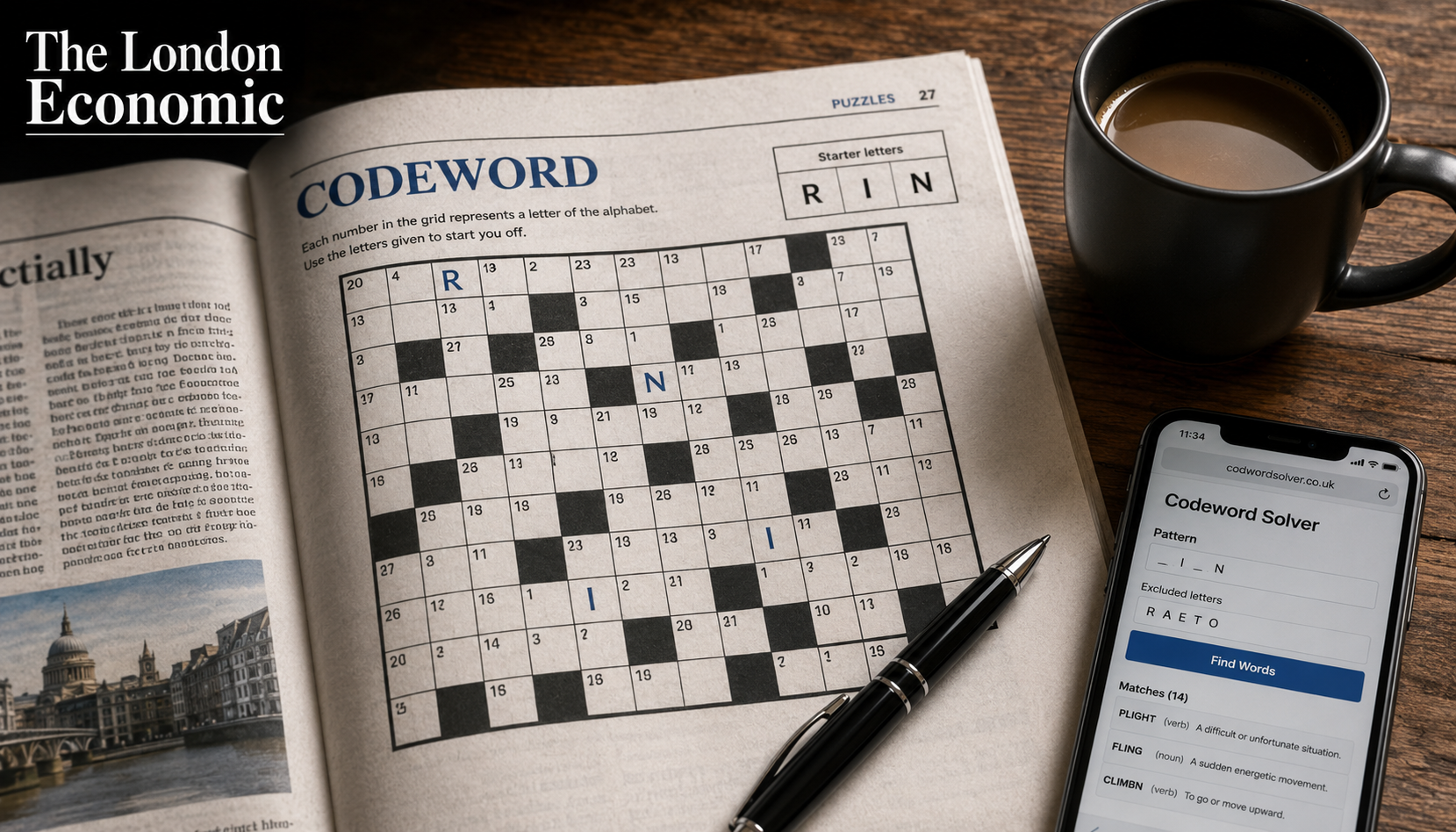
A codeword (sometimes called a code-cracker or codecracker) is a completed crossword grid in which every letter has been replaced by a number from 1 to 26. Each number always represents the same letter throughout the entire puzzle, and every letter of the alphabet appears at least once. Solvers receive a small number of starter letters as anchor points, then use logic, pattern recognition, and knowledge of the English language to decode the rest.
Unlike a traditional crossword, there are no clues. The challenge is purely structural. You are not asked what a river in South America is called; you are asked to identify which number corresponds to which letter by looking at how words are shaped around the letters you already know.
Codeword puzzles first appeared in print in the late 1970s and gained a strong following in the UK during the 1980s, becoming a fixture in national newspapers and puzzle magazines. Today they remain widely published in titles such as the Daily Mail, the Telegraph, and specialist puzzle publications, and have made a natural transition into digital apps and online platforms.
What Is a Codeword Solver?
A codeword solver is a digital tool that helps you identify which words can fit a given pattern in a codeword grid. You input the letters you already know, use placeholder characters for unknowns, and the tool searches a dictionary to return every word that matches both the letter positions and the same-number/same-letter rule.
The best solvers do more than simple pattern matching. They enforce the core rule of codewords: because each number maps to exactly one letter, a letter you have already discovered elsewhere in the grid cannot reappear as an unknown in any other position. A high-quality tool will filter results accordingly, considerably narrowing the candidate list and pointing you toward the genuine solution.
Some solvers also offer a multi-pattern feature, allowing you to input two or more word patterns simultaneously and solve them together. Because the same substitution key applies across the entire puzzle, solving two words in relation to each other eliminates possibilities far faster than working on each in isolation.
How Does a Codeword Solver Work?
The mechanics behind a codeword solver are straightforward but powerful. Here is the process step by step:
- Input your pattern. You enter the letters you know in their correct positions. Unknown letters are represented by underscores or dots, depending on the tool. If the same unknown number appears in two positions, you use the same placeholder symbol in both, so the solver knows they must be the same letter.
- Exclude discovered letters. You flag any letters already identified elsewhere in your puzzle. These cannot fill the blank positions you are trying to solve.
- The solver queries a dictionary. The tool runs your pattern against a dictionary of valid English words, returning all matches that satisfy both conditions: correct known letters in the right places, and no use of your excluded letters.
- Review the results. You scan the candidates, often aided by dictionary definitions, to judge which word fits the puzzle logically given the words already confirmed around it.
- Apply the new letter to the whole grid. Once you confirm a word, that number-to-letter mapping applies everywhere in the puzzle, typically unlocking further words in a cascade.
The quality of the underlying dictionary matters considerably. British English codewords draw on a wide vocabulary, and some puzzles, particularly in specialist publications, include less common or archaic words. The best tools offer multiple dictionary tiers, from a compact everyday set to an expanded list covering rarer and technical vocabulary.
When Should You Use a Codeword Solver?
Using a solver is not cheating. Codewords are solved for pleasure, not examined under exam conditions. That said, there are smarter and less satisfying ways to deploy one.
Use a solver when you are genuinely stuck. If two or three possible letters fit a word equally well and you have no further evidence to distinguish between them, a solver can confirm which of your guesses is actually a valid English word. This saves you from committing to an incorrect letter that would corrupt every other word sharing that number.
Use it to learn, not just to finish. Many experienced solvers use tools not to complete puzzles for them but to understand why a particular word appeared in a puzzle they could not crack. Seeing the vocabulary that turns up in codewords gradually improves pattern recognition and speeds up unaided solving.
Avoid over-reliance in the early stages. The opening phase of a codeword, where you work outward from the given starter letters, is where the most satisfying deductive reasoning happens. Reaching for a solver before attempting this phase removes the central pleasure of the format.
The Best Codeword Solver Tools Available
Several dedicated tools exist for solving codewords online, each with different strengths.
CodwordSolver.co.uk is one of the most feature-complete options available. It offers three dictionary tiers (Pocket, Original, and Big) reflecting different breadth of vocabulary, and includes definitions alongside results to help solvers judge likely candidates. A multi-pattern solver allows two linked words to be checked simultaneously, and it correctly enforces the same-number/same-letter constraint throughout.
Danny Brien’s Codeword Solver is a clean, straightforward tool that accepts underscore placeholders for unknown letters and allows solvers to exclude letters already identified in the grid. It is particularly useful for users who want a simple interface without additional features.
Crossword Solver and Anagram Solver sites often include codeword-style pattern tools as a secondary feature, though these rarely enforce the substitution rule specific to codewords and are therefore less precise for this format.
Edu-Games Codeword Generator is aimed at educators creating their own puzzles but provides useful insight into how the format works technically, including how starter letters are selected and how grids are validated to include all 26 letters.
Expert Strategies for Solving Codewords Without a Tool
A solver should be a last resort, not a first response. These strategies will help you make significant progress unaided.
Start with short words. Two- and three-letter words have a limited pool of possibilities in English. A three-letter word where you know the first letter is almost certainly identifiable from common vocabulary alone.
Look for doubled letters. Two identical numbers adjacent to each other dramatically reduce the pool of candidate words. Common doubled letters in English include SS, LL, EE, OO, and TT. Spotting these early gives you high-probability guesses to test.
Use letter frequency to your advantage. E, T, A, O, and I are the most common letters in English. In a codeword grid, the number that appears most frequently is almost certainly one of these. The rarest numbers are likely to be Q, Z, X, or J.
Target common endings and prefixes. Patterns like -ING, -TION, -ED, -LY, -UN, and PRE- appear constantly in English. If you can identify a word ending by its pattern, you can work backwards to the individual letters.
Build a substitution key as you go. Keep a handwritten or on-screen table mapping each number to its discovered letter. This reference prevents errors and makes the cascade effect of new discoveries much faster to apply.
Comparison: Codeword Solver Tools at a Glance
| Tool | Dictionary Scope | Enforces Substitution Rule | Multi-Pattern | Definitions |
|---|---|---|---|---|
| CodwordSolver.co.uk | Pocket / Original / Big | Yes | Yes | Yes |
| Danny Brien’s Solver | Standard | Yes | No | No |
| General anagram/word tools | Variable | No | No | Variable |
The Cognitive Benefits of Codeword Solving
Codewords are not just leisure. Research into word puzzles and cognitive health has produced encouraging findings. A large-scale study of nearly 20,000 adults aged 50 to 93, published in the International Journal of Geriatric Psychiatry, found that regular engagement with word puzzles correlated directly with better performance on tests of attention, reasoning, and memory. A separate study from the Bronx Aging Study found that regular crossword solvers experienced a delay in the onset of accelerated memory decline of approximately 2.5 years compared to non-puzzlers.
Codewords arguably offer a cognitive workout distinct from the crossword. Where crosswords test general knowledge and vocabulary retrieval, codewords place greater demand on deductive reasoning, working memory, and systematic logic. You must simultaneously track which letters have been assigned, which have not, and what structural patterns suggest about the remaining unknowns. This is closer to the kind of reasoning used in logic puzzles and cipher analysis than in traditional word games.
For those who engage with codewords regularly, the anecdotal evidence mirrors the research: problem-solving speed improves, vocabulary recognition widens, and the frustrating early stages of a new puzzle become shorter over time.
Key Takeaways
- A codeword replaces every letter with a number from 1 to 26, with each number representing the same letter throughout. All 26 letters appear at least once.
- A codeword solver helps identify valid words matching a known pattern, filtered to exclude already-discovered letters.
- The best solvers enforce the substitution rule and offer tiered dictionaries covering everyday and specialist vocabulary.
- Strategic unaided solving, using short words, doubled letters, and letter frequency analysis, produces better long-term results than immediate use of a solver.
- Regular engagement with word puzzles, including codewords, has documented cognitive benefits, particularly for working memory and reasoning.
Frequently Asked Questions
What is a codeword solver?
A codeword solver is an online tool that accepts a partial word pattern (with known letters in position and unknowns indicated by placeholders) and returns all valid English words that fit, while enforcing the rule that each number maps to only one letter.
Is using a codeword solver cheating?
Not in any meaningful sense. Codewords are recreational puzzles solved for personal enjoyment. Using a solver to get unstuck or verify a guess is a legitimate part of the experience for many solvers.
What is the difference between a codeword and a crossword?
A crossword provides clues that lead you to each answer. A codeword provides no clues; instead, every letter in the grid has been substituted with a number, and solvers must crack the substitution code using logic and word knowledge.
How many letters are given in a standard codeword?
Most published codewords provide three starter letters chosen to give solvers a productive starting point. These are usually letters of middling frequency so they appear in multiple words without being so common that the puzzle is trivially easy.
Which numbers should I solve first in a codeword?
Start with numbers that appear frequently in short words (two to three letters), as these have the fewest possible solutions. Also prioritise any number that appears twice consecutively, suggesting a doubled letter, as these are strongly constrained.
Do codeword solvers work for American English puzzles?
British English solvers may include some American variants, but dedicated British-English tools (which reflect the vocabulary used in UK newspaper puzzles) will be most accurate for UK publications. For American puzzle books, check whether the tool explicitly supports American spellings.
Can I solve a codeword on paper without digital tools?
Yes, and many enthusiasts prefer this. The approach is identical: work from starter letters, apply known substitutions across the grid, and use linguistic strategies to narrow down unknowns. A pencil, an eraser, and a substitution key table alongside the grid are all you need.
What makes a codeword different from a cryptogram?
Both substitute letters for other symbols, but a codeword is structured as a crossword grid where words intersect, adding an additional constraint: solved words must read coherently both across and down the grid, not just in isolation.
Conclusion
A codeword solver is a genuinely useful tool, provided you understand its proper role. It is a precision instrument for eliminating ambiguity, not a replacement for the reasoning process that makes codewords satisfying in the first place. The most productive approach combines systematic unaided solving with targeted use of a solver when a pattern presents too many equally plausible options.
The best tools, particularly those with multi-pattern capabilities and tiered dictionaries, reflect a serious understanding of what the puzzle format actually demands. Knowing how to use them well, rather than reflexively reaching for one at the first sign of difficulty, makes the difference between a solver that diminishes the puzzle and one that enhances it.
Whether you solve in print or digitally, alone or alongside a partner, codewords remain one of the most intellectually distinctive puzzle formats available in the British press. A good solver is simply part of the toolkit, used wisely.
About the Author