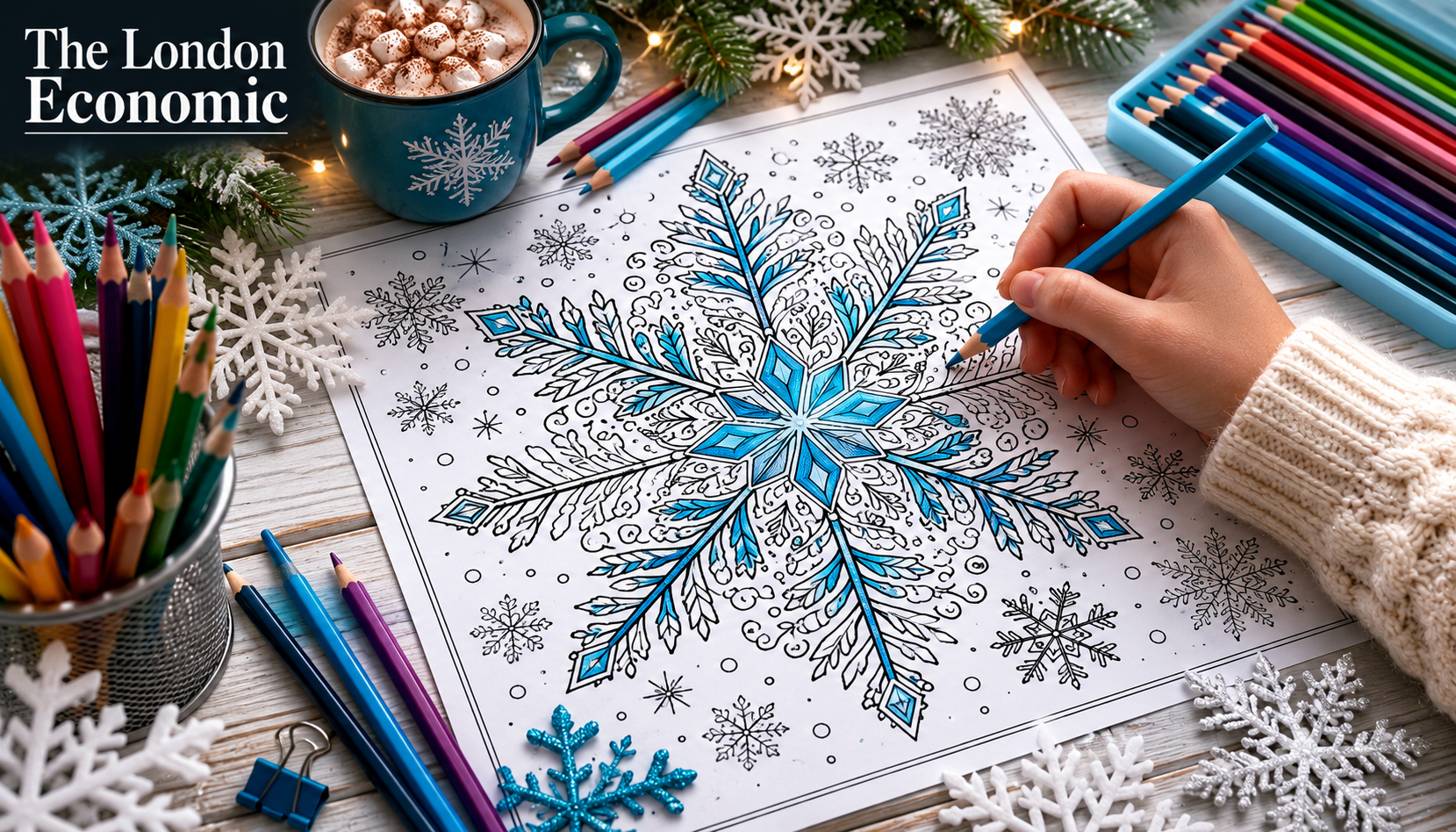
Snowflake Coloring Pages
Snowflake coloring pages are among the most searched-for printable craft resources during the winter months, and for good reason. They combine the meditative appeal of colouring with the visual complexity of one of nature’s most structurally fascinating designs. Whether you are looking for a simple outline to keep a five-year-old occupied on a rainy afternoon or a densely patterned mandala-style snowflake for adult colouring, the range of available designs has never been wider.
This guide covers everything from where to find the best free snowflake colouring pages to how they are used in classrooms, what makes a good design for different age groups, and what research says about the benefits of colouring as a regular activity for both children and adults.
What Is a Snowflake Coloring Page?
A snowflake coloring page is a printed or printable outline illustration of a snowflake intended for colouring in by hand, typically using pencils, crayons, felt-tip pens, or watercolour paints. These pages range from basic symmetrical six-pointed star designs suitable for toddlers to intricate, photorealistic renderings of ice crystal structure aimed at adult colouring enthusiasts.
The term “coloring page” uses the American English spelling because the format originates largely from American publishing and craft culture, though the activity itself is widespread across the UK and is more commonly described here as a colouring sheet or colouring page. Both spellings refer to the same thing.
The Science Behind Snowflake Symmetry
Real snowflakes have a hexagonal symmetry, meaning they display six-fold rotational symmetry: rotate a snowflake 60 degrees and it looks identical. This is a consequence of how water molecules bond as ice crystals form, locking into a hexagonal lattice structure. Wilson Bentley, an American farmer and photographer known as “Snowflake Bentley,” was the first person to photograph individual snowflakes successfully in 1885, and his thousands of photographs demonstrated that while snowflakes share the same basic symmetry, no two are perfectly identical in their branching patterns.
This natural geometry makes snowflakes ideal subjects for colouring pages. The inherent symmetry provides visual structure and balance, making even simple designs feel satisfying to complete. For children, colouring within a symmetrical outline also provides an early, informal introduction to geometric concepts.
Why Snowflake Colouring Pages Are More Valuable Than You Might Think
The colouring page is sometimes dismissed as mere entertainment, but there is a genuine body of educational and psychological evidence behind its value, particularly for children.
Cognitive and Developmental Benefits for Children
Colouring activities support several areas of child development simultaneously:
- Fine motor skills: Holding a pencil or crayon and staying within or around a design boundary strengthens the small muscles of the hand and improves hand-eye coordination. Occupational therapists frequently recommend colouring as a preparatory activity for writing.
- Colour recognition and creativity: Choosing which colours to use, experimenting with shading, and deciding how to interpret a design gives children meaningful creative decision-making practice.
- Focus and concentration: Completing a colouring page requires sustained attention, which can be a productive settling activity before school tasks or as a transition between activities.
- Geometric awareness: Snowflake designs in particular introduce concepts of symmetry, pattern, and repetition in a visual, hands-on way.
A 2018 review published in the journal Art Therapy noted that structured art activities, including colouring, help children regulate emotions and reduce anxiety. Teachers in UK primary schools have long used colouring activities as part of structured quiet time and as a component of art and design curricula.
Benefits for Adults
Adult colouring books became a significant cultural phenomenon in the mid-2010s, with titles by illustrator Johanna Basford selling millions of copies worldwide. The appeal was not nostalgia but stress relief. Research supports this. A 2005 study by psychologist Dr Gloria Macknell found measurable reductions in anxiety among adult participants who engaged in colouring mandala designs, compared to those who coloured randomly or wrote in a journal.
Snowflake designs fit naturally into this adult colouring space. Their symmetry and complexity make them well-suited to the meditative, repetitive quality that colouring enthusiasts describe as the format’s primary appeal.
Types of Snowflake Coloring Page Designs
Not all snowflake colouring pages are alike. Understanding the different categories helps you select the right design for the intended user.
Simple Outlines for Young Children (Ages 3 to 6)
These designs feature thick, clear outlines, large spaces for colouring, and minimal internal detail. A basic six-pointed snowflake with broad arms and simple geometric tips is ideal at this stage. The goal is enjoyment and motor development, not precision.
Intermediate Designs for Older Children (Ages 7 to 12)
At this level, designs can introduce more internal patterning, including smaller geometric shapes within the snowflake arms, decorative elements, and branching structures. Thin lines become manageable, and children can begin experimenting with colour gradients and tonal variation.
Complex and Mandala-Style Designs for Adults
Adult-oriented snowflake colouring pages often blur the boundary between snowflake and mandala, incorporating intricate lace-like patterns, concentric layers of detail, and fine linework that rewards hours of careful colouring. These designs are typically A4 or A3 in format for comfortable working space and are best coloured with fine-tipped pencils or gel pens.
Themed and Seasonal Variations
Some snowflake colouring pages incorporate additional seasonal elements: snowflakes framed within Christmas ornaments, combined with woodland animals, or arranged in decorative borders. These hybrid designs expand the creative scope beyond pure geometric colouring and are popular in primary school settings for display work.
Where to Find Free Snowflake Colouring Pages
Several reputable platforms offer free printable snowflake designs of good quality. Here is a practical overview of the main options:
Education and craft platforms Sites such as Twinkl, which specialises in educational resources for UK schools and parents, offer a range of snowflake colouring pages specifically aligned with Early Years and Key Stage 1 and 2 learning objectives. Many of these are free for registered users.
General printable resource sites Platforms like Super Coloring and Crayola’s official website offer extensive free libraries of snowflake designs across all difficulty levels. Crayola’s educational resources are well-regarded by teachers and include guidance on how to use colouring activities to support curriculum goals.
Adult colouring communities Pinterest functions as a significant discovery platform for adult colouring designs, with many illustrators sharing free previews or full pages from their portfolios. Reddit’s r/Coloring community regularly shares and reviews free printable pages.
Paid alternatives with free tiers Creative Fabrica and Etsy feature both free and paid snowflake colouring sheets created by independent artists. Paid options are typically higher resolution and include commercial use licences, which matters if you are printing for a classroom or community event.
Comparison: Snowflake Colouring Page Formats at a Glance
| Format | Best For | Typical Detail Level | Cost |
|---|---|---|---|
| Simple outline (A4) | Ages 3-6, quick activities | Low | Free |
| Intermediate geometric | Ages 7-12, school projects | Medium | Free to low |
| Mandala-style complex | Adults, dedicated hobbyists | High | Free to paid |
| Themed seasonal | Classroom display, events | Varies | Free to low |
| High-resolution digital | Printing at large scale | High | Paid (typically) |
How to Get the Best Results When Printing Snowflake Colouring Page
Printing quality affects the colouring experience significantly. A thin, poorly reproduced outline is harder to colour within and less rewarding to complete. A few practical steps help considerably:
- Print at 100% scale. Many browser print settings default to “fit to page,” which can shrink designs. Always print at actual size unless you specifically want a smaller version.
- Use at least 80gsm paper. Standard printer paper (typically 70-75gsm) can be flimsy and may bleed through when using felt-tip pens or watercolour. Slightly heavier paper improves the result noticeably.
- Check ink settings. For black outline pages, printing in grayscale or black-and-white only saves colour ink without any loss of quality.
- Consider card stock for display pieces. If a completed colouring is intended for display, printing on 160gsm or heavier card stock gives a more substantial, frameable result.
- Adjust printer contrast if lines appear faint. Some designs with fine linework print better with contrast increased slightly in your printer settings or image editing software.
Snowflake Colouring Pages in the Classroom
UK primary school teachers make considerable use of seasonal colouring pages as part of the winter term. Within the national curriculum, art and design at Key Stage 1 requires pupils to “use a range of materials creatively” and to “develop a wide range of art and design techniques in using colour.” Snowflake colouring pages support both objectives while also connecting naturally to science topics around weather, water cycles, and the physical properties of ice.
Cross-curricular applications include:
- Maths: Using snowflake symmetry as a concrete introduction to lines of symmetry and rotational symmetry, which appear in the Key Stage 2 maths curriculum.
- Science: Discussing why snowflakes form as part of a unit on states of matter or the water cycle.
- PSHE: Using colouring as a mindfulness activity to support emotional regulation.
Many teachers laminate completed snowflake colouring pages and use them as winter window displays, combining a craft activity with seasonal classroom decoration.
Key Takeaways
- Snowflake coloring pages suit a wide range of ages and skill levels, from simple outlines for toddlers to complex mandala-style designs for adults.
- Real snowflakes display six-fold symmetry due to the hexagonal structure of ice crystals, making them visually satisfying and geometrically rich subjects for colouring.
- Colouring has documented benefits for children including motor skill development, emotional regulation, and early geometric awareness.
- For adults, structured colouring activities reduce anxiety and provide a meditative, screen-free creative outlet.
- Free, high-quality snowflake colouring pages are available from Crayola, Twinkl, Super Coloring, and numerous independent artists on Etsy and Pinterest.
- Print at 100% scale on at least 80gsm paper for the best colouring experience.
Frequently Asked Questions
Where can I find free snowflake colouring pages to print at home? Free designs are available from Crayola’s website, Super Coloring, Twinkl (free tier for registered users), and via Pinterest. Most are available as PDF or JPG files ready to print on a standard home printer.
What age are snowflake colouring pages suitable for? Designs exist for all ages. Simple thick-outline snowflakes suit children from around age three. Intermediate designs work well for ages seven and above. Complex mandala-style snowflakes are designed for teenagers and adults who enjoy detailed colouring.
Are snowflake colouring pages useful in schools? Yes. They support art and design curriculum objectives, introduce geometric symmetry in a hands-on way, and are widely used as mindfulness or settling activities in UK primary and secondary classrooms.
Can I use snowflake colouring pages with watercolours? Yes, though standard printer paper may buckle when wet. Print on heavier card stock (160gsm or above) or watercolour paper for best results. Pencil or gel pen colouring works well on standard 80gsm paper.
What is the best paper weight for printing colouring pages? 80gsm is the practical minimum for comfortable colouring with pencils or crayons. For felt-tip pens or markers, 100gsm reduces bleed-through. For display pieces, 160gsm card stock produces the most durable result.
Are there copyright restrictions on free snowflake colouring pages? It depends on the source. Pages offered by educational platforms like Twinkl and Crayola are licensed for personal and classroom use but not for commercial redistribution. Always check the specific licence terms before sharing or reproducing designs beyond personal use.
How do I make colouring more engaging for children who lose interest quickly? Introduce a simple challenge: ask them to colour each snowflake arm using a different pattern, or challenge them to use only three colours in a creative way. Giving a framing goal, however loose, tends to extend engagement for younger children.
What colouring materials work best on printed pages? Coloured pencils offer the most control and are ideal for detailed work. Wax crayons suit younger children for bold, quick coverage. Gel pens work beautifully on clean white paper for intricate adult designs. Felt-tip pens produce vivid results but risk bleed-through on thin paper.
Conclusion
Snowflake colouring pages occupy a deceptively broad creative space. At one end sit the simplest outlines that help a three-year-old practise holding a crayon. At the other sit designs of such intricacy that they keep adult colouring enthusiasts engaged for hours. What unites them is the inherently satisfying geometry of the snowflake form and the universal, low-barrier appeal of putting colour to paper.
For parents and teachers, the case for using these resources is strengthened by genuine evidence around motor development, concentration, and emotional wellbeing. For adult hobbyists, they offer a seasonally appropriate, accessible entry point into structured creative colouring without the cost of a commercial book.
As digital screens dominate more of daily life, the appeal of a printable page and a set of pencils grows rather than diminishes. Snowflake designs, with their visual elegance and flexible complexity, are likely to remain among the most enduringly popular seasonal colouring resources available.
About the Author