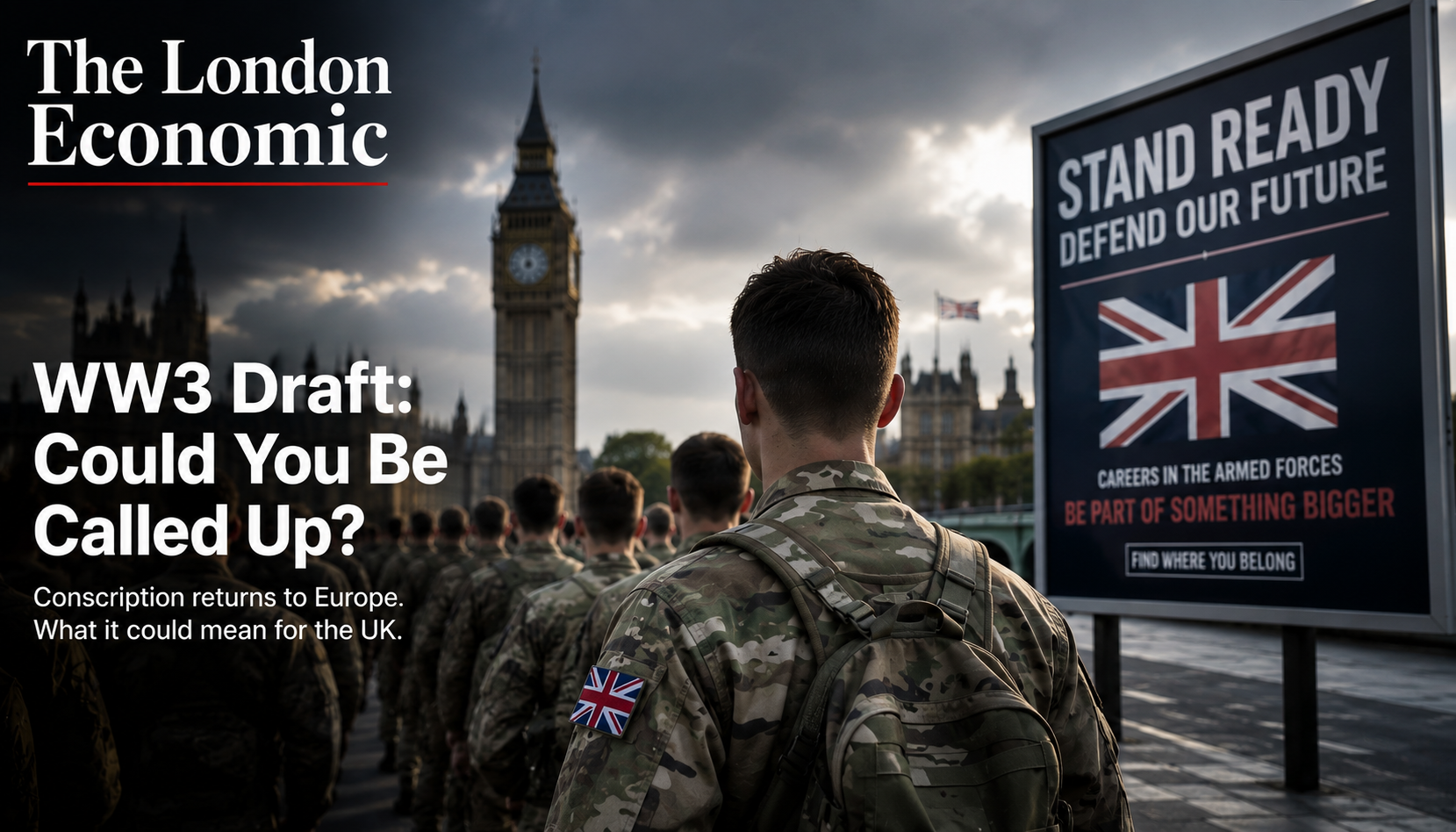
WW3 Draft
The question of whether people could be drafted into military service in the event of a major conflict has moved from theoretical concern to active public debate. As of 2026, nine European Union countries operate compulsory military conscription, a number that has grown significantly since Russia’s full-scale invasion of Ukraine in February 2022. Across the continent, governments that spent the post-Cold War decades winding down their professional armies are now rebuilding them, debating mandatory service, and, in some cases, already calling up young citizens.
The “WW3 draft” question is not a fringe concern. It reflects a genuine and rapidly shifting strategic reality in which European governments are having to confront the possibility that professional volunteer armies may be insufficient for the scale of conflict that could emerge from current geopolitical tensions. This article sets out the facts: which countries have already reintroduced conscription, where the UK currently stands, who would be most likely to be called up if a draft were implemented, and what the legal and political landscape actually looks like.
The Global Security Context: Why This Question Is Being Asked
The debate about conscription and military drafts in Europe has escalated dramatically since 2022. Russia’s full-scale invasion of Ukraine in February of that year demonstrated that large-scale, high-intensity conventional warfare had returned to the European continent for the first time since the Second World War. The conflict has consumed military equipment and personnel at rates that have strained even NATO’s largest member states.
Several developments in 2025 and 2026 have sharpened the anxiety driving searches for “WW3 draft”:
- NATO member countries agreed in 2025 to increase defence and security-related spending to 5 per cent of GDP, a significant escalation from the previous 2 per cent target.
- The Global Peace Index 2025, produced by the Institute for Economics and Peace, recorded that military expenditure as a share of GDP saw one of the largest year-on-year deteriorations among its indicators.
- European armed forces have faced persistent recruitment and retention shortfalls, with professional armies struggling to meet staffing targets even before the Ukraine war increased demand on defence resources.
- Concerns about the reliability of American security guarantees, particularly following political developments in the United States, have pushed European governments to accelerate independent rearmament.
Against this backdrop, the question of how European states would staff a larger military in the event of a significant conflict has moved from academic discussion to active policy planning.
Which European Countries Have Already Reintroduced Conscription?
The return of military conscription in Europe is not a future possibility. It is a present reality that has been expanding steadily since 2015. As of 2026, nine EU countries operate compulsory military service.
Countries With Active Compulsory Conscription
Lithuania became the first EU country to reintroduce compulsory conscription in 2015, following Russia’s annexation of Crimea in 2014. Conscripts are selected by lottery for nine-month service, while women may join voluntarily. After service, conscripts remain in the reserve for ten years, rising to fifteen years from 2026.
Sweden restored conscription in 2017 after a seven-year pause, implementing a gender-neutral system. Service terms range from nine to fifteen months, with all young Swedes potentially subject to mobilisation in a crisis under the country’s “total defence” model.
Latvia reinstated an eleven-month mandatory service for men in 2023, voluntary for women. Young Latvians can alternatively commit to five years in the National Guard with annual training.
Denmark operates a mixed conscript-volunteer system and has significantly expanded it. In 2025, Denmark extended mandatory conscription assessments to women on equal terms with men, and extended the duration of military service from four to eleven months.
Estonia, Finland, Greece, Cyprus, and Austria all maintain forms of compulsory military service, with several expanding their programmes in response to current security conditions.
Croatia voted in October 2025 to reinstate mandatory military service after a seventeen-year hiatus. From January 2026, basic military training lasting two months became mandatory for men aged nineteen to twenty-nine. Women have the option to volunteer. Croatia became the ninth EU country with a compulsory draft.
Countries Moving Toward Expanded Voluntary Service
Several major European countries have stopped short of mandatory conscription but have introduced significant new voluntary programmes:
Germany suspended compulsory conscription in 2011 but has moved to rebuild military capacity. In 2025, Germany began requiring eighteen-year-old men to complete compulsory questionnaires about their suitability for service, and plans to recruit 20,000 volunteers annually starting in 2026. Defence Minister Boris Pistorius stated that mandatory conscription would not return “in the immediate future” but the trajectory is clear.
France suspended conscription in 1997 but President Emmanuel Macron announced in November 2025 a new ten-month voluntary national service to begin by mid-2026, replacing the earlier civic service programme. Macron described it as “entirely military” and framed it around accelerating global threats.
Belgium plans to contact all eighteen-year-olds with invitations to volunteer for a twelve-month paid service, targeting 1,000 recruits by 2028, with volunteers receiving a monthly salary of approximately 2,000 euros.
Romania is launching a four-month voluntary military scheme starting in 2026 for eighteen to thirty-five-year-old men and women to replenish professional army reserves.
Poland, which ended conscription in 2009, has created a one-month basic voluntary training programme followed by an optional eleven-month specialisation, alongside plans for universal military training for all adult men.
The UK Position: No Draft, But Growing Pressure
The United Kingdom abolished conscription in 1960, and the current government’s position is that it has no plans to reintroduce it. Prime Minister Keir Starmer formally abandoned his predecessor Rishi Sunak’s proposal to reintroduce national service, which had been a Conservative Party manifesto commitment ahead of the 2024 general election. Starmer has stated publicly that “nobody is talking about conscription” in the UK context.
The Ministry of Defence confirmed in early 2026 that it has no plans to introduce conscription despite growing concern.
However, several credible voices have challenged whether the current professional-army-only model is sustainable given the strategic environment.
General Sir Patrick Sanders, a former head of the British Army, issued a warning that Britons should prepare for conscription “within six years” if the threat from Russia does not diminish. Sanders was speaking in the context of whether the UK’s professional army, which has fallen to some of its lowest recruitment levels in decades, could meet the demands of a major conflict.
Former MP and British Army officer Dr Mike Martin has stated directly: “Would we need to conscript? Yeah, we would. Because ultimately, we’re not at a stage yet where you can replace people with drones. We’re a long way off from that. Drones are fine, as far as they go, but you still need people to occupy villages, hold ground, and all the rest of it.”
The UK’s current professional army is the only NATO member army that routinely recruits individuals under eighteen. According to Ministry of Defence figures, a third of new recruits are aged eighteen or under, and around ten per cent of those who signed up between September 2024 and March 2025 were sixteen years old.
UK Army Recruitment Challenges
The British Army has faced persistent recruitment shortfalls. Recruitment and retention difficulties have been documented across the armed forces for several years, with the army failing to meet its annual intake targets consistently. This structural weakness in the professional army model is a central argument made by those who believe some form of mandatory or expanded voluntary service will eventually become necessary.
The Arms Forces (Scotland) analysis for the European Parliamentary Research Service found that conscription has “increasingly made its way back” onto European and global policy agendas since Russia’s invasion of Ukraine, and noted that even countries hesitant to reintroduce mandatory service are turning to voluntary programmes as a first step.
Who Would Be Most Likely to Be Drafted in the UK?
While there is currently no draft in the UK, the question of who would be called up if one were introduced is one of the most frequently searched aspects of this topic. Historical precedent and military logic both point toward specific groups.
Young Men Aged 18 to 30
In virtually every historical conscription model, young and physically fit men have been the primary draft pool. In 1939, men aged twenty-one and twenty-two were conscripted before war had even been formally declared. The rules subsequently changed to include men aged eighteen to forty-one. In a contemporary draft, men aged eighteen to thirty would be the most likely initial call-up group.
Single People Without Dependants
In the Second World War, people without children were drafted before those with families, to avoid disrupting family structures. This principle, while not codified in any current UK legislation, reflects a social logic that has been consistent across historical conscription models.
Women
Whether women would be conscripted in the UK remains genuinely uncertain. Women have never been drafted for direct combat roles in British history, though women aged twenty to thirty were conscripted during the Second World War for roles including nursing, munitions manufacturing, and auxiliary functions. A YouGov poll conducted in 2025 found that seventy-two per cent of Britons support women serving on frontlines, suggesting public opinion would not be a significant barrier. Denmark’s extension of conscription to women on equal terms in 2025 represents the direction of travel in comparable countries.
Former Soldiers and Reservists
People with existing military training would be among the most immediately deployable in any draft scenario. Former soldiers and reservists have skills that would be needed from the earliest stages of mobilisation, making them high-priority call-up candidates.
Exemptions That Would Likely Apply
Historical and contemporary conscription models consistently include exemptions for:
- People with serious physical or mental health conditions preventing service
- Sole carers for dependants
- Those in essential civilian roles (healthcare workers, critical infrastructure)
- Conscientious objectors (with alternative service requirements)
- Certain religious communities
The precise terms of any UK draft legislation would depend entirely on the circumstances of its introduction and the political decisions made at the time. No current UK law provides for conscription, and any reintroduction would require primary legislation through Parliament.
Public Opinion on Conscription in the UK and Europe
Public attitudes toward conscription vary significantly across Europe and are changing rapidly in response to the security environment.
In Poland, an August 2025 opinion poll reported by Euronews found that 49.1 per cent of all respondents refused to volunteer to defend the country in the event of war, with 6.1 per cent undecided. Among eighteen to twenty-nine-year-olds, the group that would face conscription first, sixty-nine per cent said they did not want to join the army.
In Germany, the reintroduction of military registration requirements for young men in 2025 prompted school strikes in December 2025 and plans for further protests in early 2026.
In the UK, polling has historically shown limited public appetite for conscription, though the picture is more nuanced when the question is framed around national defence necessity rather than general principle. The YouGov finding that seventy-two per cent of Britons support women on frontlines suggests greater openness to expanded military participation than older polling data might suggest.
The Legal Framework: How a UK Draft Would Work
The UK last operated conscription under the National Service Acts, with the final conscripts completing their service in 1963. Reintroducing conscription would require new primary legislation, as no current statutory framework exists for mandatory military service.
The process would involve:
- A government decision that voluntary recruitment is insufficient for defence requirements
- Introduction of a National Service Bill to Parliament
- Parliamentary debate and votes in both the House of Commons and House of Lords
- Royal Assent
- Implementation regulations establishing eligibility, exemptions, and enforcement
In practice, the political barriers are substantial. No major UK political party currently supports the reintroduction of conscription, and any government proposing it would face significant opposition. The more likely short-term trajectory, if professional army recruitment continues to fall short, is an expansion of reserve forces and voluntary service incentives before any mandatory element is considered.
Key Takeaways
- As of 2026, nine EU countries operate compulsory military conscription, a number that has grown steadily since Russia’s annexation of Crimea in 2014 and accelerated following the full-scale Ukraine invasion in 2022.
- Croatia became the most recent country to reintroduce mandatory service, voting in October 2025 to require two months of basic military training for men aged nineteen to twenty-nine from January 2026.
- The UK government’s current position is that there are no plans to introduce conscription. Prime Minister Keir Starmer has explicitly rejected the national service proposal put forward by the previous Conservative government.
- Senior military figures including General Sir Patrick Sanders and Dr Mike Martin have publicly stated that conscription would likely be necessary if a major conflict involving the UK were to occur.
- If a UK draft were introduced, young men aged eighteen to thirty without dependants would be the most likely initial call-up group, with former soldiers and reservists also prioritised. Whether women would be included is genuinely uncertain but increasingly plausible given European precedent.
- Any reintroduction of UK conscription would require new primary legislation through Parliament. No current legal framework exists for mandatory military service.
Frequently Asked Questions
Is there a WW3 draft in the UK right now? No. The UK has no active military draft or conscription. The Ministry of Defence confirmed in early 2026 that there are no plans to introduce one. The UK abolished national service in 1960.
Which countries in Europe already have military conscription? As of 2026, nine EU countries operate compulsory military service: Greece, Cyprus, Austria, Denmark, Estonia, Finland, Latvia, Lithuania, and Sweden. Croatia joined this group in January 2026 after voting to reinstate mandatory service in October 2025.
Could the UK introduce a draft without a world war? Yes, in theory. Conscription can be introduced by any government through parliamentary legislation without a formal declaration of war. However, in practice, no major UK political party currently supports reintroduction and the political barriers are very high.
Who would be exempt from a UK draft? Historical and contemporary models suggest exemptions would apply to people with serious health conditions, sole carers for dependants, people in critical civilian roles such as healthcare, conscientious objectors (typically required to perform alternative service), and potentially certain religious communities. The precise terms would depend entirely on the legislation introduced.
Would women be drafted in the UK? No current proposal for UK conscription includes women, and women have never been drafted for combat in British history. However, European precedent is shifting: Denmark extended mandatory conscription assessments to women in 2025, and public polling suggests majority support in the UK for women serving in frontline roles.
What did Keir Starmer say about conscription? Starmer has stated that “nobody is talking about conscription” in the UK and formally abandoned the previous Conservative government’s national service proposal after taking office. The current Labour government’s position is that professional volunteer forces are the appropriate model for the UK.
What would trigger a UK draft? A draft would most likely be considered if the UK became involved in a large-scale conventional military conflict that volunteer recruitment could not sustain, or if the threat environment deteriorated to the point where reserve force expansion was deemed insufficient. Neither condition currently exists, though senior military figures have warned they could emerge within years rather than decades if the strategic situation does not improve.
Conclusion
The WW3 draft question sits at the intersection of genuine geopolitical anxiety and very real policy change. The anxiety is understandable: the security environment in Europe has deteriorated significantly since 2022, nine EU countries already operate mandatory military service, and credible military figures in the UK have stated publicly that conscription would be necessary in a major conflict. These are not fringe concerns.
The facts, however, are also clear. The UK has no draft. The current government has no plans to introduce one, and doing so would require primary legislation through Parliament. The trajectory in comparable European countries suggests that voluntary expansion is the first step, with mandatory service typically introduced only when volunteer numbers prove wholly insufficient for the security challenge at hand. That threshold has not been reached in the UK, and the political consensus against conscription remains strong.
What has changed is the wider strategic environment that makes the question feel less hypothetical than it did even three years ago. Whether that environment continues to deteriorate, stabilises, or improves will determine whether the WW3 draft question remains a search term driven by anxiety or becomes a policy question driven by necessity.
About the Author