EasyJet Flight U2238 Emergency Landing Newcastle
On the evening of 27 October 2025, easyJet flight U2238 made an unscheduled emergency landing at Newcastle International Airport after a passenger suffered a serious medical emergency mid-flight. The aircraft, a scheduled service from Copenhagen Airport to Manchester Airport, diverted to Newcastle as the nearest suitable airport capable of providing immediate medical assistance.
EasyJet confirmed the incident with an official statement: flight EZY2238 from Copenhagen to Manchester on 27 October diverted to Newcastle due to a customer on board requiring urgent medical attention. The aircraft landed safely, the passenger received prompt medical care, and the flight subsequently continued to Manchester. No other passengers or crew members were affected.
This article provides the full verified account of what happened, how the crew and ground services responded, why Newcastle was chosen, and what this incident reveals about how commercial aviation handles in-flight medical emergencies.
What Happened on EasyJet Flight U2238?
Flight U2238, operating under the easyJet designator EZY2238, departed Copenhagen Airport on the evening of Monday 27 October 2025. The aircraft was an Airbus A320, one of the most widely used narrow-body commercial aircraft in European aviation, registered as G-EZPB. The flight was a routine scheduled service on a short European route that typically takes approximately two hours to complete.
The aircraft departed Copenhagen at around 22:13 CET, approximately 28 minutes later than its scheduled departure time of 21:45. For the first portion of the flight, everything proceeded normally. Passengers were settled, the aircraft was at cruising altitude, and the crew were carrying out standard in-flight duties.
During the cruise phase, a passenger became seriously unwell. Cabin crew identified the situation quickly and immediately responded using the medical equipment carried on board all commercial aircraft, including oxygen supplies and the emergency medical kit. The crew assessed the passenger’s condition and communicated the situation to the flight deck.
The pilots, receiving the assessment from the cabin crew, determined that the passenger required professional medical attention on the ground as quickly as possible. Continuing to Manchester, the original destination, would have extended the time before the passenger could reach hospital care. The captain made the decision to divert.
Flight tracking data records the aircraft transmitting squawk code 7700, the internationally recognised transponder code for a general emergency. This code alerts all nearby air traffic control facilities that the aircraft is declaring an emergency and requires priority handling. Air traffic control cleared the aircraft and provided immediate priority routing to Newcastle International Airport.
The aircraft landed safely at Newcastle at approximately 22:52 to 22:54 GMT, just before 11pm local time. The entire sequence from the onset of the medical emergency to landing was handled with speed and professionalism.
What Is Squawk 7700 and What Does It Mean?
The squawk code 7700 is a term that appeared in reporting around this incident and is worth explaining clearly, as it is frequently misunderstood.
Every commercial aircraft carries a transponder that communicates an identity code, known as a squawk code, to air traffic control radar. Squawk 7700 is the universal code for a general emergency, regardless of cause. When pilots dial in 7700, it immediately flags the aircraft on every air traffic control radar in the region and triggers priority handling.
Critically, squawk 7700 identifies that an urgent situation exists but does not reveal its cause. The emergency could involve a passenger requiring medical assistance, a technical issue, weather-related concerns, or another operational matter. In the case of easyJet flight U2238, the available evidence, including easyJet’s own confirmed statement, points clearly to a passenger medical emergency rather than any mechanical or structural problem with the aircraft.
The fact that the flight resumed its journey to Manchester after landing at Newcastle provides a strong indication that the diversion was not related to any technical issue with the aircraft itself. Had there been a mechanical problem requiring investigation or repair, the flight would not have been able to continue.
Why Newcastle Airport Was Chosen
The choice of Newcastle International Airport as the diversion point reflects standard aviation decision-making rather than any arbitrary selection.
When the captain decided to divert, the primary considerations were the aircraft’s position over the North Sea on approach to the UK east coast, the urgency of the passenger’s medical need, the proximity of suitable airports, and the availability of emergency services and medical facilities at those airports.
Newcastle Airport was the nearest suitable airport at the time the diversion decision was made. It has runways capable of accommodating an Airbus A320, operates around the clock with emergency services on standby, and has access to the North East Ambulance Service and nearby hospital facilities including Newcastle’s Royal Victoria Infirmary.
The geography is significant. The Copenhagen to Manchester route crosses the North Sea and approaches the UK coast in the vicinity of north-east England. At the point when the medical emergency required a diversion decision, Newcastle was closer than Manchester and could be reached more quickly. In time-critical medical situations, every minute between the onset of a serious health event and the arrival of professional medical care matters.
The Emergency Response at Newcastle Airport
When Newcastle Airport received notification of the incoming emergency, standard airport emergency protocols were activated.
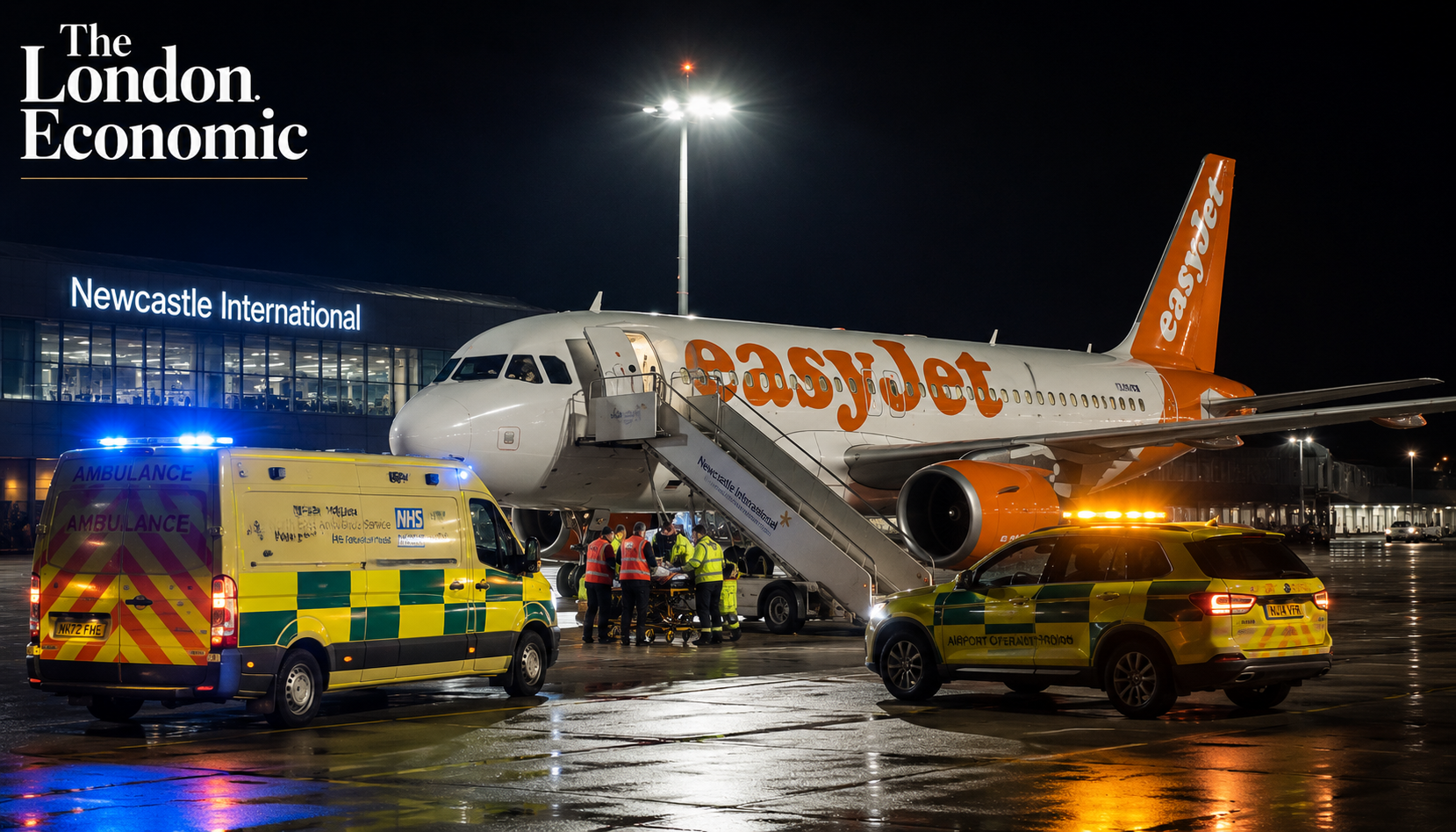
Airport emergency procedures for declared in-flight emergencies involve positioning fire and rescue services at the runway, alerting ground medical teams, coordinating with the relevant ambulance service, and clearing the runway to give the incoming aircraft priority access. These procedures are practised regularly and are designed to ensure that the aircraft can land and that medical responders are in position before the plane stops.
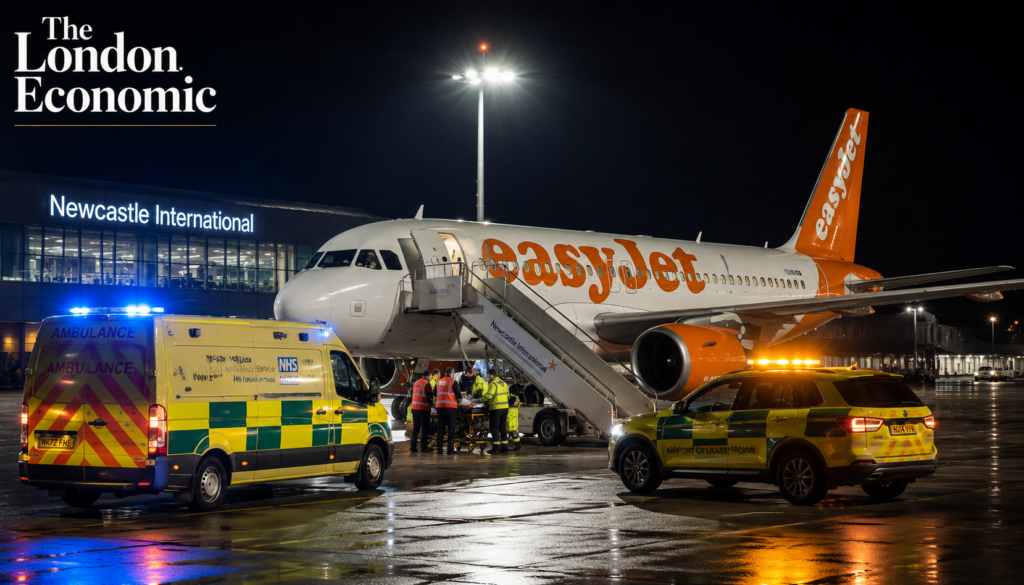
The North East Ambulance Service was on standby as the aircraft landed. Paramedics boarded the aircraft immediately upon landing and provided urgent assessment and care to the affected passenger. The passenger was subsequently transferred to medical facilities for further treatment, reported to be Newcastle’s Royal Victoria Infirmary.
Once the medical situation on the ground was resolved, the remaining passengers and crew were able to continue to Manchester. The flight departed Newcastle and reached Manchester approximately half an hour later, arriving in the early hours of 28 October 2025.
How the Cabin Crew Managed the Situation
The response of the easyJet cabin crew during this incident reflects the training that all commercial airline cabin crew receive as a regulatory requirement under UK and European Union Aviation Safety Agency standards.
Commercial aircraft cabins are equipped with emergency medical kits, oxygen supplies, and automated external defibrillators, commonly known as AEDs. Cabin crew are trained in first aid, cardiopulmonary resuscitation, the use of AEDs, and the administration of supplementary oxygen. They are also trained to recognise a range of medical symptoms, communicate effectively with the flight deck, and coordinate assistance from any medically qualified passengers who may be travelling.
During the flight U2238 incident, the cabin crew responded to the passenger’s condition, administered available medical support, kept the pilots informed, and maintained a calm environment for the remaining passengers. Passenger accounts from the flight noted that the crew communicated clearly and provided reassurance throughout the diversion, which is a significant contributor to managing the anxiety that an unexpected landing naturally creates among other travellers.
The pilots, meanwhile, were required to make a rapid and well-reasoned judgement call under pressure: assess the severity of the situation, identify the nearest suitable airport, communicate with air traffic control, and execute the diversion safely. The smooth handling of the entire sequence from in-air declaration to safe landing is consistent with the training standards maintained by easyJet and required by aviation regulators.
How Common Are In-Flight Medical Emergencies?
The easyJet flight U2238 incident is notable partly because it became widely discussed, but it is worth placing in the broader context of commercial aviation.
Medical emergencies occur on approximately one in every 604 commercial flights. Of those in-flight medical emergencies, roughly ten per cent result in a diversion to an unscheduled airport. In 2024, more than 12,000 diversions were recorded globally across commercial aviation, averaging more than thirty per day.
This means that while an emergency diversion is an unusual event for any individual passenger, it is a routine part of aviation safety operations at a network level. Airlines, airports, and air traffic control systems are prepared for them. The procedures that were activated during easyJet flight U2238’s diversion to Newcastle are practised and refined continuously.
The broader aviation safety picture is also worth noting. Commercial aviation in Europe operates under some of the most rigorous safety regulatory frameworks in the world, overseen by the UK Civil Aviation Authority and the European Union Aviation Safety Agency. EasyJet operates under both regulatory frameworks. The airline has maintained a strong safety record across its decades of operation.
What Passengers Should Know About Flight Diversions
For any passenger who has experienced or is concerned about an in-flight diversion, understanding how these situations work practically can reduce anxiety and help people make informed decisions.
Your rights during a diversion
Under UK aviation consumer regulations, passengers whose flight is diverted are entitled to care and assistance from the airline, including meals, refreshments, and accommodation where relevant. If the diversion causes you to miss a connecting flight or prevents you from reaching your final destination by a reasonable time, you may be entitled to rerouting or refund depending on the circumstances.
Travel insurance policies typically cover costs arising from flight diversions, including meals, accommodation, and alternative transportation to your final destination. Checking the specific terms of your policy before travelling is always advisable.
Staying calm during a diversion
Emergency landings and diversions can feel frightening, but the statistical reality of commercial aviation is that declared emergencies almost always result in safe landings. The easyJet flight U2238 incident is itself illustrative: a declaration of general emergency, a diversion to an unscheduled airport, a safe landing, rapid medical response, and continuation of the journey. No drama, no disaster.
Cabin crew instructions during any unusual event should be followed immediately and without hesitation. Their training is specifically designed to manage these situations, and their calm authority during a diversion is not performance. It is the product of extensive preparation.
The Significance of the Incident
The easyJet flight U2238 emergency landing at Newcastle was not an aviation failure. It was aviation safety working precisely as it is designed to.
The captain identified a time-critical medical situation, made a swift and correct decision to divert, communicated effectively with air traffic control, and landed safely. The cabin crew provided in-flight medical support and maintained calm. The airport activated its emergency protocols. The ambulance service was on the ground before the aircraft stopped. The passenger received hospital care quickly. The flight continued.
Every element of that sequence reflects the layered safety systems that underpin commercial aviation. The incident attracted widespread attention partly because it was reported prominently online in late 2025, and partly because the outcome was entirely positive. It stands as an example of the aviation industry’s fundamental principle: when something unexpected happens, the system responds, and passengers reach safety.
Key Takeaways
- EasyJet flight U2238, operating as EZY2238 from Copenhagen to Manchester on 27 October 2025, made an emergency diversion to Newcastle International Airport due to a passenger medical emergency.
- The aircraft was an Airbus A320 registered as G-EZPB. It departed Copenhagen at approximately 22:13 CET and landed at Newcastle at approximately 22:52 to 22:54 GMT.
- EasyJet confirmed the incident officially: flight EZY2238 from Copenhagen to Manchester on 27 October diverted to Newcastle due to a customer on board requiring urgent medical attention.
- The aircraft transmitted squawk code 7700, the universal general emergency transponder code, which gave the flight priority handling from air traffic control.
- There is no credible evidence of any mechanical or structural issue with the aircraft. The fact that the flight resumed to Manchester after landing at Newcastle strongly supports the conclusion that the diversion was caused entirely by the passenger medical emergency.
- The North East Ambulance Service met the aircraft on the ground. The affected passenger was taken to the Royal Victoria Infirmary in Newcastle for further treatment.
- The remaining passengers and crew continued to Manchester approximately half an hour after landing at Newcastle.
- Medical emergencies occur on approximately one in 604 commercial flights. Approximately ten per cent of in-flight medical emergencies result in a diversion. The response to easyJet flight U2238 reflects standard, well-practised aviation safety protocols.
Frequently Asked Questions
What happened on easyJet flight U2238?
EasyJet flight U2238, operating from Copenhagen to Manchester on 27 October 2025, diverted to Newcastle International Airport because a passenger suffered a serious medical emergency during the flight. The captain declared a general emergency, the aircraft landed safely at Newcastle at approximately 22:52 GMT, and the passenger was transferred to hospital. The flight subsequently continued to Manchester.
What caused the emergency landing at Newcastle?
EasyJet confirmed that the diversion was caused by a customer on board requiring urgent medical attention. There is no credible evidence of any technical or mechanical problem with the aircraft. The flight resumed its journey to Manchester after the medical situation was resolved on the ground.
What is squawk code 7700?
Squawk 7700 is the internationally recognised transponder code for a general aviation emergency. When pilots dial this code, it immediately alerts all nearby air traffic control facilities that the aircraft requires priority handling. The code signals that an urgent situation exists but does not specify the cause. In the case of easyJet flight U2238, the emergency was a passenger medical situation rather than a technical fault.
Why did the flight land at Newcastle rather than Manchester?
Newcastle was the nearest suitable airport at the point when the diversion decision was made. The Copenhagen to Manchester route crosses the North Sea and approaches the UK via the north-east coast. Newcastle International Airport had the runway capacity, emergency services, and proximity to medical facilities required to handle the situation quickly. Continuing to Manchester would have delayed the passenger’s access to professional medical care.
Was anyone seriously injured on easyJet flight U2238?
The passenger who required urgent medical attention was transferred to Newcastle’s Royal Victoria Infirmary for further treatment. Reports indicate no life-threatening conditions were confirmed following the incident. No other passengers or crew members were reported as affected.
Did the rest of the passengers make it to Manchester?
Yes. After the affected passenger was transferred to medical care on the ground at Newcastle, the remaining passengers and crew continued to Manchester. The onward flight from Newcastle took approximately half an hour, arriving in the early hours of 28 October 2025.
How common are emergency landings caused by medical emergencies?
Medical emergencies occur on approximately one in every 604 commercial flights. Roughly ten per cent of those result in a diversion to an unscheduled airport. More than 12,000 flight diversions were recorded globally in 2024, averaging over thirty per day. In-flight medical diversions are unusual for individual passengers but are a routine part of aviation safety operations at network level.
What are passengers entitled to if their flight is diverted?
Under UK aviation consumer regulations, passengers whose flight is diverted are entitled to care and assistance from the airline, including meals and refreshments. Where a diversion causes passengers to miss a connection or prevents them reaching their destination by a reasonable time, rerouting or refund entitlements may apply. Travel insurance policies typically cover costs arising from diversions. Checking your specific policy before travelling is recommended.
Conclusion
The easyJet flight U2238 emergency landing at Newcastle on 27 October 2025 was a medical emergency handled with the efficiency, professionalism, and speed that commercial aviation’s safety systems are designed to deliver.
A passenger fell seriously ill mid-flight on a routine Copenhagen to Manchester service. The cabin crew responded immediately, the captain made a swift and correct decision to divert, squawk 7700 gave the flight priority handling from air traffic control, and Newcastle Airport’s emergency services were in position before the aircraft stopped. The passenger received hospital care. The remaining passengers continued to their destination. The aircraft resumed service.
This outcome is not fortunate. It is the intended result of years of crew training, rigorously maintained aircraft equipment, continuously practised airport emergency protocols, and a coordinated safety system that exists specifically for moments when the unexpected happens at altitude.
For anyone reading about this incident with concern about flying, the appropriate response is the opposite of alarm. The easyJet flight U2238 emergency landing at Newcastle is evidence that the system works. When a passenger needed help quickly, every part of the network designed to provide that help responded, and the outcome was safe for everyone on board.
About the Author