The Winter War Movie
The Winter War movie is one of the most remarkable war films ever made in Europe, and one of the least seen outside its home country. Known in Finnish as Talvisota, it was released in 1989 to mark the fiftieth anniversary of Finland’s fight for survival against the Soviet Union, and it remains the definitive cinematic account of a conflict that reshaped northern Europe yet rarely features in mainstream Western film or television.
If you have heard the name mentioned in discussions of the greatest war films ever committed to screen, or encountered it through renewed global interest in Finland following its 2023 NATO accession, this guide covers everything you need to know: what the film is about, who made it, how it stands up critically and historically, and why it deserves a place alongside the war cinema that Western audiences tend to celebrate most loudly.
What Is The Winter War Movie?
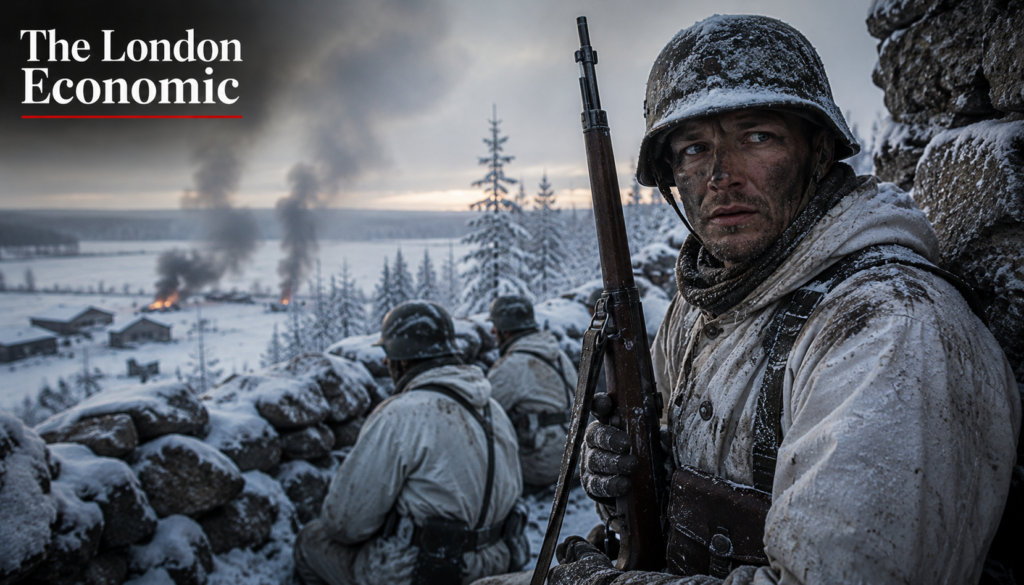
The Winter War, known by its original Finnish title Talvisota, is a 1989 Finnish war film directed by Pekka Parikka. It is based on the 1984 novel Talvisota by Antti Tuuri and tells the story of a Finnish infantry regiment from Southern Ostrobothnia fighting on the Karelian Isthmus. The film focuses on a platoon of reservists from the municipality of Kauhava.
It was released in Finland on 30 November 1989, the fiftieth anniversary of the beginning of the Winter War itself. It became Finland’s most popular film with over 600,000 admissions. It won six Jussi Awards, Finland’s premier film honours, and was Finland’s entry for Best Foreign Language Film at the 63rd Academy Awards, though it was not accepted as a nominee.
Talvisota was the most expensive Finnish film ever made at the time of its production. Its production company, National-Filmi Oy, subsequently went bankrupt because the international success it had hoped for did not materialise.
Despite that commercial disappointment outside Finland, the film has built a devoted international following through home video, streaming, and the recommendation of war film enthusiasts. Its reputation among those who have seen it is quietly formidable.
What Is The Film About? The Plot Explained
The film’s story is rooted in the ground-level experience of ordinary Finnish men called to fight an extraordinary conflict.
On 13 October 1939, reservists of the Finnish Army are called up for active duty as the threat of Soviet invasion becomes imminent. Two farmer brothers from Kauhava, Martti and Paavo Hakala, join other men from the municipality in a half-platoon under the command of Second Lieutenant Jussi Kantola.
The group travels by train to Seinäjoki to join the rest of the Finnish Army’s 23rd Regiment under the command of Lieutenant-Colonel Matti Laurila. After some training, the regiment deploys to the Karelian Isthmus, where Kantola’s men help civilians evacuate a village in the potential war zone. After marching to the Taipale River, they help build defences in preparation for the anticipated Soviet attack.
The battle begins on 6 December, Finnish Independence Day, when the Finns are shelled by Soviet artillery. The Red Army launches a human wave attack supported by T-26 tanks, but the Finns hold them back. Paavo is wounded and sent home, where he attends the funeral of four Kauhava men. He recovers and returns to the front, but is soon killed by a direct Soviet artillery hit in front of his brother Martti. Several times the Soviets attack and enter the Finnish trenches, but the Finns manage to push them back.
The film’s emotional architecture is built around this relationship between the brothers, the steady attrition of the men around them, and the psychological weight of fighting an enemy that outnumbers them at every turn. It does not resolve into heroism or victory in the Hollywood sense. It ends with the survivors exhausted, diminished, and carrying the dead with them into an uncertain peace.
The Historical Background: What Was the Winter War?
To understand the film fully, some historical context helps enormously.
The Soviet Union invaded Finland in November 1939 when the Finns refused Stalin’s demands to relinquish territory in Karelia. The Finns were outnumbered approximately fifty to one but fought with extraordinary courage and tenacity, inflicting what is estimated at around half a million casualties on the Soviets before they were finally forced to capitulate in March 1940.
The conflict lasted 105 days. Finland lost approximately 25,000 men and was forced to cede significant territory, including the Karelian Isthmus, but retained its independence. The Soviet Union’s catastrophically poor performance in the early stages of the war, despite its enormous numerical superiority, contributed directly to Adolf Hitler’s decision to invade the USSR in June 1941, believing the Red Army to be a weakened and poorly led force.
This is a conflict with enormous implications for European and global history, and yet it receives almost no representation in mainstream Western cinema. Talvisota remains the primary cinematic account of what happened.
Director and Cast: Who Made The Winter War?
The film was directed by Pekka Parikka, who also co-wrote the screenplay based on Antti Tuuri’s 1984 novel. Parikka was nominated for the Golden Bear at the 40th Berlin International Film Festival in 1990 for his work on the film.
The two brothers at the centre of the story are played by real-life brothers Taneli Mäkelä and Konsta Mäkelä. Vesa Vierikko plays Second Lieutenant Jussi Kantola. The film features a large ensemble cast of Finnish actors, many of whom have since become well-known names in Finnish cinema and television.
The casting of genuine brothers in the roles of Martti and Paavo adds a layer of authenticity to the central relationship that permeates the film’s emotional core. The chemistry between the two requires no fabrication.
The film also benefits from considerable technical authenticity. The filmmakers had access to correct period equipment and gear, including original Soviet T-26 tanks captured by the Finns during the Continuation War of 1941 to 1944, several of which remain in working condition in Finnish museums.
Critical Reception: How Good Is Talvisota?
The film holds a 7.6 out of 10 on IMDb based on substantial audience ratings, which reflects the divided but broadly positive response it generates across different viewers.
Among war film enthusiasts, its reputation is significantly higher than that score suggests. It is frequently cited in discussions of the most realistic war films ever made, alongside works like Das Boot, Come and See, and Stalingrad.
One of the most consistent observations from viewers is that it presents the absolute horror of war and the desperation felt by those men forced to face combat without the softening that characterises much American war cinema. The film shows Finns pinned down in dirt and constant fear of death, while Russians are mowed down in large numbers by defenders fighting for their survival.
The realism extends to the geography itself. Talvisota’s battle landscapes were chosen to depict historical locations with considerable accuracy. A viewer who compares the battle map of the historical Battle of Äyräpää with the film’s final sequences will find the troops fighting and moving through similar geographical landscapes. The one significant compromise to realism was the atypically warm winter during filming in 1988, which means the frozen conditions of the actual war, where temperatures fell to minus forty degrees Celsius in places, are not fully captured on screen.
Critical opinion is not unanimous in its praise. Some reviewers note that the large ensemble cast can make individual soldiers difficult to distinguish from one another in the film’s lengthy middle section, and that the enemy is largely portrayed as a faceless mass rather than individuals with their own perspective. These are fair observations. The film’s approach is resolutely one-sided, by design, placing viewers exclusively within the Finnish experience.
One assessment positions it alongside the German film Stalingrad and the French film Capitaine Conan as examples of European war cinema that achieve something American productions rarely approach: the presentation of war without falsification, without imposed heroic narrative structures, and without the genre conventions that tend to insulate audiences from genuine discomfort.
The Two Versions: Which Cut Should You Watch?
This is a practical question that matters significantly for new viewers.
The film exists in two distinct versions. The Finnish theatrical version runs at 195 minutes. The abridged international cut, which was released on VHS and DVD in various non-Finnish countries, is considerably shorter. The Finnish theatrical version had a 4K digital restoration in 2013 and has since been released on Finnish DVD, Blu-ray in Finland, Germany, and Japan, and is available for streaming internationally.
The strong consensus among viewers who have seen both is that the full-length Finnish version is the one to seek out. The international cut removes scenes that provide crucial character context and diminish the cumulative weight of the film’s losses. The three-hour-plus running time is not padding. It is the point. The duration mirrors the experience of the men it depicts: the waiting, the brief moments of normalcy, the sudden violence, and the returning stillness afterwards.
Why The Winter War Movie Matters in 2026
The question of why this thirty-five-year-old Finnish film is worth discussing in 2026 has a clear answer that goes beyond cinephile interest.
Finland joined NATO in April 2023 after decades of deliberate neutrality, a decision driven directly by Russia’s full-scale invasion of Ukraine in February 2022. For Finnish society, the decision was freighted with historical memory. The Winter War of 1939 to 1940, and the Continuation War that followed it from 1941 to 1944, are not distant academic history in Finland. They are living cultural memory, close enough that many Finnish families still have direct generational connections to those who fought.
Talvisota, released on the fiftieth anniversary of the conflict’s beginning, was explicitly intended as an act of collective memory and tribute. Dedicated to the Finns who fought in the Winter War, it serves a function that goes beyond entertainment. It is a record, in the most visceral cinematic terms available, of what that fight cost and what it meant.
For international audiences in 2026, with Finland now a NATO member and the geopolitical tensions of Europe once again urgent, the film offers context that is genuinely illuminating. It explains, better than most written accounts, why Finnish society regards Russian military aggression with a particular clarity born from direct experience.
Talvisota Compared With Other European War Films
| Film | Country | Year | Subject | Tone |
|---|---|---|---|---|
| Talvisota (The Winter War) | Finland | 1989 | Russo-Finnish War 1939 | Unflinching realism, no heroism |
| Das Boot | Germany | 1981 | U-boat warfare, WWII | Claustrophobic, psychological |
| Come and See | Soviet Union | 1985 | Nazi occupation of Belarus | Hallucinatory, traumatic |
| Stalingrad | Germany | 1993 | Battle of Stalingrad | Brutal, anti-war |
| Capitaine Conan | France | 1996 | WWI Balkan theatre | Moral ambiguity, aftermath |
Talvisota belongs firmly in this company. It shares with these films a commitment to depicting war as it is experienced by the people caught inside it, rather than as a narrative framework through which heroism and sacrifice are given meaning.
Where to Watch The Winter War Movie
The Winter War is available for international streaming, with the 4K restored version accessible on various platforms. The Blu-ray release is available in Finland, Germany, and Japan. International viewers should seek the full Finnish version rather than the abridged international cut wherever possible.
Availability on UK streaming services changes regularly, so checking current platforms at the time of reading is recommended. The film has been carried by various European streaming services and is accessible through import physical media.
Key Takeaways
- The Winter War movie, originally titled Talvisota, is a 1989 Finnish war film directed by Pekka Parikka and based on Antti Tuuri’s 1984 novel of the same name.
- It tells the story of a platoon of Finnish reservists from Kauhava fighting on the Karelian Isthmus during the Soviet invasion of Finland in November 1939 to March 1940.
- The film was released on 30 November 1989, the fiftieth anniversary of the conflict’s beginning, and became Finland’s most popular film with over 600,000 admissions.
- It won six Jussi Awards, Finland’s premier film honours, and was nominated for the Golden Bear at the 40th Berlin International Film Festival in 1990.
- It was Finland’s submission for Best Foreign Language Film at the 63rd Academy Awards but was not accepted as a nominee.
- Two versions exist: the full Finnish cut of approximately 195 minutes and a shorter international cut. The full version is strongly recommended.
- The film holds an IMDB rating of 7.6 and is widely regarded among war film enthusiasts as one of the most realistic and emotionally honest war films ever made.
- Its relevance has grown in 2026 given Finland’s NATO membership and renewed global attention to Russian military conduct in Europe.
Frequently Asked Questions
What is The Winter War movie about?
It follows a platoon of Finnish army reservists from the municipality of Kauhava as they are called up, deployed to the Karelian Isthmus, and fight the Soviet invasion of Finland from November 1939 to March 1940. The story centres on two brothers, Martti and Paavo Hakala, and the men alongside them as the conflict grinds on.
What is the Finnish title of The Winter War movie?
The original Finnish title is Talvisota, which translates directly as The Winter War. The film is often referred to by both names internationally.
Who directed The Winter War 1989 film?
The film was directed by Pekka Parikka, who also co-wrote the screenplay. He was nominated for the Golden Bear at the 40th Berlin International Film Festival in 1990 for the film.
Is The Winter War movie historically accurate?
It is considered one of the more historically accurate war films made. The battle locations were chosen to reflect the actual geography of the conflict, and period-correct equipment including original captured Soviet T-26 tanks was used in production. The one notable limitation is that the atypically warm winter during filming meant the extreme cold of the actual conflict is not fully conveyed.
How long is The Winter War movie?
The full Finnish theatrical version runs at approximately 195 minutes. An abridged international cut exists but is significantly shorter and omits important scenes. Most viewers strongly recommend the full version.
Where can I watch Talvisota in the UK?
The film is available on international streaming platforms and via import Blu-ray. Availability changes, so checking current UK streaming catalogues is recommended. The 4K restored version is the best available edition.
Was The Winter War movie nominated for an Academy Award?
It was Finland’s submission for Best Foreign Language Film at the 63rd Academy Awards in 1991 but was not accepted as a nominee. It did win six Jussi Awards, Finland’s national film awards.
How does The Winter War compare with Saving Private Ryan?
They are stylistically very different films. Saving Private Ryan uses the chaos of combat as a framework for exploring American military heroism. Talvisota is less interested in heroism as a concept and more concerned with the experience of ordinary men fighting overwhelming odds with inadequate resources. Many viewers who have seen both regard Talvisota as the more honest and emotionally demanding of the two.
Conclusion
The Winter War movie occupies a unique position in the history of war cinema. Made with unprecedented ambition for Finnish film production, released on the fiftieth anniversary of the conflict it depicts, and carrying a dedication to those who actually fought, Talvisota is simultaneously a piece of national memory and a genuinely exceptional work of cinema.
Its relative obscurity outside Scandinavia is partly a function of language and distribution, and partly a reflection of how little the world has paid attention to Finland’s extraordinary military history. But that obscurity is no longer a good reason to avoid it. The film is more available than at any previous point, its historical subject matter carries fresh and urgent relevance in the context of European security in 2026, and its quality stands comparison with the most celebrated war films in the European tradition.
Viewers who approach it expecting the conventions of mainstream English-language war cinema will need to adjust their expectations. Talvisota does not provide resolution, catharsis, or a satisfying arc of heroism. What it provides instead is something considerably harder to achieve and more valuable to have: the sense of what it actually felt like to be there.
That is what the greatest war films do. By that measure, Talvisota earns its place among them.
About the Author