Cacio e Pepe Arancini
Cacio e pepe arancini are exactly what they sound like and considerably more than you might expect. They take two of Rome’s most iconic culinary traditions, the sharp, peppery pasta sauce cacio e pepe and the Sicilian fried rice ball arancini, and combine them into a single dish that is simultaneously faithful to both and greater than either on its own.
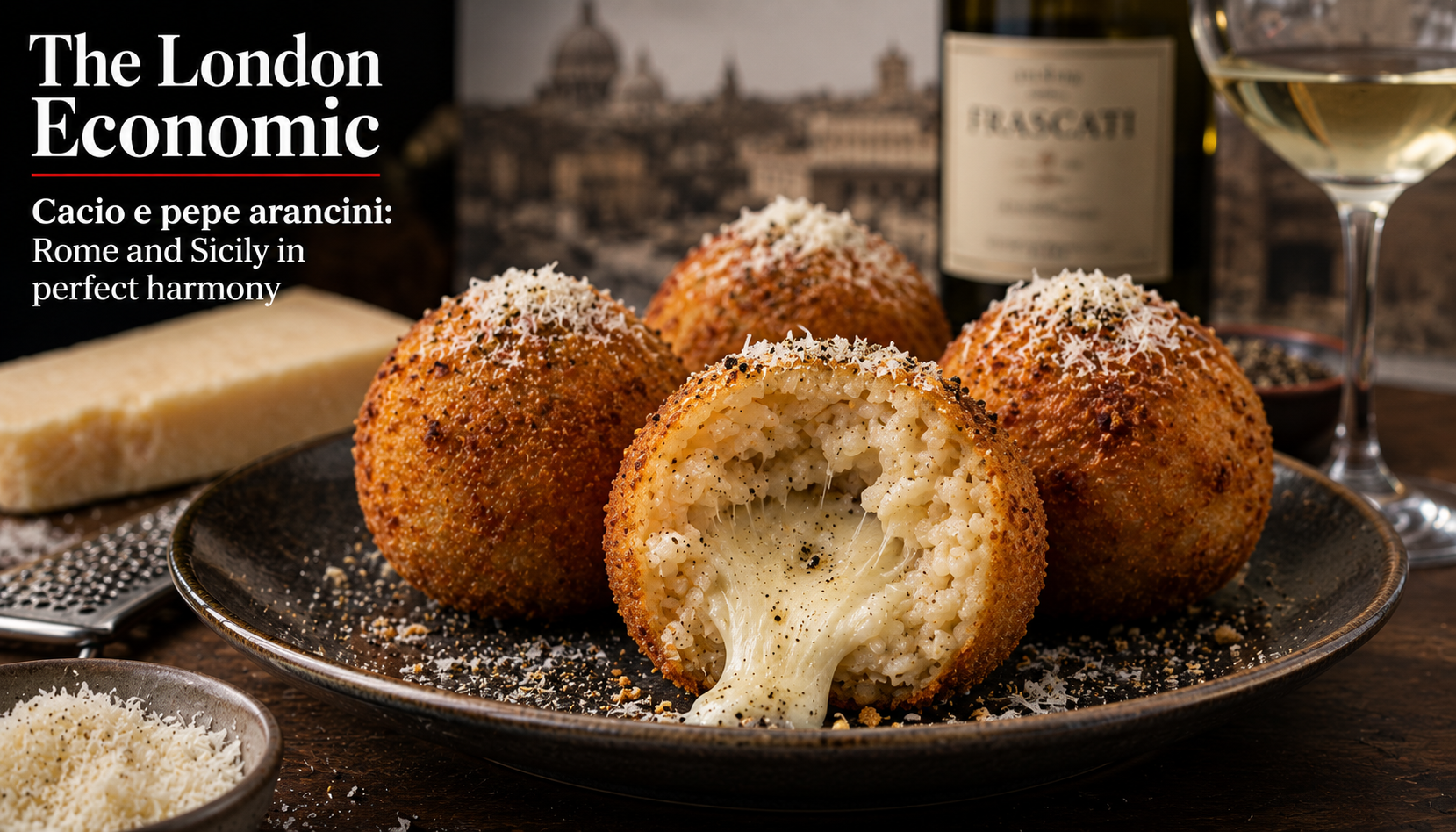
The result is a golden, crisp-shelled rice ball with a molten interior of starchy, peppery rice bound with Pecorino Romano and black pepper: the precise flavour profile of cacio e pepe pasta but in an entirely different form. It has become one of the more compelling examples of within-Italian culinary fusion to appear on restaurant menus across London, New York, and Rome itself in recent years, appearing everywhere from casual aperitivo bars to Michelin-recognised trattorias.
This guide covers everything: the cultural background of both component dishes, the technique that makes the fusion work, a complete step-by-step recipe, the most common failure points and how to avoid them, and the variations worth exploring once you have mastered the base version.
The Two Traditions: Understanding the Components
Cacio e Pepe: Rome’s Most Deceptively Simple Pasta
Cacio e pepe is one of the four canonical Roman pasta dishes, alongside carbonara, amatriciana, and gricia. Its name translates directly as “cheese and pepper,” and its ingredient list is equally unsparing in its brevity: pasta, Pecorino Romano, and black pepper. No cream, no butter beyond a trace amount used by some cooks, no stock, no garlic.
The dish is believed to have originated as sustenance for Roman shepherds, who carried dried pasta, hard aged cheese, and black pepper on long transhumance journeys because these ingredients preserved well without refrigeration. The technique involves creating an emulsified sauce from pasta cooking water and finely grated cheese, with freshly cracked black pepper providing both heat and aromatics.
The apparent simplicity is profoundly misleading. Getting cacio e pepe right demands precise temperature control, exact pasta water starch concentration, and the correct ratio of cheese to liquid. Too much heat and the cheese seizes into clumps. Too little starch and the sauce breaks and turns grainy. The dish has an almost binary quality: it is either perfect or it has failed, with very little middle ground.
Pecorino Romano, the correct cheese for authentic cacio e pepe, is a hard, salted sheep’s milk cheese with Protected Designation of Origin (PDO) status. It is produced primarily in Lazio, Sardinia, and Tuscany, and has a sharper, more intense flavour than Parmigiano-Reggiano, which some home cooks substitute partially to moderate the saltiness.
Arancini: Sicily’s Golden Rice Balls
Arancini are stuffed, breaded, and fried rice balls originating in Sicily, where they have been a staple of street food culture for over a thousand years. The name derives from the Italian word for orange, “arancia,” reflecting both the golden colour and roughly spherical shape of the classic version.
Their origins are traced to Arab rule in Sicily during the ninth and tenth centuries, when the practice of eating saffron-scented rice and meat together was introduced to the island. The rice ball format allowed the dish to be eaten without cutlery, making it practical for markets and public spaces. Over subsequent centuries, arancini developed into a defined Sicilian tradition with significant regional variation in both shape and filling.
Traditional fillings include ragu with tomato sauce and peas (the most widely recognised version), mozzarella and ham (known as arancini al burro), and various local specialities involving spinach, mushrooms, and aubergine. The classic arancino is substantially larger than the bite-sized versions now common in aperitivo culture, often weighing 150 to 200 grams as a satisfying standalone snack.
Arancini are made using risotto rice cooked to a slightly denser consistency than table risotto, formed around the filling, coated in breadcrumbs, and deep-fried until golden. The starchy Arborio or Carnaroli rice used holds together reliably during frying and provides the characteristic dense, slightly chewy interior that contrasts with the crisp exterior.
It is worth noting a naming convention: in eastern Sicily, including Catania and Messina, the rice balls are called “arancino” (masculine) and are typically cone-shaped. In Palermo and western Sicily, they are called “arancina” (feminine) and are usually round. The distinction is a source of ongoing, good-natured regional debate in Sicily that has no correct resolution.
Why Cacio e Pepe Arancini Work So Well
The combination succeeds for reasons that are culinary rather than merely novelty.
The core challenge of cacio e pepe is the emulsified sauce: achieving a smooth, cohesive coating that requires precise temperature and ratio control. When you incorporate the cacio e pepe flavour profile into arancini, you sidestep the emulsification challenge entirely. The rice itself binds the cheese and pepper without the need for the sauce to emulsify on the plate. The starch in the rice performs a similar function to pasta cooking water starch, but with far greater structural stability.
The result is a dish in which the cacio e pepe flavour is, paradoxically, more reliably achievable than in the pasta itself, because the technical demands are reduced rather than increased. The Pecorino Romano and black pepper come through clearly in every bite, amplified by the richness of the fried exterior, without the risk of a broken sauce.
The textural contrast also adds something that the pasta version lacks. Cacio e pepe pasta is soft throughout. The arancini version adds a crisp, fried shell, a creamy molten interior, and the slight chew of the rice, creating multiple textural layers that make each bite more complex.
The Complete Recipe: Cacio e Pepe Arancini
This recipe makes approximately 16 arancini of bite-sized to medium proportions, suitable for an aperitivo spread or a starter for four to six people.
Ingredients
For the cacio e pepe rice:
- 300g Arborio or Carnaroli rice
- 1 litre good-quality chicken or vegetable stock, kept hot
- 150ml dry white wine
- 1 small white onion, very finely diced
- 2 tablespoons unsalted butter
- 150g Pecorino Romano, very finely grated (microplane preferred)
- 30g Parmigiano-Reggiano, very finely grated
- 2 teaspoons coarsely ground black pepper, plus more to taste
- 1 teaspoon fine black pepper
- 1 tablespoon olive oil
- Salt to taste, used sparingly given the saltiness of Pecorino Romano
For the breading:
- 100g plain flour, seasoned with salt and black pepper
- 3 large eggs, beaten
- 200g fine dried breadcrumbs (panko works well but traditional fine breadcrumbs give a slightly tighter crust)
For frying:
- Sunflower oil or a neutral vegetable oil with a high smoke point, enough for deep frying (approximately 1.5 litres for a medium saucepan)
Method
Step 1: Make the Cacio e Pepe Risotto Base
Heat the olive oil and one tablespoon of the butter in a wide, heavy-bottomed pan over a medium heat. Add the onion and cook gently for eight to ten minutes until completely soft and translucent but not coloured.
Add the rice and stir to coat in the fat, cooking for two minutes until the edges of the grains become slightly translucent. Add the white wine and stir continuously until it has been fully absorbed.
Begin adding the hot stock one ladle at a time, stirring frequently and allowing each addition to be mostly absorbed before adding the next. This process takes approximately eighteen to twenty minutes. The rice should be cooked through but retain a very slight bite, and the mixture should be slightly drier than a standard risotto because you need it to hold its shape when cold.
Remove from the heat. Add the remaining tablespoon of butter, all the Pecorino Romano, and all the Parmigiano-Reggiano. Stir vigorously until the cheese is fully incorporated. Add both quantities of black pepper and stir again. Taste carefully for seasoning, remembering that Pecorino Romano is already very salty.
Spread the risotto across a large tray or baking sheet in an even layer approximately 2cm thick. Cover with cling film pressed directly against the surface to prevent a skin forming. Refrigerate for a minimum of two hours and ideally overnight. The mixture must be cold and firm to form properly.
Step 2: Shape the Arancini
With damp hands, take a portion of the cold rice mixture, approximately 50 to 60 grams for bite-sized arancini. Compress it firmly in your palm, then roll into a tight ball. The key is compression: press firmly and repeatedly to ensure there are no air pockets that could cause the arancini to crack during frying.
Place on a lined tray and repeat until all the mixture is used. If the mixture is not holding together well, return to the refrigerator for thirty minutes and try again.
Step 3: Bread the Arancini
Set up a three-stage breading station: seasoned flour in one shallow bowl, beaten eggs in a second, and breadcrumbs in a third.
Roll each rice ball first in the flour, shaking off any excess. Transfer to the egg and turn to coat completely. Move to the breadcrumbs and press gently to adhere an even, thorough coating. Place on a clean tray.
For extra crispness and structural integrity, repeat the egg and breadcrumb stages for a double coating. This is particularly recommended if the arancini will be transported or need to sit before frying.
Refrigerate the breaded arancini for at least thirty minutes before frying. Cold arancini hold together better and fry more evenly.
Step 4: Fry
Heat the oil in a deep, heavy-bottomed saucepan or deep fryer to 175 degrees Celsius. Use a kitchen thermometer: this is not a step to estimate. Too cool and the arancini absorb excess oil and turn greasy. Too hot and the exterior browns before the interior heats through.
Fry in batches of three to four, never crowding the pan, for three to four minutes until deep golden brown all over. Turn gently with a slotted spoon to ensure even colouring.
Remove with a slotted spoon and drain on a rack over a tray rather than directly on paper towel, which traps steam and softens the crust.
Serve immediately for maximum crispness, with a light dusting of additional finely grated Pecorino Romano and cracked black pepper.
Common Mistakes and How to Avoid Them
The arancini fall apart during frying. This is almost always a rice mixture problem. Either the risotto was not cooked dry enough, the mixture was not cold enough before shaping, or the shaping was insufficiently firm. Ensure the risotto is properly dried during cooking, refrigerate until genuinely cold and solid, and compress each ball firmly and repeatedly.
The exterior browns too quickly. Oil temperature is too high. Bring it down to 175 degrees Celsius and let it stabilise before the next batch.
The interior is still cold when the exterior is cooked. The arancini are too large, or the oil temperature is too high. Smaller portions cook more evenly. Reduce the portion size or lower the oil temperature slightly and extend the frying time.
The Pecorino flavour is too sharp or salty. Pecorino Romano is significantly saltier than Parmigiano-Reggiano. Using a 70:30 or 60:40 ratio of Parmigiano to Pecorino reduces the intensity while maintaining the character of the dish. Add no additional salt until you have tasted the finished mixture.
The black pepper is not coming through. Freshly ground black pepper is essential. Pre-ground pepper loses its volatile aromatic compounds and produces a flatter flavour. Use a grinder set to a coarse setting and toast the ground pepper briefly in a dry pan for thirty seconds before adding to amplify its aromatics.
Variations Worth Exploring
With a molten cheese core: Press a small cube of aged Pecorino Romano or mozzarella into the centre of each arancino before shaping. The cheese melts during frying to create a molten centre that amplifies the cacio e pepe experience.
Baked version: For a lighter approach, brush the breaded arancini with olive oil or melted butter and bake at 200 degrees Celsius fan for twenty to twenty-five minutes, turning halfway. The exterior will not achieve the same crispness as the fried version, but the flavour is fully preserved and the result is considerably less rich.
Truffle variation: A small amount of truffle oil or finely grated truffle incorporated into the rice mixture before chilling takes the dish into more luxurious territory. This variation has become popular on London restaurant menus where cacio e pepe arancini appear as a premium bar snack.
Mini aperitivo size: Reducing the portion size to twenty to twenty-five grams per ball creates a one-bite version ideal for canapé service. These require a slightly shorter frying time of two to two and a half minutes.
Key Takeaways
- Cacio e pepe arancini combine Rome’s iconic cheese-and-pepper pasta sauce flavour profile with Sicily’s ancient fried rice ball tradition, producing a dish that is technically easier to execute than cacio e pepe pasta while being equally flavourful.
- Pecorino Romano PDO is the correct cheese for authentic flavour. Its saltiness means additional salt should be added sparingly or not at all.
- The cold, firm rice base is the foundation of successful arancini: the mixture must be refrigerated for at least two hours (overnight preferred) before shaping.
- Oil temperature of 175 degrees Celsius and frying in small batches are the two most important variables for achieving a properly cooked, golden, non-greasy result.
- A double breadcrumb coating improves structural integrity and crispness, particularly if the arancini need to sit before serving.
Frequently Asked Questions
What is the difference between arancini and arancine? Both refer to the same Sicilian fried rice ball. “Arancino” (plural: arancini) is the masculine form used in eastern Sicily including Catania, where the balls are typically cone-shaped. “Arancina” (plural: arancine) is the feminine form used in Palermo and western Sicily, where they are round. The naming debate is a point of regional pride in Sicily with no definitive resolution.
Can I make cacio e pepe arancini in advance? Yes. The rice mixture can be made up to two days in advance and kept refrigerated. Shaped and breaded arancini can be refrigerated for up to twenty-four hours before frying. They can also be frozen after breading and fried from frozen, adding approximately one minute to the frying time.
What rice is best for arancini? Arborio and Carnaroli are both suitable. Carnaroli holds its shape slightly better and is preferred by many Italian cooks for arancini. Both are widely available in UK supermarkets. Do not use long-grain rice, which lacks the starch necessary to bind the mixture.
Can I bake arancini instead of frying them? Yes, though the result differs. Baked arancini achieve a crisp exterior when brushed with oil and baked at 200 degrees Celsius fan for twenty to twenty-five minutes, but they will not match the golden, uniformly crisp shell of the fried version. The flavour of the interior is fully preserved.
What should I serve with cacio e pepe arancini? They work well as an aperitivo alongside a light sparkling wine such as Prosecco or Franciacorta, or a crisp Italian white such as Frascati, which is produced in the Castelli Romani hills just south of Rome and shares the Lazio heritage of cacio e pepe. A simple dipping sauce of whipped ricotta with lemon zest and black pepper complements without overwhelming.
Is Pecorino Romano the same as regular pecorino? No. Pecorino is a broad category of Italian sheep’s milk cheeses. Pecorino Romano is a specific variety with PDO status, produced in Lazio, Sardinia, and Tuscany. It is sharper, harder, and considerably saltier than other pecorino varieties such as Pecorino Toscano or Pecorino Sardo. For cacio e pepe dishes, Pecorino Romano is the correct choice.
Conclusion
Cacio e pepe arancini represent something genuinely interesting in contemporary Italian cooking: a fusion that emerges not from the desire for novelty but from an understanding of why both component dishes work and what happens when their most compelling qualities are combined. The flavour logic is Roman. The form is Sicilian. The result belongs to both traditions and neither exclusively.
For home cooks, the dish offers a compelling proposition. It takes the flavour of one of Italy’s most demanding pasta preparations and makes it achievable without mastering emulsification. It takes one of Italy’s most beloved street foods and gives it a new filling that happens to be perfectly suited to the format. The technique is demanding in its details, particularly the temperature control during frying and the need for a properly dried and chilled rice base, but none of the individual steps requires specialist equipment or skills beyond what an engaged home cook already possesses.
The dish has appeared on the menus of some of London’s most respected Italian restaurants in recent years and continues to spread through aperitivo culture on both sides of the Atlantic. Making it at home, properly and from scratch, is one of the more satisfying exercises in contemporary Italian cooking.
About the Author