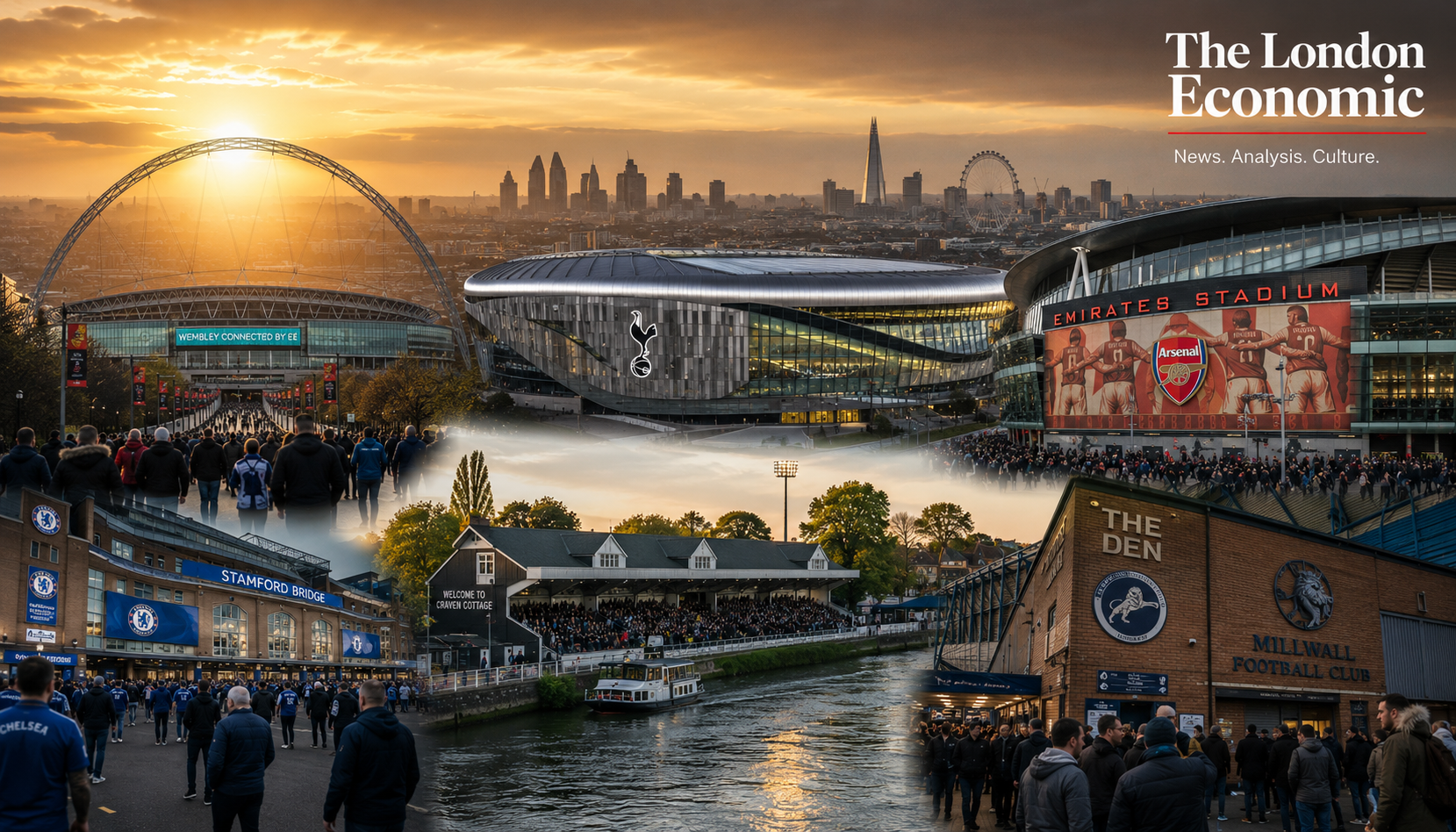
Football Grounds in London
No city on earth has more professional football grounds than London. From the 90,000-capacity national stadium at Wembley to the compact community atmospheres of Brisbane Road and Plough Lane, the capital contains a density and variety of football venues that reflects its unique place in the history of the sport. The Football Association itself was founded in London in 1863, and football has been woven into the fabric of the city ever since.
As of the 2026 to 2027 season, there are seventeen teams playing in professional leagues in London: six in the Premier League, eight in the Football League, and three in the National League. Each of those clubs has a home ground, and each ground carries its own identity, history, and character. This guide covers all of them.
How Many Football Grounds Are in London?
Thirteen London-based teams are in the English football system’s top four professional divisions, from some of the most elite sides in Europe such as Arsenal and Chelsea to the newly promoted League One side Bromley.
There isn’t another city on the planet with as many professional football clubs as London. That density is part of what makes the capital such an extraordinary place to experience the game. On any given Premier League Saturday, there may be three or four London clubs playing at home simultaneously, each within reach of central London by tube, bus, or train.
The Premier League Grounds in London
Tottenham Hotspur Stadium, Tottenham
With a seating capacity of 62,850, Tottenham Hotspur Stadium is the third largest football stadium in England and the largest club ground in London. It is also used for NFL International Series games. It features the world’s first dividing, retractable synthetic turf pitch used for NFL games, concerts and other events.
This state-of-the-art ground features retractable and dividing pitches. The venue is widely regarded as one of the better stadiums in England, and arguably the best ground in the Premier League.
For many observers, the Tottenham Hotspur Stadium is the best football stadium in the United Kingdom, proving that new builds can be successful. The new stadium has everything you would want: stands on top of the pitch, a single giant end, large concourses, state-of-the-art facilities, and a big capacity.
Opened in April 2019, it replaced the iconic White Hart Lane. The stadium is located in N17 and is easily accessible from Seven Sisters and White Hart Lane stations.
The Emirates Stadium, Holloway
The Emirates Stadium is the home of Arsenal and has a capacity of 60,704.
Arsenal won the Premier League title in 2025 to 2026, bringing the club’s total to 14 First Division and Premier League titles, more than double the number Chelsea have won. The Emirates has been the stage for that success since the club left Highbury in 2006, and the atmosphere on European nights in particular has become one of the most highly rated in the Premier League.
Arsenal are reportedly planning a significant expansion of the Emirates. The overhaul would restore it as the biggest club-specific ground in London, overtaking West Ham and Tottenham, with the Gunners potentially moving temporarily into Wembley Stadium during the rebuild. A growing season ticket waiting list reportedly exceeds 100,000 individuals.
The Emirates is located in Holloway, N7, and is served by Arsenal tube station on the Piccadilly line, a short walk from the main entrance.
London Stadium, Stratford
The London Stadium’s full capacity is 68,013. However, planning permission limits capacity to 62,500 seats for football events hosted by West Ham.
The stadium, originally built as the centrepiece of the 2012 London Olympics, became West Ham’s home in 2016. West Ham’s relegation to the Championship in 2025 to 2026 brought to an end fourteen consecutive seasons in the Premier League. The club is now in the Championship, making the London Stadium one of the largest grounds in the second tier of English football.
The stadium is located in Stratford, E20, and is served by Stratford station, which provides connections via the London Overground, Elizabeth line, DLR, and London Underground.
Stamford Bridge, Fulham
Stamford Bridge has a capacity of just over 40,000. There is something to be said for one of the biggest clubs in the country playing in a stadium that size. It is an easy in and out to the centre of London via the local transport links.
Chelsea have played at Stamford Bridge since 1905. The ground is located in SW6, served by Fulham Broadway station on the District line, just minutes from the turnstiles. Plans for a redevelopment or new stadium have been discussed for years, and the club continues to weigh its options.
Selhurst Park, South Norwood
Selhurst Park is home to Crystal Palace and is one of the most atmospheric grounds in the capital. Apart from serving as the home of Crystal Palace, Charlton Athletic and Wimbledon have also been tenants of Selhurst Park in its 100-plus years of existence. The atmosphere created at Selhurst Park is virtually always fantastic. For the very best experience, visiting a big midweek fixture under the lights rarely fails to impress.
Crystal Palace secured the Conference League in 2025 to 2026, winning their first ever continental trophy. An expansion of Selhurst Park is currently underway to increase its capacity from its current 25,486.
The ground is located in SE25 and is served by Selhurst, Norwood Junction, and Thornton Heath rail stations.
Craven Cottage, Fulham
Craven Cottage, one of London’s most iconic sites, has been home to Fulham for more than 100 years. The ground is situated on the banks of the River Thames in the affluent SW6 postcode. The name is related to its origins as a cottage built in 1780 before being transformed into a stadium in 1896. In 2026, the capacity of Craven Cottage sits at just under 20,000.
The riverside location gives Craven Cottage a character that no other London ground can replicate. Arriving along the Thames path on a matchday afternoon, with the river to one side and the iconic white cottage building visible ahead, is one of the more distinctive experiences English football has to offer.
Gtech Community Stadium, Brentford
Opened in 2020, the Gtech Community Stadium is home to Brentford. The club made the switch from Griffin Park to their new 17,200-capacity ground and have become Premier League regulars in the years since. The venue cost £71 million to build and is also equipped to host rugby matches.
It is commercially known as the Gtech Community Stadium. The stadium is located near Kew Bridge in TW8, and is accessible by rail to Brentford station. It replaced the beloved Griffin Park, which held the distinction of having a pub on each of its four corners, a quirk that made it one of the most fondly remembered grounds in London’s football history.
The Championship Grounds in London
London Stadium (West Ham United)
As noted above, West Ham now compete in the Championship at the London Stadium following their 2025 to 2026 relegation, making this the largest ground in the second division.
The Den, Millwall
Millwall is one of England’s oldest professional clubs, founded in 1885, and their home ground, The Den, is set to undergo redevelopment and expansion in the near future. Located in SE16, the current Den opened in 1993, replacing the original ground of the same name. It holds approximately 20,146 fans and is known for generating one of the more intense atmospheres in English football.
Loftus Road, Queens Park Rangers
QPR’s home, Loftus Road, has been around since 1904. Located in W12, the 18,439-capacity stadium is known for its intense atmosphere due to the stands being so close to the pitch.
Loftus Road is one of the most compact professional grounds in London, and its intimacy creates an atmosphere that belies the modest capacity. The ground is served by Shepherd’s Bush Market station on the Hammersmith and City line.
The Valley, Charlton Athletic
The Valley has been Charlton Athletic’s ground since the 1920s. It has a capacity of just over 27,000. Since its construction in 1919, the ground has undergone numerous expansions and renovations. The ground is situated between the Greenwich and Woolwich regions of London. Some fans occasionally opt to make their way to the stadium via boat, providing a unique matchday experience.
Charlton joined Millwall and QPR in the Championship for the 2025 to 2026 campaign after earning promotion out of League One by way of winning the League One playoff final.
The League One Grounds in London
Brisbane Road, Leyton Orient
Leyton Orient play their home matches at Brisbane Road, which is located in the E10 postcode. Opened in 1937, the stadium has a capacity of just over 9,270 and is served very well by Leyton tube station on the Central line.
Leyton Orient are one of London’s most historic clubs, formed in 1881. Brisbane Road’s compact size and traditional feel make it a genuine throwback matchday experience for supporters who find the larger Premier League venues too corporate in atmosphere.
Plough Lane, AFC Wimbledon
AFC Wimbledon play their home matches at Plough Lane, a relatively new ground that opened in 2020.
AFC Wimbledon is a special club with a unique story. The club was founded in 2002 by supporters of the former Wimbledon FC, after that club moved to Milton Keynes and continued as MK Dons. Plough Lane sits adjacent to the site of the original Wimbledon ground of the same name. Its return to the street brought the club home in a symbolically significant way. It holds approximately 9,300 supporters and is located in SW17.
Hayes Lane, Bromley
Bromley FC was founded in 1892 and is based in south-east London. Bromley were crowned League Two champions in 2026, allowing the club to play in League One for the first time in their history. Bromley’s stadium, Hayes Lane, can be reached by taking the train from London Bridge station towards Bromley South, alighting at Shortlands and walking for around ten minutes.
Hayes Lane has a capacity of approximately 5,000 and represents the grassroots end of London’s professional football landscape, a modest but proper ground for a club whose recent rise through the pyramid has been one of the more heartwarming stories in the lower leagues.
The League Two Ground in London
Underhill and Beyond: Barnet
Barnet is a London-based League Two outfit. The club currently plays at the Hive Stadium in Edgware, a ground shared with Barnet FC’s women’s team and various non-league sides. The stadium holds approximately 6,000 fans and represents a community football experience at the foot of the professional pyramid.
Wembley: London’s National Stadium
No guide to football grounds in London would be complete without Wembley.
The largest stadium in England is Wembley Stadium, which is located in North London. The ground has an impressive capacity of 90,000. Wembley hosts games of the England national football team and is also the home of the FA Cup Final and semi-finals, as well as numerous other cup competitions.
Wembley Stadium is easily accessible from different parts of London. It takes around 30 minutes on the tube from Waterloo and King’s Cross stations.
Wembley is served by Wembley Park station on the Metropolitan and Jubilee lines and Wembley Central station on the Bakerloo line and London Overground. On major cup final days, it is one of the most extraordinary spectacles London sport has to offer.
London Football Grounds at a Glance
| Club | Ground | Capacity | Location | Division 2026/27 |
|---|---|---|---|---|
| Tottenham Hotspur | Tottenham Hotspur Stadium | 62,850 | N17 | Premier League |
| Arsenal | Emirates Stadium | 60,704 | N7 | Premier League |
| Chelsea | Stamford Bridge | c.40,343 | SW6 | Premier League |
| Crystal Palace | Selhurst Park | c.25,486 | SE25 | Premier League |
| Fulham | Craven Cottage | c.19,500 | SW6 | Premier League |
| Brentford | Gtech Community Stadium | 17,250 | TW8 | Premier League |
| West Ham United | London Stadium | 62,500 (football) | E20 | Championship |
| Millwall | The Den | 20,146 | SE16 | Championship |
| QPR | Loftus Road | 18,439 | W12 | Championship |
| Charlton Athletic | The Valley | 27,111 | SE7 | Championship |
| Leyton Orient | Brisbane Road | 9,271 | E10 | League One |
| AFC Wimbledon | Plough Lane | 9,300 | SW17 | League One |
| Bromley | Hayes Lane | c.5,000 | BR2 | League One |
| Barnet | Hive Stadium | c.6,000 | HA8 | League Two |
What Makes London’s Football Grounds Unique
Almost every major Underground, Overground, and National Rail line leads directly to a roaring London stadium. There is a staggering contrast when comparing top-tier and lower league London teams. The elite clubs offer world-class corporate hospitality, globally recognised superstars, and massive 60,000-seater arenas.
Chelsea, Fulham, QPR, and Brentford compete in closely contested local derbies that carry strong neighbourhood pride. West Ham, Millwall, Charlton, and Crystal Palace share historic rivalries shaped by geography and tradition.
The range of grounds also reflects the remarkable diversity of London’s football culture. In a single city, you can attend a state-of-the-art 62,000-seat venue with a retractable pitch and an NFL deal one weekend, and a 5,000-capacity community ground with a traditional terrace feel the next. Very few cities anywhere in the world offer that breadth.
Tips for Visiting Football Grounds in London
For anyone planning to attend a match at one of the capital’s grounds, a few practical points help:
- Book tickets early. Premier League matches in London sell out quickly, particularly for Arsenal, Chelsea, and Tottenham. Checking club websites directly is always recommended over third-party resellers.
- Use public transport. Every major London football ground is accessible by tube, rail, or bus. Driving to a match in London is rarely sensible on matchdays.
- Arrive early. The areas around most grounds have good pubs and food options, and arriving 45 to 60 minutes before kick-off is always more relaxed than a last-minute rush.
- For lower-league matches at grounds like Brisbane Road, Hayes Lane, or Plough Lane, tickets are often available on the day and the experience is excellent value for the price.
- If you want to see multiple grounds on a trip to London, planning around a weekend when multiple clubs are playing at home simultaneously makes for an efficient itinerary.
Key Takeaways
- London has seventeen professional football clubs in the 2026 to 2027 season, spanning the Premier League, Championship, League One, League Two, and the National League, with thirteen in the top four professional divisions of the English football pyramid.
- The largest club ground in London is Tottenham Hotspur Stadium, with a capacity of 62,850. The largest stadium in London overall is Wembley, with a capacity of 90,000.
- The six Premier League clubs in London for 2026 to 2027 are Arsenal, Brentford, Chelsea, Crystal Palace, Fulham, and Tottenham Hotspur. West Ham United were relegated to the Championship at the end of 2025 to 2026.
- Arsenal won the Premier League title in 2025 to 2026, while Crystal Palace won the Conference League, the club’s first ever continental trophy.
- London’s grounds range from the ultra-modern Tottenham Hotspur Stadium and Gtech Community Stadium to historic venues like Craven Cottage, which has hosted football since 1896, and Selhurst Park, which has been in continuous use for over a century.
- Every professional football ground in London is accessible by public transport, making stadium visits straightforward for visitors from anywhere in the city.
- Arsenal are planning a significant expansion of the Emirates Stadium, and Selhurst Park is currently undergoing an expansion, meaning the London football ground landscape is actively evolving.
Frequently Asked Questions
How many professional football grounds are there in London?
There are fourteen professional football grounds in London across the top four divisions of the English football pyramid for the 2026 to 2027 season, plus Wembley Stadium as the national ground. Additional grounds exist for National League clubs and the numerous semi-professional and amateur clubs across the capital.
What is the largest football ground in London?
The largest stadium in London is Wembley, the national stadium, with a capacity of 90,000. The largest club football ground in London is Tottenham Hotspur Stadium, with a capacity of 62,850.
Which Premier League clubs are based in London in 2026?
The six Premier League clubs based in London for the 2026 to 2027 season are Arsenal, Brentford, Chelsea, Crystal Palace, Fulham, and Tottenham Hotspur. West Ham United were relegated to the Championship at the end of 2025 to 2026.
What is the oldest football ground in London?
Craven Cottage, home of Fulham, has been used for football since 1896 and is one of the oldest continuously used football grounds in London. Selhurst Park, home of Crystal Palace, has also been in use for over a century.
How do I get to football grounds in London by public transport?
All professional football grounds in London are accessible by public transport. Arsenal’s Emirates Stadium is served by Arsenal tube station. Tottenham Hotspur Stadium is near White Hart Lane and Seven Sisters stations. Chelsea’s Stamford Bridge is served by Fulham Broadway on the District line. Crystal Palace’s Selhurst Park is served by Selhurst, Norwood Junction, and Thornton Heath rail stations. Brentford’s Gtech Community Stadium is near Brentford rail station. Full transport guidance is available from each club’s official website.
Which London football ground has the best atmosphere?
Atmosphere is subjective, but Selhurst Park, The Den, and Brisbane Road are consistently cited as producing some of the most intense and authentic atmospheres in London football. At Premier League level, the Tottenham Hotspur Stadium and Stamford Bridge both generate strong matchday atmospheres. For away supporters in particular, The Den is one of the most challenging environments in English football.
Can I visit London football grounds on non-matchdays?
Most of the major London grounds offer stadium tours. The Tottenham Hotspur Stadium and Emirates Stadium both run popular guided tours that take visitors behind the scenes, including dressing rooms, dugouts, and press facilities. Wembley also offers stadium tours. Checking each club’s official website for tour availability and pricing is recommended.
Is it easy to get tickets for London football matches?
It depends on the club and the fixture. Tickets for Arsenal, Chelsea, and Tottenham Premier League matches can sell out quickly and should be booked as far in advance as possible through official club channels. Lower-league London clubs including Charlton, Leyton Orient, AFC Wimbledon, and Bromley generally have tickets available closer to matchday and often offer excellent value for money.
Conclusion
London’s football grounds are as varied as the city itself, and that variety is precisely what makes the capital such an extraordinary place to experience the game. No other city on earth offers the same combination of world-class modern venues, historic grounds steeped in tradition, compact lower-league atmospheres, and sheer concentration of professional football within a single, well-connected transport network.
The 2026 to 2027 season presents a particularly interesting moment for London football. Arsenal are Premier League champions. Crystal Palace have their first European trophy. West Ham are navigating the Championship from one of the largest grounds in the second division. Bromley have climbed to League One for the first time in their history. Across the capital, seventeen professional clubs are competing, each with a ground that tells its own story about the communities it serves and the history it carries.
For anyone with even a passing interest in football, London’s grounds deserve to be experienced rather than simply read about. Whether your visit takes you to a 62,000-seat venue in Tottenham or a 5,000-capacity community ground in Bromley, the game feels immediate, human, and genuinely alive in a way that very few cities in the world can match
About the Author