Victoria and Abdul Cast
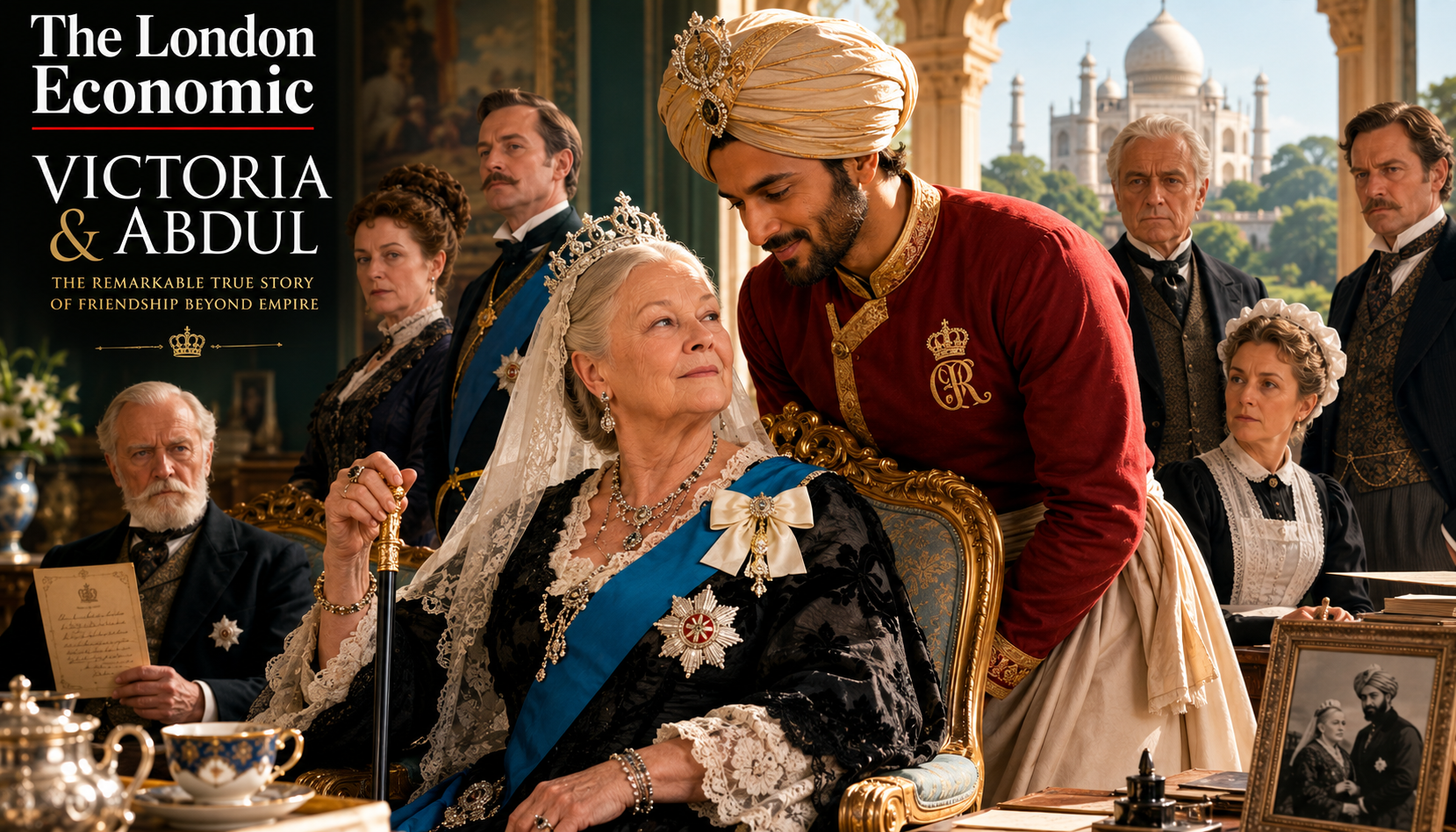
Victoria and Abdul, the 2017 biographical historical drama directed by Stephen Frears, remains one of the most quietly remarkable British films of recent years. At its heart is an extraordinary cast led by Judi Dench in her second portrayal of Queen Victoria, alongside Ali Fazal as Abdul Karim, the Indian Muslim clerk whose unlikely friendship with Britain’s longest-reigning monarch became one of the most deliberately buried stories in royal history.
The full Abdul and Victoria cast extends well beyond its two leads, populated by some of Britain’s finest character actors playing the courtiers, politicians, and household members who worked to destroy the friendship that Victoria refused to abandon. This guide covers every significant member of the cast, what they bring to their roles, and where the characters depart from or align with the documented historical record.
The Film at a Glance
Victoria and Abdul is a 2017 biographical historical drama directed by Stephen Frears and written by Lee Hall. It is based on the book “Victoria and Abdul: The True Story of the Queen’s Closest Confidant” by journalist and author Shrabani Basu, published in 2010, which itself drew on letters and documents that had largely been suppressed for over a century following Queen Victoria’s death.
The film had its world premiere at the 74th Venice Film Festival and was theatrically released in the United Kingdom on 15 September 2017. It was co-produced by Working Title Films and BBC Films and co-financed by Focus Features, which handles US distribution, and Universal Pictures International for all other territories.
Victoria and Abdul grossed 66.6 million US dollars worldwide against a production budget typical of mid-range British period films. It was nominated for two Academy Awards at the 90th ceremony: Best Costume Design and Best Makeup and Hairstyling. Judi Dench received a Golden Globe nomination for Best Actress in a Motion Picture Musical or Comedy for her performance.
The film carries a Rotten Tomatoes approval rating of 66 per cent based on 199 reviews, with an average rating of 6.10 out of 10. Critical consensus acknowledged the power of Dench’s central performance while noting an imbalanced narrative, and several critics raised substantive concerns about the film’s handling of its imperial context, a debate that reflects genuine historical complexity.
The Lead Cast: Abdul Karim and Queen Victoria
Judi Dench as Queen Victoria
Dame Judi Dench is the undisputed centre of gravity in Victoria and Abdul, delivering what many reviewers described as one of the finest performances of her career in a role she had previously inhabited in the 1997 film Mrs Brown, directed by John Madden. Victoria and Abdul has been described as an unofficial sequel to that earlier film, covering the final decade of Victoria’s life.
Dench was 82 years old during filming, a fact that gives her portrayal of the ageing, increasingly isolated monarch a particular authenticity. She plays Victoria as simultaneously imperious and lonely, capable of both petulant cruelty toward her household and genuine warmth toward the people she chooses to admit into her confidence. The performance navigates the comedy and sadness of the role with the precision that has characterised Dench’s work across six decades of stage and screen performance.
Her Golden Globe nomination for Best Actress in a Motion Picture Musical or Comedy reflects the film’s tonal ambiguity: Victoria and Abdul is genuinely funny in places, but its comedy sits atop a story about race, empire, and the cost of human connection across the boundaries that empire created.
The historical Victoria: Queen Victoria died on 22 January 1901 at Osborne House on the Isle of Wight, aged 81. She had reigned for 63 years and 7 months, making her the longest-reigning British monarch until Queen Elizabeth II surpassed her record in 2015. In her final years she was genuinely devoted to Abdul Karim, and the destruction of their correspondence by her son Bertie (King Edward VII) upon her death was a documented historical act.
Ali Fazal as Abdul Karim
Ali Fazal plays Abdul Karim, the Indian Muslim clerk from Agra who arrived in England in 1887 as part of Queen Victoria’s Golden Jubilee celebrations and remained in her service until her death in 1901. Fazal, an Indian actor whose international profile has grown considerably since Victoria and Abdul, brings warmth, intelligence, and a gentle ambiguity to a role that the film treats with more straightforwardness than some critics felt the historical record warranted.
Several reviewers noted that the film presents Abdul as essentially guileless and wholly sincere, while the historical record is somewhat murkier. Abdul Karim’s motivations, his management of his relationship with the Queen, and the accuracy of claims he made about his background are all more contested in historical scholarship than the film’s sympathetic portrayal suggests. The film acknowledges one significant deception, that Abdul overstated his social status in India, and shows Victoria remaining loyal despite it, but otherwise treats him as straightforwardly virtuous.
Fazal handles this somewhat idealised characterisation with genuine charm. His Abdul is wide-eyed but not naive, respectful but not servile, and the chemistry between him and Dench is entirely convincing as the foundation of an improbable but emotionally real friendship.
The historical Abdul Karim: Abdul Karim was born in 1863 in Lalitpur, India. He came to England as part of Victoria’s Golden Jubilee celebrations in 1887, initially as a waiter at state banquets. He rose rapidly in Victoria’s favour, becoming her personal attendant, then her Munshi (language and cultural teacher), teaching her Urdu and elements of Islamic culture. He died in Agra in 1909, eight years after Victoria’s death, at approximately 46 years of age. A large statue of Queen Victoria near the Taj Mahal, in front of which the film ends, exists and remains a notable landmark.
The Supporting Cast: The Queen’s Household and Court
Tim Pigott-Smith as Sir Henry Ponsonby
Tim Pigott-Smith plays Sir Henry Ponsonby, Victoria’s private secretary, one of the central figures in the court’s sustained campaign to remove Abdul from the Queen’s favour. Pigott-Smith, who died on 7 April 2017 before the film’s September release, delivers one of his finest late-career performances: Ponsonby is not simply a bigot but a man of genuine institutional loyalty whose opposition to Abdul is rooted in a combination of social snobbery, racial prejudice, and sincere concern for what he sees as the dignity of the monarchy.
Victoria and Abdul was Tim Pigott-Smith’s final film role. He was 70 years old at the time of his death.
The historical Ponsonby: Sir Henry Ponsonby served as Queen Victoria’s private secretary from 1870 until a stroke incapacitated him in 1895. He died in 1895, which means the film takes some historical liberties with his presence and role in the later events it depicts.
Eddie Izzard as Bertie, Prince of Wales
Eddie Izzard plays Bertie, the Prince of Wales who becomes King Edward VII upon Victoria’s death. It is Bertie who, upon ascending to the throne, orders the destruction of Victoria’s correspondence with Abdul and forces him and his family to return to India. Izzard plays Bertie as complacent, entitled, and driven by a combination of genuine dynastic concern and straightforward racial contempt, and the performance has a comic edge that sharpens rather than softens its depictions of prejudice.
The historical Bertie: Albert Edward, Prince of Wales, became King Edward VII upon his mother’s death in 1901 and reigned until his own death in 1910. His destruction of the Victoria-Abdul correspondence is a documented historical act. The letters that survived, and which formed the basis of Shrabani Basu’s book, were preserved through other means, including by Abdul Karim’s family in India.
Michael Gambon as Lord Salisbury
Michael Gambon plays Robert Gascoyne-Cecil, the 3rd Marquess of Salisbury, Prime Minister of the United Kingdom during much of Victoria’s final decade. Salisbury is presented as deeply opposed to Abdul’s influence over the Queen, working alongside the household to limit his role and, ultimately, to force a break. Gambon brings his characteristic authority to the role, giving Salisbury a gravitas that makes the character’s prejudices feel institutional rather than merely personal.
The historical Salisbury: The 3rd Marquess of Salisbury served three terms as Prime Minister between 1885 and 1902, including the period covered by the film. He was a significant figure in British imperial policy and a genuinely powerful political operator. His opposition to Abdul Karim’s influence at court is documented.
Adeel Akhtar as Mohammed
Adeel Akhtar plays Mohammed, Abdul’s companion who travelled with him from India and who serves as something of a comic foil throughout the film: ill with the British climate, homesick, resentful, and deeply uncomfortable with the situation in which he finds himself. Akhtar, one of Britain’s finest comic character actors, brings genuine humanity to what could easily have been a purely functional role.
The historical Mohammed: Mohammed did travel to England with Abdul Karim and did return to India before Abdul. The film uses his discomfort and homesickness as a counterpoint to Abdul’s apparent contentment, grounding the story’s more idealised elements.
Paul Higgins as Dr James Reid
Paul Higgins plays Dr James Reid, Queen Victoria’s personal physician, who is tasked with examining Abdul and discovers that he has gonorrhoea. The scene in which Reid expects this discovery to end Victoria’s loyalty to Abdul, only to find her ordering his treatment and refusing to dismiss him, is one of the film’s most striking and is historically documented.
Olivia Williams as Baroness Churchill
Olivia Williams plays Lady Jane Churchill, one of Victoria’s ladies-in-waiting and a significant figure in the court’s opposition to Abdul. Williams plays her with cool, elegant hostility, making her one of the more effectively menacing presences in the film’s depiction of a court united against the Queen’s wishes.
Fenella Woolgar as Aggie
Fenella Woolgar plays Aggie, a lady-in-waiting whose social discomfort with Abdul provides some of the film’s gentler comedy. Woolgar is a consistently reliable British character actress whose work here is economical and precise.
Production: Key Creative Figures
Stephen Frears (Director)
Stephen Frears directed Victoria and Abdul, bringing to it the same combination of intelligence, craft, and willingness to engage with uncomfortable historical material that has characterised his finest work, including My Beautiful Laundrette (1985), Dangerous Liaisons (1988), The Queen (2006), and Philomena (2013). His directorial touch here is described by critics as “light but sure,” allowing the performances to lead while maintaining confident control of tone across a film that moves between comedy and genuine emotional weight.
Lee Hall (Screenwriter)
Lee Hall, best known as the writer of Billy Elliot (2000), adapted Shrabani Basu’s book for the screen. His script has been both praised for its wit and criticised for presenting a somewhat sanitised version of the historical relationship, particularly in its handling of Abdul’s character and his possible manipulations of Victoria.
Shrabani Basu (Author of Source Book)
Shrabani Basu, an Indian journalist and author, wrote the 2010 book on which the film is based. Her research into the Victoria-Abdul relationship drew on documents that had been deliberately suppressed, including letters preserved by Abdul Karim’s family in India. Basu’s work is the reason this story is known at all, and her role as source author makes her a crucial figure in the film’s existence.
Critical and Historical Debates
Victoria and Abdul has attracted substantive criticism from two distinct directions, and both are worth understanding.
The imperial context criticism: Several critics argued that the film, in focusing on Victoria’s personal warmth toward Abdul, effectively rehabilitates the British Empire by emphasising individual kindness within a system of collective subjugation. The film barely engages with the broader realities of British rule in India during this period, presenting an essentially cosy vision of imperial relations.
The characterisation of Abdul criticism: Some historians and critics argued that the film presents Abdul Karim as more straightforwardly virtuous than the historical record supports. Abdul was a skilled self-promoter who significantly embellished his background and who has been described by some historians as a sophisticated operator within the constraints of his position.
Both criticisms reflect genuine scholarly debate rather than mere contrarianism, and readers who find the film compelling would benefit from reading Shrabani Basu’s source book, which engages more directly with these complexities.
Key Takeaways
- Victoria and Abdul was released on 15 September 2017, directed by Stephen Frears, written by Lee Hall, and based on the 2010 book by Shrabani Basu.
- Judi Dench plays Queen Victoria in her second portrayal of the monarch, receiving a Golden Globe nomination for Best Actress. Tim Pigott-Smith’s role as Sir Henry Ponsonby was his final film appearance before his death in April 2017.
- Ali Fazal plays Abdul Karim, the Indian Muslim clerk who became Victoria’s closest confidant in her final years. The film presents him more sympathetically than some historians consider fully accurate.
- The supporting cast includes Eddie Izzard as Bertie (later King Edward VII), Michael Gambon as Lord Salisbury, Adeel Akhtar as Mohammed, Paul Higgins as Dr James Reid, and Olivia Williams as Baroness Churchill.
- The film grossed 66.6 million US dollars worldwide and received two Academy Award nominations: Best Costume Design and Best Makeup and Hairstyling.
- Victoria and Abdul raises genuine and unresolved historical questions about empire, race, and the nature of the friendship it depicts, which the film handles with more comfort than the historical record strictly allows.
Frequently Asked Questions
Who plays Queen Victoria in Victoria and Abdul? Dame Judi Dench plays Queen Victoria. She previously played the same role in the 1997 film Mrs Brown, directed by John Madden. Victoria and Abdul is considered an unofficial sequel to that film.
Who plays Abdul Karim in Victoria and Abdul? Ali Fazal, an Indian actor, plays Abdul Karim. Fazal’s performance received considerable critical praise and helped establish his international profile. He has subsequently appeared in the Mirzapur series and other international productions.
Is Victoria and Abdul based on a true story? Yes. The film is based on the book “Victoria and Abdul: The True Story of the Queen’s Closest Confidant” by Shrabani Basu (2010). The friendship between Queen Victoria and Abdul Karim is historically documented, though the film takes certain creative liberties with characterisation and some details.
What happened to Abdul Karim after Queen Victoria died? Upon Victoria’s death in 1901, her son Bertie (King Edward VII) ordered the destruction of her correspondence with Abdul and sent him and his family back to India. Abdul Karim returned to Agra, where he lived until his death in 1909, approximately eight years after the Queen.
Was Tim Pigott-Smith alive when Victoria and Abdul was released? No. Tim Pigott-Smith, who plays Sir Henry Ponsonby, died on 7 April 2017. The film was theatrically released on 15 September 2017. Victoria and Abdul was his final film role.
Where can I watch Victoria and Abdul in the UK? Victoria and Abdul is available to stream on Netflix in the UK. It is also available to rent or purchase on digital platforms including Apple TV and Amazon Prime Video.
How historically accurate is Victoria and Abdul? The broad outline of the friendship between Victoria and Abdul Karim is historically documented. The film is accurate in depicting Bertie’s destruction of their correspondence, Abdul’s medical situation, and the court’s sustained opposition to his presence. However, historians have noted that the film presents Abdul as more guileless and Victoria’s relationship with empire as more benign than the full historical record supports.
Was Abdul Karim a Muslim? Yes. Abdul Karim was a Muslim, a fact that heightened the hostility of the court toward his relationship with Victoria. The film depicts Victoria’s genuine interest in Islam and Urdu as part of what drew her to Abdul.
Conclusion
The cast of Victoria and Abdul, led by one of the most accomplished actresses in British film history and supported by a depth of talent across every role, is ultimately what carries a film that its critics rightly identify as more comfortable with its subject than the history demands. Judi Dench’s Victoria is extraordinary: a monarch ageing toward death who finds in an unexpected friendship something that her position and her court had long since denied her.
The questions the film raises, about race, empire, the nature of human connection across institutional barriers, and what it means to tell a story of warmth set within a system of profound injustice, are genuinely important ones that the film engages with only partially. Readers who want the fuller picture should turn to Shrabani Basu’s book, which provides considerably more historical texture than the screen adaptation allows.
What the film achieves it achieves through its cast. And at its centre, in a performance that belongs among her finest, Judi Dench ensures that Victoria and Abdul endures as a film worth watching, debating, and returning to.
About the Author