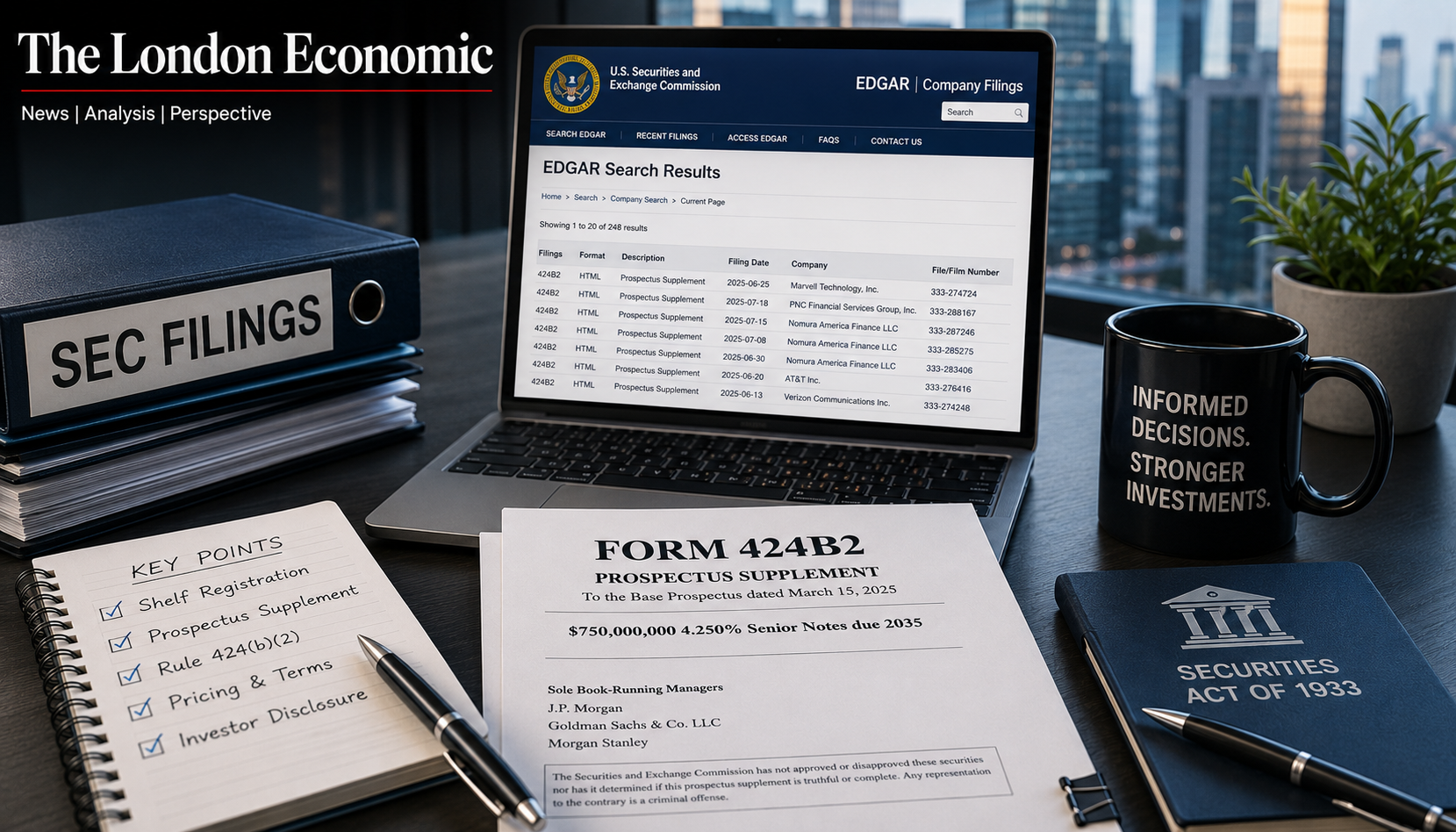
Form 424B2 Prospectus
Form 424B2 is a prospectus supplement filed with the US Securities and Exchange Commission under Rule 424(b)(2) of the Securities Act of 1933. It is used for securities offered under a shelf registration and includes specific pricing and other transaction details for a delayed or continuous offering.
If you have seen a 424B2 filing on the SEC’s EDGAR database and wondered what it means, this guide covers everything you need to know, from the regulatory framework behind the form to how investors should approach reading one before making a decision.
What Is Form 424B2?
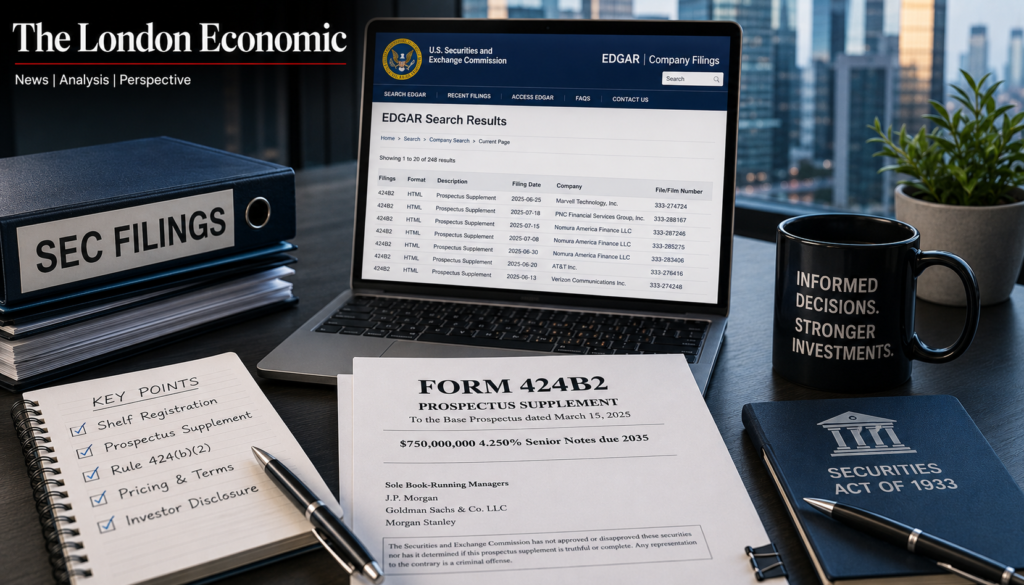
A Form 424B2 is a specific type of prospectus supplement filed pursuant to Rule 424(b)(2) under the Securities Act of 1933. It is used when a company wants to sell securities to the public through a shelf registration statement and needs to file a document with the SEC that sets out the final pricing terms and specific details of that particular offering.
The “424” in the form name refers to Rule 424 under the Securities Act, which governs the filing of final prospectuses with the SEC after a registration statement becomes effective. The “B2” designation refers specifically to the sub-provision of that rule, namely Rule 424(b)(2), which applies to prospectus supplements filed in connection with primary shelf offerings.
In plain terms: when a large, established company wants to raise money by selling bonds, notes, or other securities to the public and it has already set up a shelf registration, it files a 424B2 to tell investors exactly what it is selling, at what price, and on what terms, at the point when those details are finalised.
A real-world example: Marvell Technology, Inc. filed a 424B2 with the SEC on 25 June 2025 in connection with a senior notes offering, describing the specific terms of that debt offering, including interest rates, maturity dates, underwriters, use of proceeds, and applicable risk factors. PNC Financial Services Group filed a 424B2 on 18 July 2025 for a senior notes offering, similarly setting out the final terms for investors. Nomura America Finance LLC has filed multiple 424B2 forms throughout 2025 in connection with various structured notes programmes.
The Regulatory Framework: Rule 424 and the Securities Act
To understand Form 424B2 fully, it helps to understand the broader framework within which it sits.
The Securities Act of 1933, passed in the aftermath of the Wall Street Crash of 1929, established the fundamental requirement that companies selling securities to the public must register those securities with the SEC and provide investors with a prospectus containing material information about the offering and the issuer.
Rule 424 of the Securities Act establishes specific requirements for the filing of final prospectuses after a registration statement becomes effective. Different sub-provisions of Rule 424(b) apply to different types of offerings and different circumstances.
The main variants used in practice are as follows: 424B2 is used for securities offered under a shelf registration and includes pricing and other details for a delayed or continuous offering. 424B3 is a prospectus used to reflect information previously omitted from the effective registration statement or to comply with prospectus delivery requirements, typically when no post-effective amendment is required. 424B4 is often used as the final prospectus, particularly when the registration statement did not initially include pricing and other final terms. 424B5 is a supplement to previously filed prospectuses, often under 424B2 or 424B3, used to add or update material information during a shelf offering.
The key distinction for 424B2 is its specific connection to shelf registration statements, which are a particularly important feature of how large, established companies access public capital markets.
What Is a Shelf Registration and Why Does It Matter?
Understanding Form 424B2 requires understanding shelf registration, because the two are inseparable.
A Form S-3 that registers the future sale of securities is commonly referred to as a shelf registration statement because all of the registration activity, including SEC staff review, takes place upfront, and then, when the decision is made to sell securities, they are taken off the shelf with no further review by the SEC staff. Securities are normally taken off the shelf by filing a prospectus supplement under Securities Act Rule 424(b) that describes the terms of the securities offered. The process of selling securities from an already effective shelf Form S-3 is also referred to as a shelf takedown.
This structure gives large companies significant flexibility. Rather than going through a full registration process every time they want to raise capital, they can register a large volume of securities in advance, then issue them in tranches when market conditions are favourable, with each individual offering documented through a prospectus supplement such as a 424B2.
The base prospectus filed as part of the shelf registration provides general information about the company and the types of securities it might issue. The 424B2 prospectus supplement, filed at the time of each specific offering, provides the specific terms of that particular transaction.
This document is in two parts that are bound together: the prospectus supplement, which describes the specific details regarding the offering, and the accompanying prospectus, which provides general information, some of which may not apply to that particular offering.
Who Files Form 424B2?
Form 424B2 is most commonly filed by large, established public companies that have set up shelf registration statements. The requirements for shelf registration under Form S-3 mean that not all companies are eligible, which is why 424B2 filings are predominantly associated with well-known, financially stable issuers.
Well-Known Seasoned Issuers
The most significant category of 424B2 filers are companies that qualify as well-known seasoned issuers, or WKSIs, under SEC Rule 405.
For an issuer to qualify as a WKSI, they must satisfy three requirements of SEC Rule 405: the issuer must meet the requirements of Form S-3, which essentially requires that the issuer has timely filed periodic reports for 12 calendar months and not defaulted on any indebtedness or long-term leases; the issuer has either over $700 million in public float or has issued more than $1 billion in principal of non-convertible debt securities in primary offerings; and the issuer is not an ineligible issuer.
Another major benefit of qualifying as a well-known seasoned issuer is that they qualify for automatic shelf registration, meaning that their shelf offerings are immediately effective upon filing their Form S-3, since their shelf registration statements are not subject to SEC review.
A WKSI is defined as a company that has been publicly listed for at least 12 months and that has a public float of at least $700 million.
In practical terms, this means that the companies most frequently filing 424B2 forms are large-cap corporations, major financial institutions, and investment-grade debt issuers. Examples from 2025 include Marvell Technology, PNC Financial Services Group, and Nomura America Finance LLC, all of which filed 424B2 forms for debt offerings during that year.
Financial Institutions and Structured Products
Financial institutions are particularly active filers of 424B2 forms because they frequently issue structured notes, medium-term notes, and other debt securities through established shelf programmes. Investment banks and commercial banks with active capital markets operations may file dozens or hundreds of 424B2 forms in a single year, each relating to a separate issuance.
What Does a Form 424B2 Contain?
The contents of a 424B2 vary depending on the type of securities being offered and the nature of the issuer, but most include a consistent set of core disclosures.
Cover Page Information
The cover page of a 424B2 typically identifies the filing as a prospectus supplement to a specific base prospectus, states the date of filing, identifies the issuer, and summarises the key terms of the offering, including the type of securities, the aggregate principal amount or number of shares, the offering price or interest rate, and the maturity date for debt securities.
The cover page also carries a standard SEC disclosure noting that the Commission has not approved or disapproved of these securities or determined if the prospectus supplement is truthful or complete, and that any representation to the contrary is a criminal offence.
Terms of the Securities
For debt offerings, which are the most common use of 424B2 forms, this section typically covers:
- The principal amount being offered
- The interest rate, which may be fixed or floating
- The interest payment dates
- The maturity date
- Redemption provisions, if any
- Whether the securities will be listed on any exchange (and if not, a statement that no public market exists)
- The settlement and delivery arrangements, typically through The Depository Trust Company
Use of Proceeds
Companies are required to disclose how they intend to use the money raised from the offering. Common uses of proceeds disclosed in 424B2 filings include repayment of existing debt, general corporate purposes, capital expenditure, or working capital. PNC Financial Services Group’s July 2025 424B2 filing, for example, stated that proceeds would be applied principally to the repayment of existing senior notes.
Underwriting
The prospectus supplement identifies the underwriters, their roles, the underwriting discounts and commissions they will receive, and the net proceeds to the issuer after deducting those costs. It also describes any stabilisation activities or overallotment options.
Risk Factors
424B2 filings typically include risk factors specific to the particular securities being offered, alongside a reference to the broader risk factors incorporated by reference from the company’s annual report on Form 10-K, quarterly reports on Form 10-Q, and the base prospectus.
Incorporation by Reference
One of the most important features of 424B2 filings is that they do not stand alone. They are read in conjunction with the base prospectus and with the company’s other SEC filings, particularly its annual and quarterly reports, which are incorporated by reference. Readers who want a complete picture of the company’s financial condition and risk profile must read those incorporated documents alongside the 424B2 itself.
How Form 424B2 Differs From Other 424 Forms
Understanding where 424B2 sits relative to other prospectus forms helps clarify when and why it is used.
| Form | Primary Use | Typical Issuer | Shelf Required? |
|---|---|---|---|
| 424B1 | Prospectus filed where no Rule 430A pricing omission | Varied | No |
| 424B2 | Shelf offering prospectus supplement with final pricing | Large, established issuers | Yes |
| 424B3 | Reflects omitted information or ensures delivery compliance | Varied | No |
| 424B4 | Final prospectus including pricing previously omitted under Rule 430A | IPOs and non-shelf offerings | No |
| 424B5 | Supplement to existing shelf prospectus (adds or updates material information) | Large issuers with active shelf programmes | Yes |
| 424B7 | Prospectus filed by well-known seasoned issuers only | WKSIs | Yes |
The most important distinction for investors is between 424B2 and 424B4. A 424B4 is the final prospectus filed for most initial public offerings and non-shelf transactions, where the full prospectus including pricing is delivered to investors before purchase. A 424B2 is specifically a supplement to an already-existing shelf registration, meaning it does not contain all the information about the company in a single document. Investors reading a 424B2 must also read the base prospectus and incorporated reference documents to get the full picture.
How to Find Form 424B2 Filings
All 424B2 filings made with the SEC are publicly available through EDGAR, the Electronic Data Gathering, Analysis, and Retrieval system, at no cost. EDGAR can be searched by company name, ticker symbol, or CIK number.
To find 424B2 filings for a specific company:
- Go to the SEC’s EDGAR full-text search system at efts.sec.gov/LATEST/search-index.
- Enter the company name or ticker in the search field.
- In the filing type field, enter “424B2” to filter results.
- Select the filing of interest and click through to the full document.
For investors monitoring a particular company’s capital markets activity, setting up EDGAR alerts for 424B2 filings from that issuer is a practical way to stay informed of new debt or equity issuances as they occur.
What Investors Should Know Before Relying on a 424B2
Form 424B2 is a disclosure document, not an endorsement. Several important points are worth emphasising for anyone reading one in connection with an investment decision.
SEC approval does not mean the investment is safe. The standard cover page disclaimer, stating that the SEC has not approved or disapproved the securities or determined whether the prospectus is truthful or complete, is not boilerplate to skip. It is an accurate and legally significant statement. The SEC’s role is to ensure disclosure, not to evaluate the merit or safety of the securities.
Risk factors are important, not decorative. The risk factor sections of 424B2 filings are often lengthy and contain specific disclosures about factors that could adversely affect the investment. Reading them carefully before making an investment decision is essential rather than optional.
The 424B2 does not contain all material information. Because it incorporates other documents by reference, investors who rely only on the prospectus supplement itself without reading the base prospectus, recent annual reports, and quarterly reports are working with an incomplete picture of the issuer’s financial position, risks, and prospects.
No public market may exist for the securities. Particularly for structured notes and certain debt securities, 424B2 filings often disclose that the securities will not be listed on any exchange and that no public market currently exists. This has significant implications for liquidity, and investors in such securities should understand that selling before maturity may be difficult.
Key Takeaways
- Form 424B2 is a prospectus supplement filed with the SEC under Rule 424(b)(2) of the Securities Act of 1933, used for securities offered under a shelf registration statement.
- It is filed at the time of a specific offering to provide investors with the final pricing terms and specific details of that transaction, supplementing a previously filed base prospectus.
- It is most commonly filed by large, established public companies and financial institutions that meet the requirements for Form S-3 shelf registration, including well-known seasoned issuers with a public float exceeding $700 million.
- A 424B2 does not stand alone. It must be read alongside the accompanying base prospectus and documents incorporated by reference, including the issuer’s annual and quarterly reports.
- The SEC’s review of a 424B2 does not constitute approval or endorsement of the securities being offered.
- All 424B2 filings are publicly available through the SEC’s EDGAR database at no cost.
- Common filers in 2025 include major corporations such as Marvell Technology and PNC Financial Services Group, as well as financial institutions such as Nomura America Finance LLC.
Frequently Asked Questions About Form 424B2
What is a Form 424B2 prospectus?
A Form 424B2 is a prospectus supplement filed with the US Securities and Exchange Commission under Rule 424(b)(2) of the Securities Act of 1933. It is used for securities offered under a shelf registration and contains the specific pricing and terms of a particular offering at the time that offering is made.
Who files a 424B2?
Large, established public companies and financial institutions that have set up shelf registration statements file 424B2 forms. They are most commonly filed by well-known seasoned issuers, meaning companies with a public float exceeding $700 million or that have issued more than $1 billion in non-convertible debt in primary offerings.
What is the difference between 424B2 and 424B4?
A 424B4 is the final prospectus for an initial public offering or non-shelf transaction, containing all required information in a single document. A 424B2 is a supplement to an existing shelf registration and does not stand alone; it must be read alongside the base prospectus and other incorporated documents.
What does 424B2 contain?
A typical 424B2 contains the cover page summary of the offering, terms of the securities (interest rate, maturity, redemption provisions), use of proceeds, underwriting arrangements and fees, risk factors specific to the offering, and references to incorporated documents including the company’s annual and quarterly reports.
Does SEC review mean the investment is safe?
No. The SEC’s role in the 424B2 filing process is to ensure adequate disclosure, not to evaluate the merit or safety of the investment. The standard cover page disclaimer in every 424B2 states explicitly that neither the SEC nor any state securities commission has approved or disapproved the securities or determined whether the prospectus supplement is truthful or complete.
Where can I find 424B2 filings?
All 424B2 filings are publicly available through the SEC’s EDGAR database, accessible at no cost. Search by company name, ticker symbol, or CIK number, and filter by the filing type “424B2” to locate relevant filings.
What is a shelf registration?
A shelf registration is a registration statement filed under Form S-3 that allows an eligible company to register a volume of securities in advance for potential future sale, without going through the full registration process each time. When the company decides to sell securities from the shelf, it files a prospectus supplement, typically a 424B2, with the final terms of that offering.
What is a well-known seasoned issuer?
A well-known seasoned issuer, or WKSI, is a category of issuer under SEC Rule 405 that benefits from streamlined regulatory treatment. To qualify, a company must have been current in its SEC reporting for at least 12 months, have a public float of at least $700 million or have issued more than $1 billion in non-convertible debt in primary offerings, and not be an ineligible issuer. WKSIs benefit from automatic shelf registration, meaning their shelf registration statements are immediately effective upon filing without SEC review.
What is the difference between a base prospectus and a 424B2?
The base prospectus is the foundational document filed as part of the shelf registration statement. It provides general information about the company and the types of securities it might issue. The 424B2 prospectus supplement is filed at the time of each individual offering and provides the specific terms of that transaction. The two documents must be read together.
Conclusion
Form 424B2 is one of the most frequently encountered prospectus forms for investors and finance professionals following the capital markets activities of large public companies. Its prevalence reflects the dominance of shelf registration as the preferred mechanism for seasoned issuers seeking efficient, flexible access to public capital.
For investors, understanding what a 424B2 is and what it contains is a practical skill with direct application. Companies ranging from major technology firms and pharmaceutical groups to global investment banks regularly use shelf offerings documented by 424B2 filings to raise billions in capital through bond and note issuances. Each of those filings represents a disclosure opportunity, and the investors who read them carefully, including the incorporated documents, the risk factors, and the use of proceeds, are better positioned to assess what they are buying than those who treat the cover page as the full picture.
The SEC’s EDGAR database makes all 424B2 filings freely available, and developing a working familiarity with how these documents are structured is one of the most straightforward steps any investor in public debt or equity securities can take to improve the quality of their research. The regulatory framework governing these filings, built on foundations established by the Securities Act of 1933, is designed precisely to ensure that this information is available. Using it is the investor’s job.
About the Author